Internet addiction update

In my last post on internet addiction I mentioned a few of the treatment options available; in a new development the Capio Nightingale Hospital in London has started offering a Young Person Technology Addiction programme. This is as far as I know the first specialised therapy programme for IA available in the UK, though I’m sure there are other people like me who are interested in the subject, and have been seeing cases as they come up in our routine work.

The Capio programme offers inpatient and outpatient therapy, and is only available privately, though I guess it might be possible to get it paid for by the NHS via an extra-contractual referral. The therapeutic model they are using seems to be a mix of CBT, IPT and behavioural interventions. I did train in IPT a few years back, but I’ve only ever used it in depression, so I don’t know how effective it might be in IA, though, now I think of it, it does seem likely it would be useful in cases where lack of confidence in interpersonal relationships is an issue. It’ll be interesting to see if they publish any outcome studies.

On Second Life and addiction

I wasn’t going to say anything on the sad story of the Korean couple who allegedly left their baby to starve while they spent time in the virtual world Prius Online, because, you know, it seemed a bit exploitative, but I noticed that a few other blogs had referred to the issue directly or indirectly, and of course I couldn’t resist putting my two cents worth into the comments, (though it turns out that last post wasn’t inspired by the Korean incident after all), so I thought I might as well draw a few thoughts together and post them here.

Actually I’m not going to address the Korean story directly, since all I know about it is what I’ve read in the papers, and in cases like these one really needs to have all the facts before formulating any opinions. Instead I’ll say something more general about the concept of internet addiction – whether it exists at all, and, if so, what can be done to help those suffering from the problem.

My personal opinion is that problematic use of the internet should be regarded as a pathological behaviour, and that it is best thought of as an impulse-control disorder. I first became interested in the topic after reading Caught in The Net, by Kimberly Young, who did a lot of the early work in this area, and who runs the Center for Internet Addiction. Her book is aimed at a lay audience – she does tend to throw around terms like “obsession”, “compulsion” and “addiction” a bit freely – but her conceptualisation of dysfunctional online activity, drawing on the model of pathological gambling, is basically sound.

The existence and nature of internet addiction is still the subject of academic debate though. I thought Jerald Block made a good case a couple of years ago in an editorial in the AJP, Issues for DSM-V: Internet Addiction, but the draft DSM V, out last month, fails to include it. Interestingly the draft also proposes to move pathological gambling out of “Impulse-Control Disorders Not Elsewhere Classified” and into “Addiction and Related Disorders”, a move that has been labelled one of the “The 19 Worst Suggestions For DSM5“.

This argument about classification may seem a bit arcane, but it reflects a division of opinion that was also evident in the discussion of the Korean case; to what extent does labelling a particular behaviour an “addiction” absolve the person concerned of responsibility for their actions?

When it comes to MMORPGs (which for the sake of this argument we’ll take as including Second Life) there is a tendency among pro-game writers to deny that virtual worlds have any addictive properties at all, and to focus instead on the personal characteristics of the “addicts”, and especially their “personal responsibility” or lack thereof, when seeking to explain the problem. This is evident in the posts I linked to above, and more so in the comments, and is understandable when one considers that politicians and the media are quick to stir up moral panics about the supposed corrupting influence of games on society.

It’s true that impulse-control disorders are rooted in individual psychopathology, which in turn develops from the complex interaction of neurobiology, psychodynamics, cognition, social factors and environment. However I think it has to be acknowledged that games, and especially MMORPGS, have features which may promote problematic use in vulnerable people.

What are these elements? The ability to produce feelings of mastery, to increase confidence in social interaction and to explore hidden aspects of personality, which can combine to boost self-esteem. (These are of course the same things that make the worlds attractive in the first place.) Add in the variable reward schedules that are designed into the games to a greater or lesser degree, and you have the potential to set up cycles of dysfunctional behaviour.

This doesn’t mean that games are inherently dangerous, since clearly the vast majority of players manage to use them without coming to any harm. It does suggest though that there is a particular subset of players for whom over-use of games might become a problem, and raises the question of whether game developers like Linden Lab should be responsible for raising awareness of the possible hazards among residents of their worlds. I would argue that there should be some material about recognising the signs of internet addiction included in the orientation process, and perhaps a timer built into the viewer that that pops up after, say, two hours on the grid and suggests that it might be time to take a break. I can’t see this happening though, since steps like these could be construed as an admission by the Lab that they are aware of the potentially harmful nature of their product, which would presumably expose them to some sort of liability.

What of treatment? In general terms, my experience of treating this sort of problem has convinced me of the importance of taking a non-judgemental approach. Although therapy for impulse-control disorder does focus on the choices that the client makes in certain situations, with the aim of helping them regain a feeling of control, over-emphasising “personal responsibility” is usually not helpful. These clients start with low-self esteem, and the condition further erodes their confidence in their ability to take charge of their lives, so reminding them that they could have avoided the mess by making different choices tends not to make them feel any better. Instead it’s more useful to focus on the positives, the areas of their lives that they feel they can manage sucessfully, and try to build on these.

It’s interesting that discussion of addictions, and particularly process addictions (which, as mentioned above, I prefer to conceptualise as impulse-control disorders, though plenty of people would disagree with me), often takes on a rather moralistic tone, with implicit, or sometimes explicit, condemnation of addicts for failing to take “responsibility” for what they do. I tend to think that this position represents a defence against acknowledging the extent to which everyone is a potential “addict”, a projection of intolerable unconscious “irresponsibility”. I think it’s healthier to recognise that we are all fallible humans, and we can all make bad choices, and remember that when we do mess up it’s nicer if people treat us with sympathy and compassion, rather than going on and on about “personal responsibility”.

In internet addiction specifically the treatment with the best evidence base is CBT – Young published a paper on treatment outcomes in 2007. There was also an interesting paper last year from the International Gaming Research Unit at Nottingham Trent University last year looking at various treatment approaches to videogame addiction, including 12-step, CBT and Motivational Interviewing. 12-step programmes for internet addiction are widely available – at On-Line Gamers Anonymous for example – but I’m not aware that these have been rigorously evaluated. I’m not as familiar as I would like to be with the published work coming out of South Korea and China, where they take this problem very seriously, but what I have read suggests that behavioural and family therapy approaches are useful, in younger populations especially. I expect there will be a lot more research into treatment of internet addiction published in the West over the next few years, and the best therapeutic options should become more evident.

Discordant Thinking

Here’s a classic social psychology experiment: recruit a bunch of college students and split them into two groups. Have them all spend a couple of hours doing some dull, repetitive task, but give the first group $50 each for their trouble, and the second group only $1. Then ask them to report how enjoyable the job was; the high-paid group will tend to rate it lower than those who received only a pittance.

This may seem paradoxical, but is easily explained. The contrast between the subjects’ image of themselves as smart, successful people and the menial task they have been assigned causes them to experience an uncomfortable cognitive dissonance; the first group can resolve this by reasoning that they’re doing it for the money, but the second group have to try to convince themselves that the job itself is intrinsically interesting, and that they’re not stupid for wasting their time with it.

I thought of this when I read the story of the businessman who dramatically cut his document-translation bill by getting SL residents to do it for L$50 (US$0.20) a go, rather than the going rate of US$50. (I learned of this via a tweet from Wallace Linden, who seems to think that it’s a great advert for the platform; “Do business in Second Life – our residents are morons who will work for buttons!”) I can’t imagine that the people who did the work really believe that their time is worth only 0.4% of their real-life equivalents, so they must be thinking that, because it’s happening in SL, it’s actually fun, and not work at all. (Of course they may be ripping the guy off by cutting and pasting his documents through Google translate, but even that would take a couple of minutes, so we’re still talking sub-minimum-wage labour).

It makes me wonder if a similar psychological process is behind my own enjoyment of Second Life. I spend a lot of time wandering around deserted landscapes looking at rather dull virtual architechture, and even more time reading (and commenting upon) the boring tittle-tattle that makes up the SL blogosphere. When I think about it, it does seem a bit pointless (which is probably why I keep it a secret from just about everyone I know.)

On the other hand, virtual worlds are the brightest stars in the technological heavens, aren’t they? They must be, or all us smart people wouldn’t be wasting our valuable time with them…

The Kid With The Replaceable Head

People who know how I dress would probably refuse to believe this, but I am a regular reader of the fashion pages in the newspaper, especially when there is some big event like London Fashion Week on. I don’t update my own style, such as it is, with any great frequency – an observer with only my wardrobe to go by would conclude that there had been no major developments in male couture since Richard Hell started wearing ripped T-shirts in 1976 – but I do like to keep in touch with the latest trends, so that when I meet someone new I can judge how much of a fashion victim they are.

LFW has of course been overshadowed this year by the death of Alexander McQueen. Fashion is by its nature ephemeral, but there is no doubt that McQueen was one of those designers who deserves to be thought of as a serious artist, and whose influence on popular culture went far beyond the catwalk. The tragic circumstances of his passing, with so much of his career still in front of him, only adds to the feeling that the world has lost a major talent.

Anyway, I mention this because I was reading an article about Swedish designer Ann-Sofie Back’s new collection, which apparently has been inspired by her experience working as a stripper in Second Life. Interestingly, she doesn’t seem to rate SL, or the virtual fashion industry, very highly, describing it thus: “Second Life is quite a shitty, slow game where nothing much happens, but people do make an effort with clothes, hair and make-up. The weird thing is, you have the chance to really create something fantastic – you know, with rabbit ears or you could be green. But most people want to look like Katie Price and Peter Andre, and wear clothes like people on Big Brother. It’s even more conformist than real life.”

I won’t pretend that I know enough about the SL fashion scene to say whether or not Ms Back’s opinion is accurate, though my limited observation has made me think that there is quite a degree of conservatism operating, with most of the items available being a variation on a few themes, so she may well be on to something.

The assertion that SL in general is essentially conventional does seem more counter-intuitive, when one thinks of the myriad of character types one meets around the grid. Sometimes outward rebelliousness masks inner conformity though, and the rules governing a subculture can be as rigid as any in more mainstream society. Someone needs to do some anthropological work among SL‘s Furries or Tinys or Vampires or whatever to see if this is the case.

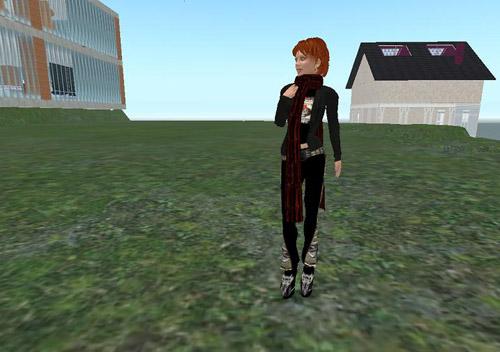
Considering all this has led me to reflect on the way I have been leading my virtual existence, on the grid and in this blog, and how much I have used SL to break with convention and explore facets of my personality that I normally keep hidden. Sadly, I must admit that I haven’t really taken up the opportunity to reinvent myself to any great extent. My avatar looks pretty much like I do (or did 20 years ago at least), and my activity is a similarly unadventurous echo of the ineffectual political agitation and low-powered cultural and psychological rumination that passes for my day to day intellectual life.

You may think that the fact that, faced with the limitless possiblities for self-expression offered by Second Life, I have chosen to create an alter-ego that is at most a slightly polished version of my real self, is a sign that I have a dreadful lack of imagination, and you may well be right. I however prefer to recall the research in this area which suggests that it is the people with the lowest self-esteem who are most likely to idealise their virtual existence, and to conclude that my rather boring cyber-identity proves that I must be supremely well-actualised in real life, and that my personality has only a little room for improvement.

And talking of Richard Hell

O Superman

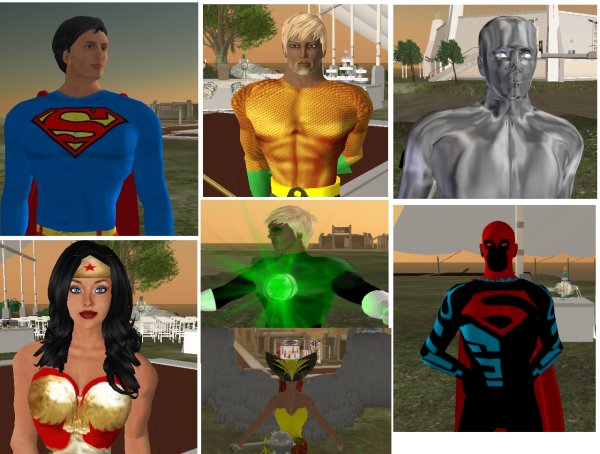
The JLU saga rumbles on, and has jumped from Second Life into the real world, on the way losing much of its lustre.

I may have exaggerated a little when I implied that the wannabe superheroes were some sort of virtual Freikorps, but they do seem to be doing their best to make themselves look like a thoroughly sinister outfit. Their latest stunt is to try to censor the Herald’s exposé of the secret JLU database by threatening the paper’s web host with the DMCA. The Herald, to their credit, are not taking this lying down, and have counter-filed a complaint charging JLU supremo Kalel Venkman with intentionally lodging a false DMCA report, which, I understand, is not a trivial offence.

(A side-effect of this process has been to reveal the real-life identity of Herald editor Pixeleen Mistral, who, rather impressively, turns out to be internet legend Mark McCahill.)

The whole story was quite fun when it was confined to the grid and the SL blogosphere, but I suspect it is about to become rather less amusing for the participants now that everyone is getting lawyered-up. A well-connected academic like McCahill can probably look after himself – I’m sure he’ll be able to hit up Lawrence Lessig for some free legal advice – but Venkman, who, the internet tells me, is really a technical writer from Los Angeles, may be having second thoughts about the potentially expensive escalation of hostilities that he has initiated.

Why has Venkman done this? He had a perfectly good role-playing scenario set up, with heroes and villains, intrigue and espionage, skulduggery and back-stabbing, confidential dossiers and secret deals, topped off with open conflict between the forces of good and evil across hundreds of worlds – all the ingredients for a gripping narrative, with Venkman himself right at the centre. He’s trading that for a dull tale of dreary lawyers exchanging dismal arguments in dusty courtrooms, a story that seems likely to end in unhappiness for Venkman and his lycra-clad cohort.

This seems to me to be a case of incomplete immersion, or perhaps over-augmentation; either way Venkman appears to have lost sight of the boundary between the virtual world and the real. The role of “Venkman” has become so important to his self-image that he is unable to see the Herald‘s story for what it is –  a chance to build on the mythology he has already established, an opportunity he should welcome – and instead regards it as a threat to his real-life identity, one which must be countered with a real-life action, regardless of the fact that such action risks destroying his existence, both virtual and real.

The story reminds me of cases we’ve covered before – the tale of another virtual superhero, Twixt, and the Stroker v. Linden lawsuit. Both of these involved people acting in ways that made no sense when seen in the context of the virtual world alone, but became more comprehensible when one thought about the interaction between virtual and real identities, particularly the unconscious aspects of the latter.

Is it possible to be a complete immersionist, to live one’s virtual life in total isolation from the conscious and unconscious influences of one’s everyday personality? Would such a thing be desirable? Probably not, for what is interesting to me about living a Second Life, and recording my thoughts about it, is the way that it casts light on corners of my consciousness that I may have been only vaguely aware of. While projection of real-life neuroses into the metaverse may be illuminating, I’m much less convinced that allowing in-world dynamics to leak out and influence one’s external behaviour can be anything other than harmful. This may be a lesson that Kalel Venkman, or at least his mortal alter-ego, is about to learn the hard way.

Because when justice is gone, there’s always force.

The Avatars United will never be defeated

I was busy with some real life issues over the last week or so, and hadn’t been paying attention to all the various SL-related blogs and tweets that I usually monitor in a sadly obsessive way, so when I finally got round to looking at them I thought I might have missed a big story. Everyone seemed to be going on about “Avatars United“, and for one terrible moment I feared that someone had stolen a march on my plans to start up a virtual revolutionary movement by launching their own grassroots organisation.

The truth turned out to be a bit less exciting; AU is a two-year old social networking site that had been more or less moribund until Linden Lab unexpectedly bought it over at the end of last month. This prompted a flurry of interest from the SL community and a rush to take advantage of the site’s USP; the ability to collect all your virtual identities in one place and associate them with one another and, if you want, with your real one (though not many people were taking that option up). Amusingly, they don’t seem to have any system to verify that users actually own the avatars they are claiming, which has led to a rash of virtual identity theft.

Why the Lab has bothered with this is not entirely clear, since I thought they were trying to promote SL itself as a social networking service with benefits, and I can’t see the advantage for them in encouraging people to take their chatting off the grid and on to some other site. I imagine that they are more interested in harnessing the development skills of the AU staff to improve the SL experience than running a virtual Facebook.

From a user’s point of view the appeal of AU is even more opaque; the main attraction (for me anyhow) of having multiple online identities is that they are separate, and thus able to reflect different aspects of my personality. (Shelly Turkle wrote about this years ago.) If I need to integrate my avatars for any purpose I already have a perfectly good place to do so; it’s called “inside my head”.

I’m not the only person to have doubts; in what must be one of the shortest hype-cycles ever the AU backlash has already started.

On being kind not cruel

Remember Gwen Bell? Social media guru? I wrote an embarrassingly mean-spirited post about her blog back in January? (I don’t know what was bugging me that day, but whatever it was it had my misanthropy turned up to 11).

Anyhow… this month Gwen has been running “The best of 2009 blog challenge“, inviting bloggers to reflect on the year just past, and nominate their favourites in various categories, one each day.

I’m usually no good at posting to a deadline like this, due to my almost complete lack of self-discipline, but it just so happens that today’s prompt is “Book”, and I was just thinking today of something that I read a few months ago, which struck me at the time as especially memorable.

It’s a passage from Hunter S. Thompson’s Hell’s Angels: The Strange and Terrible Saga of the Outlaw Motorcycle Gangs, first published in 1966, and the book that made Thompson’s name, though the style is much more straight reportage than the gonzo journalism he is famous for. It’s a solid piece of work, humanising the Angels and locating the moral panic that grew up around them in the context of social change in 60’s America, without ever losing sight of the fact that they always had the potential to act in seriously unpleasant ways.

The bit that sticks in my mind wasn’t written by Thompson himself (though he does provide many quotable lines), but by Allen Ginsberg, part of an speech he gave in 1965, in which he tried (successfully as it turned out) to dissuade the Angels from carrying out their threat to attack a march against the then-raging Vietnam war:

To take the heat off, you’ve got
to take the heat off
INSIDE YOURSELVES –
Find Peace means stop hating yourself
stop hating people who hate you
stop reflecting HEAT
THERE ARE PEOPLE WHO ARE NOT HEAT
THE MOST OF PEACE MARCHERS ARE NOT HEAT
They want you to join them to relieve
the heat on you & on all of us.

Take the heat – Anxiety Paranoia –
off us, AND off the police, off all the fearful –
REASSURE, and act clearly in such a way
as to reassure –
by being kind not
cruel –
and it’ll be remembered and responded to.

Ginsberg’s plea has been rendered no less urgent by the passage of four decades. I can’t pretend to myself that I’ll be able to live by his words, but I’ll try to recall them when I’m blogging, and my Anxiety Paranoia is getting a little out of control.

Why we hate and fear the BBC

A couple of weeks ago the BBC published a piece about Second Life on their news website. The article itself was a fairly inoffensive statement of fact – in summary “Second Life? People used to talk about that a lot; now, not so much” – but it set off an entirely predictable flurry of indignation around the SL blogosphere. The prize for the most ridiculously hyperbolic comment goes to Hamlet Au at New World Notes:

The BBC’s recent magazine article, “What Happened to Second Life?” … is so incandescently bad, to read it is to feel the entire institution’s credibility undermined.

One can picture tribesmen in the jungle of Myanmar, hunched over their short-wave radio, wondering if they can still trust the BBC’s reports on the Naypyidaw junta after that hatchet job they did on SL.

Why do SL aficionados respond to even mild criticism by foaming at the mouth in a way that makes Leave Britney Alone Guy look like a model of calm and reason? (Not that I haven’t been guilty of this myself once or twice).

I suspect there may be some projective identification going on. Anxiety is generated by the conflict between the desire to express unconscious fantasy through the medium of virtual reality, and the internalised attitude of general society that such activity is not really what one expects of a grown adult; these desires are therefore split off into “bad” internal objects.

A threatening sense of dis-integration may be produced, which, if it cannot be contained within the ego (that is, if the subject is in the paranoid-schizoid position), must be projected into our perceived critics, who, we imagine, are persecuting us because they do not understand the value of our virtual experiences – though in reality it is actually we who cannot fathom why we want to spend time on such apparently pointless activity.

The vehemence of our response is mystifying to those outside the circle, who begin to regard partisans of Second Life with genuine bafflement, and not a little trepidation. Thus the defence creates its own reality, which may be effective in relieving our anxiety (as the conflict is perceived to be between ourselves and “bad” external objects, rather than being intra-psychic), but which sets the stage for a cycle of mutual misunderstanding and hostility.

Anyone who has worked through the depressive position should be able to tolerate the ambiguity related to being a fan of Second Life, both internal (I know it’s a bit silly, but I like it anyhow), and external (other people may think it’s silly, but it doesn’t make them bad). It helps to be honest with oneself about one’s motives for spending time on the grid, and to leave the rationalisation to the Lindens, who, after all, do have a business to run. The truth is that Second Life is like any other pastime; some people are into it, most people aren’t, but that’s cool, and certainly not worth getting all angry about.

Tweetomania

I hate to admit it, but, way behind the curve as usual, I have started to view Twitter as an important part of my life, rather than a pointless irritant. When I set up our feed I was intending just to use it for publicising blog posts, but then I started following a couple of people (you know, just for kicks), then a couple more (though I could have given up any time I wanted, I just didn’t want to, right?), and before I knew it I was getting mildly agitated if I couldn’t get my tweet fix several times a day.

The tipping point came when I started following Mal Burns, who is a one-man SL newsfeed, cranking out dozens of tweets a day linking to all sorts of interesting metaverse stories. He seems to have quite a big audience, judging by the surge of traffic we have had on the couple of occasions he has featured one of our posts.

Our feed is somewhat less influential, though we do have a few followers, including one celebrity, Noreena Hertz, the vaguely left-wing economist, though I expect that by the time you read this she will have ditched us – she’s done the follow/unfollow thing on us a few times before, so I suspect that she has some sort of system that automatically follows anyone tweeting with the #economics tag, and then one of her assistants kicks us off a couple of days later when they actually read the rubbish we have written. Interestingly, our old SLS account has roughly ten times as many followers as our active feed, despite not being updated for nearly a year.

My addiction has been facilitated by my acquisition of the TweetDeck app for my iPhone, which makes it much easier to post updates and follow the general chatter. TweetDeck is part of the huge ecosystem that has grown up around Twitter, with literally hundreds of startups vying for a slice of the revenue pie, which, last time I looked, amounted to exactly US$0. Twitter head honcho Biz Stone has reportedly targeted 2010 as “the revenue year”, but even he isn’t willing to predict that the company will be profitable any time soon, so I can’t see how all the hangers-on are hoping to make any money.

I have a horrible feeling that the whole set-up is some kind of plot to get us all hooked on free produce, before they crank up the price and force us to pay big bucks to feed our habits. That wouldn’t be entirely bad news for me though, since I am qualified in the treatment of cyberaddiction, and the tweet-detox market might be worth quite a bit.

Bonfire of the Inanities

Blog-cataloguing website Technorati overhauled its database last month, purging tens of millions of spam blogs which had been making a mockery of their ranking numbers. Unfortunately there seems to have been a fair bit of collateral damage in this operation, as the internet has resounded with the protests of outraged bloggers who have seen their cherished writing projects disappear from the index. I am sad to say that Second Life Shrink was among the casualties; it is no longer possible to check how much authority we have, or see where we rank in the world wide web. Which is just as well probably, since the last time I looked the answers were “not much” and “way down”. (I never really understood how the Technorati ranking worked anyhow, since over the years our place has varied from below 5 million to inside the top half million, while all the time we have been turning out more or less the same rubbish, to more or less general indifference).

I does make me reflect on why I bother to blog at all, especially about something as unimportant as a minority-interest computer fantasy world. I think it’s the very inconsequentiality of the topic that that makes it attractive. It feels good to have strong opinions, because it sustains the illusion that one’s thoughts might actually matter in the grand scheme of things, rather than just being transient chemical reactions in the nervous tissue of a barely sentient creature in one obscure corner of an essentially chaotic cosmos. Strong opinions about important things are risky though; someone else might strongly disagree with you, raising the threat of unrestrained violence, or at least social awkwardness. Much better to confine one’s pontificating to subjects that no one really cares about; whatever I write about, say, IP rights in virtual worlds, I can be fairly sure that, in the unlikely event that anyone is paying attention, they won’t be upset to a degree that they will want to come round to my house and have a fight about it.

Even when I offer my random thoughts about things that might actually be relevant to everyday life, like politics or economics, I know that I’m not going to encounter any serious disagreement, because my voice will be lost in the general hubbub of subjectivity that is the blogosphere. There is no vehicle better than a blog for sounding off without having to think about how others might interpret or respond to your comments. The promise of Web 2.0 – that it would facilitate intellectual interactivity on a global scale – is in danger of being lost, as we bloggers use the medium to reinforce our own preconceptions instead of opening up to the ideas of others. (I’ll stop there before I prove my argument by descending into completely solipsistic nonsense).

Anyway, I’m going to try to re-register with Technorati, since I need to feed my obsession with blog statistics. Our content may be getting a boost soon – our art correspondent Olivia is back at work, and has promised me an article before the end of the month – and I wouldn’t want to miss the increased authority her erudite commentary will undoubtedly bring us.

[I was going to link to a video of the Austin Lounge Lizards performing their track “Bonfire of the Inanities”, but YouTube has failed me, so here’s another of their numbers, “Jesus Loves Me But He Can’t Stand You”.]