Teenage Kicks

I’m aware that lately we have been rather remiss in our duty to provide you, our dear readers, with ill-informed opinion on what’s going in in the wonderful world of Second Life, so here’s my two cents on some recent events:

Philip Rosedale at SLCC – Philip delayed the start of his family holiday to show up in person, sending the clear message to potential corporate customers that virtual communication is OK for trivial stuff, but if you really want to impress your audience you had better appear in the flesh.

Teen Grid to close – Not much of a shock, given that some sources put the average TG concurrency as low as 300. What’s more surprising is the decision to open the main grid to 16 year olds. I can only imagine that this has been done to placate content creators who do business with the educational sector, or perhaps the educators themselves. It looks like a lawsuit waiting to happen though. It’s one thing to have kids sneaking into your adult establishment – as long as you make some token effort to exclude them you can claim that any bad things that happen are their own fault – quite another to invite them in, thus assuming the responsibility of keeping them free from harm. I predict traumatised teens will be signing up for the inevitable class action before the end of the year.

The Emerald Viewer controversy – Now this is really what Second Life blogging is all about – the chance to work oneself up into a lather of righteous indignation over some utterly trivial “outrage”. I know that clandestinely co-opting your customers into a DDOS attack against a rival developer, or secretly building a vast database of your users’ IP addresses, is thoroughly reprehensible behaviour, but, on a global scale, it’s hardly worth getting angry about (unlike this, for example).

But who am I to talk? This whole blog is just a way for me to relieve my frustration with the world by mouthing off on subjects I know little about. I can’t say that it’s not cathartic, and it’s always fun working out how I can shoehorn in a link to some classic music.

Après le déluge

Having spent rather too much time over the last few days reading all the web has to offer on the subject of the Linden layoffs, I can report that the consensus view is somewhat downbeat. If blogger opinion is at all authoritative (and what reason is there to distrust the gaggle of ill-informed scribblers who make up the SL chatterati?) the future of the grid is grim indeed.

I am inclined to agree with this viewpoint; M Linden may talk of a carefully planned reorganisation, but I’m sure such restructuring would be best carried out by quiet redeployment and natural wastage, especially if, as M claims, there was no financial pressure driving the cuts. Instead we have had a headline-grabbing massacre which has spooked the very customers who M himself has identified as being key to the Lab’s revenue model. I can’t imagine that many people will be making long-term investments in Second Life until the smoke clears and the future of the platform looks more certain.

I find myself looking upon the prospect of Second Life‘s demise with a certain degree of equanimity though. As I have previously expressed, I believe that much of the attraction of metaversal life lies not in the rather mundane virtuality of the grid itself, but in the intellectual space of the community that has grown up around it. Perhaps that community will disperse if and when the world dies, but the years of Second Life‘s existence may just have been long enough to build a critical mass of text and links that will allow the spirit of SL to outlive its physical manifestation. Like the myths of Ancient Greece or the poems of Rimbaud, the Second Life experience will serve as an inspiration for future exploration of the mysteries of human consciousness.

Though probably not. Our attention spans attenuated by the onslaught of ubiquitous media, we’ll likely be blogging and tweeting about the next new shiny thing within minutes of Linden Lab pulling down the shutters. So it’s probably best to enjoy the ride while we can.

Like Pompeii (or Herculaneum)

The skies have been unusually quiet today, as the ash plume from the volcano below the Eyjafjallajokull glacier in Iceland has spread over northern Europe, closing UK airspace to commercial aviation.

This evening the sky has turned a deep red. Those of a superstitious nature might take this as a positive omen for the left in the coming elections, but it may take more than intervention from Loki to swing things towards Labour. Perhaps the picture will be a little clearer after the leaders’ TV debate tonight.

My first thought for musical accompaniment to this post was something by Ash, but that seemed a bit obvious, so here’s something appropriate by the B-52’s.

Never Mind the Bollocks

Another week, another of the icons of my generation’s popular culture has passed away. This time we’re mourning Malcolm McLaren, self-mythologising father of British punk.

I’m sure that there will be plenty of obituaries published over the next few days, so I’ll just link to McLaren’s most famous protégés in their finest hour.

Big Star

Well this is sad news; Alex Chilton died earlier this week, at the tragically young age of 59, just days before Big Star were due to play a reunion gig at SXSW.

I came to Big Star via Teenage Fanclub, who were heavily influenced by the harmonies of the Memphis-based band. Thirteen, the Fannies 4th album, is named for this classic Big Star track.

I’ve not listened to #1 Record for a while – although it came out in 1972, in my mind it’s associated with the mid-90’s, when I had it on a lot. I’ll get it out and enjoy some good memories – just a shame I’ve been reminded of them in such sad circumstances.

The Kid With The Replaceable Head

People who know how I dress would probably refuse to believe this, but I am a regular reader of the fashion pages in the newspaper, especially when there is some big event like London Fashion Week on. I don’t update my own style, such as it is, with any great frequency – an observer with only my wardrobe to go by would conclude that there had been no major developments in male couture since Richard Hell started wearing ripped T-shirts in 1976 – but I do like to keep in touch with the latest trends, so that when I meet someone new I can judge how much of a fashion victim they are.

LFW has of course been overshadowed this year by the death of Alexander McQueen. Fashion is by its nature ephemeral, but there is no doubt that McQueen was one of those designers who deserves to be thought of as a serious artist, and whose influence on popular culture went far beyond the catwalk. The tragic circumstances of his passing, with so much of his career still in front of him, only adds to the feeling that the world has lost a major talent.

Anyway, I mention this because I was reading an article about Swedish designer Ann-Sofie Back’s new collection, which apparently has been inspired by her experience working as a stripper in Second Life. Interestingly, she doesn’t seem to rate SL, or the virtual fashion industry, very highly, describing it thus: “Second Life is quite a shitty, slow game where nothing much happens, but people do make an effort with clothes, hair and make-up. The weird thing is, you have the chance to really create something fantastic – you know, with rabbit ears or you could be green. But most people want to look like Katie Price and Peter Andre, and wear clothes like people on Big Brother. It’s even more conformist than real life.”

I won’t pretend that I know enough about the SL fashion scene to say whether or not Ms Back’s opinion is accurate, though my limited observation has made me think that there is quite a degree of conservatism operating, with most of the items available being a variation on a few themes, so she may well be on to something.

The assertion that SL in general is essentially conventional does seem more counter-intuitive, when one thinks of the myriad of character types one meets around the grid. Sometimes outward rebelliousness masks inner conformity though, and the rules governing a subculture can be as rigid as any in more mainstream society. Someone needs to do some anthropological work among SL‘s Furries or Tinys or Vampires or whatever to see if this is the case.

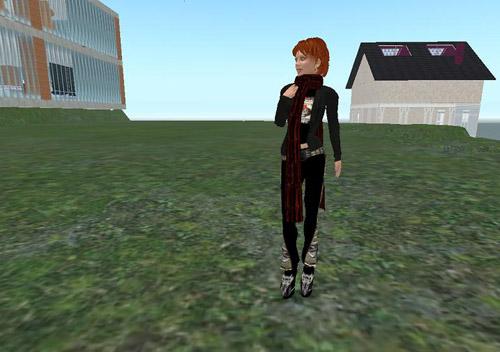
Considering all this has led me to reflect on the way I have been leading my virtual existence, on the grid and in this blog, and how much I have used SL to break with convention and explore facets of my personality that I normally keep hidden. Sadly, I must admit that I haven’t really taken up the opportunity to reinvent myself to any great extent. My avatar looks pretty much like I do (or did 20 years ago at least), and my activity is a similarly unadventurous echo of the ineffectual political agitation and low-powered cultural and psychological rumination that passes for my day to day intellectual life.

You may think that the fact that, faced with the limitless possiblities for self-expression offered by Second Life, I have chosen to create an alter-ego that is at most a slightly polished version of my real self, is a sign that I have a dreadful lack of imagination, and you may well be right. I however prefer to recall the research in this area which suggests that it is the people with the lowest self-esteem who are most likely to idealise their virtual existence, and to conclude that my rather boring cyber-identity proves that I must be supremely well-actualised in real life, and that my personality has only a little room for improvement.

And talking of Richard Hell

O Superman

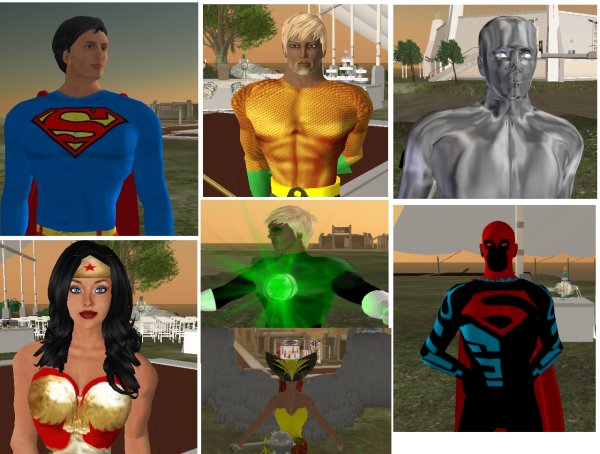
The JLU saga rumbles on, and has jumped from Second Life into the real world, on the way losing much of its lustre.

I may have exaggerated a little when I implied that the wannabe superheroes were some sort of virtual Freikorps, but they do seem to be doing their best to make themselves look like a thoroughly sinister outfit. Their latest stunt is to try to censor the Herald’s exposé of the secret JLU database by threatening the paper’s web host with the DMCA. The Herald, to their credit, are not taking this lying down, and have counter-filed a complaint charging JLU supremo Kalel Venkman with intentionally lodging a false DMCA report, which, I understand, is not a trivial offence.

(A side-effect of this process has been to reveal the real-life identity of Herald editor Pixeleen Mistral, who, rather impressively, turns out to be internet legend Mark McCahill.)

The whole story was quite fun when it was confined to the grid and the SL blogosphere, but I suspect it is about to become rather less amusing for the participants now that everyone is getting lawyered-up. A well-connected academic like McCahill can probably look after himself – I’m sure he’ll be able to hit up Lawrence Lessig for some free legal advice – but Venkman, who, the internet tells me, is really a technical writer from Los Angeles, may be having second thoughts about the potentially expensive escalation of hostilities that he has initiated.

Why has Venkman done this? He had a perfectly good role-playing scenario set up, with heroes and villains, intrigue and espionage, skulduggery and back-stabbing, confidential dossiers and secret deals, topped off with open conflict between the forces of good and evil across hundreds of worlds – all the ingredients for a gripping narrative, with Venkman himself right at the centre. He’s trading that for a dull tale of dreary lawyers exchanging dismal arguments in dusty courtrooms, a story that seems likely to end in unhappiness for Venkman and his lycra-clad cohort.

This seems to me to be a case of incomplete immersion, or perhaps over-augmentation; either way Venkman appears to have lost sight of the boundary between the virtual world and the real. The role of “Venkman” has become so important to his self-image that he is unable to see the Herald‘s story for what it is –  a chance to build on the mythology he has already established, an opportunity he should welcome – and instead regards it as a threat to his real-life identity, one which must be countered with a real-life action, regardless of the fact that such action risks destroying his existence, both virtual and real.

The story reminds me of cases we’ve covered before – the tale of another virtual superhero, Twixt, and the Stroker v. Linden lawsuit. Both of these involved people acting in ways that made no sense when seen in the context of the virtual world alone, but became more comprehensible when one thought about the interaction between virtual and real identities, particularly the unconscious aspects of the latter.

Is it possible to be a complete immersionist, to live one’s virtual life in total isolation from the conscious and unconscious influences of one’s everyday personality? Would such a thing be desirable? Probably not, for what is interesting to me about living a Second Life, and recording my thoughts about it, is the way that it casts light on corners of my consciousness that I may have been only vaguely aware of. While projection of real-life neuroses into the metaverse may be illuminating, I’m much less convinced that allowing in-world dynamics to leak out and influence one’s external behaviour can be anything other than harmful. This may be a lesson that Kalel Venkman, or at least his mortal alter-ego, is about to learn the hard way.

Because when justice is gone, there’s always force.

Two Galleries

I recently spent some time wandering around The Leominster Galleries, a new project from Sigmund Leominster, of SL on SL fame. The space exists to showcase Siggy’s personal art collection, with three floors of permanent exhibits and a room for temporary shows, all floating in the air high above the Root Squared sim.

Siggy’s taste seems to be firmly rooted in the 19th century, with the work of William Adolphe Bouguereau particularly well represented:

Bouguereau is an interesting choice; a stalwart of the French Académie des Beaux-Arts, he was acclaimed a genius in his day, but his reputation declined spectacularly in the 20th century, when his work was largely viewed as technically competent, but exemplifying the worst aspects of the ossified Academic style. He was entirely eclipsed by the Impressionists, a movement he had attempted to exclude from the Salon, and which he struggled to understand. More recently reviving the popularity of Bouguereau has become somewhat of a cause célèbre among conservative art critics, who see in his work an affirmation of traditional values tragically displaced (in their view) by modernism.

I don’t know if Siggy is making a political point with his picture selection, or if he just likes the sanitised eroticism that was popular in 19th century bourgeois circles. To be fair, the collection is not entirely composed of tasteful nudes in classical tableaux – there are some tasteful nudes in faux-Arthurian tableaux too, courtesy of the Pre-Raphaelites:

a fair representation of Symbolist works:

and a smattering of Surrealism:

The visit introduced me to several works I hadn’t seen before, since, I must admit, I usually hurry through the 19th century rooms when I visit the big galleries, so it was educational to a degree, but I do wonder what value was added by hosting the exhibition in Second Life, rather than, say, posting it in a blog. I suppose one could invite one’s friends around to make it a more social experience. The exhibits might perhaps be a little more interactive, with links to information about the artists and movements, and some explanation of the curatorial philosophy. The gallery design could be a bit less clinical too, since the modern aesthetic of the plain walls and light wood floor clashes somewhat with the cluttered hanging. A few chairs wouldn’t go amiss either. These are minor criticisms though, and the Leominster Galleries are well worth checking out.

A rather different artistic experience is on offer at The Primtings Museum, where they don’t hang the pictures on the walls, but build installations that allow visitors to place themselves into some iconic images:

(I’m pretty sure that I once sat in a real-life recreation of Van Gogh’s Room at Arles, but this was in Amsterdam, so it might just have been a drug-fuelled hallucination.)

There are dozens of works on display by various virtual artists, including our old friend AM Radio, who reworked David’s The Death of Marat, above. A full catalogue can be found on the Primtings website.

Surrealist paintings provide the inspiration for a large number of pieces, but, ironically, these are perhaps the least successful works in the gallery. The dream-like quality of Surrealism seems to be lost rather than enhanced by being lifted from the canvas and transformed into rather prosaic tangible objects:

I think for these sort of pieces to work they would have to be more immersive than just three dimensional representations of the paintings presented in a box. A sim-scale re-imagining of Un Chien Andalou perhaps, with the opportunity to slice up eyeballs and pull a piano full of dead donkeys around.

My favourite work at Primtings is this replica of Damien Hirst’s The Physical Impossibility of Death in the Mind of Someone Living:

As befits conceptual art this works just as well in Second Life as it does in reality. The best part is that you can take away a free copy of the formaldehyde tank (though not the shark), and suspend yourself, or your loved ones, in it when you get home.

I did wonder a bit about the copyright status of these two galleries. I think Siggy should be all right, since the artists he features are all long dead, but Primtings might be on shakier ground if Hirst ever finds out they have been ripping him off, so you should probably take it in while you still can.

And finally – Johnny would have a fit if I mentioned Un Chien Andalou without linking to this.

I Wanna Wanna get the New Model

I had never bought any Apple product before I got my iPhone last year; partly because I didn’t want to betray my open-source principles, but mainly because I was too cheap. I’ve been very impressed with the gadget, but I haven’t been completely converted to the cult of Jobs, and if and when someone comes out with a better smartphone I’ll probably switch, especially if it runs on Android or some other free OS.

I was intrigued rather than obsessed by the fuss surrounding the launch of the latest Apple toy, the already legendary iPad, but now that the details are public I have to confess that I am tempted to buy one, though there is absolutely no way that I could justify the expense, since I would only ever use it in the house, and I already have a desktop and four laptops of varying degrees of obsolescence lying around, as well as the iPhone.

What’s most attractive about the iPad is the promise of instant access to the web, allowing me to fill spare moments with casual browsing, much in the way that I use my iPhone now, but without the eye-straining tiny screen. I have a feeling that I will get one eventually, but I’ll leave it a while to see if any cheaper clones come out.

Or maybe I should just buy some more books, or start talking to people, or something crazy like that.

Here’s the horribly contrived (even by our standards) but musically impeccable video link.

Just what is it that we want to do?

The answer to that is fairly straightforward – no need to formulate complicated transitional demands, or debate maximum and minimum programmes. We only need to think about the things that SL residents (or SL bloggers at any rate) are always moaning about.

A major gripe is the Lindens’ propensity to change fundamental aspects of the resident experience without involving the user base in the decision process, or at best engaging in some token consultation exercise. A second, and not unrelated, complaint is the belief that the Lab privileges some residents and businesses over everyone else, by uneven application of the Terms of Service, or commercial favouritism, aggravated by their reluctance to adequately regulate commercial relations between residents, most contentiously in the realm of intellectual property rights.

The steps needed to resolve these issues broadly correspond to two features usually associated with western liberal democracy; executive accountability and the rule of law. We can therefore formulate two central demands that, one might expect, would be supported by a majority of SL residents.

  1. An elected forum with the power of veto over major changes in Second Life.
  2. A robust judicial system operating independently of Linden Lab.

Obviously some of the finer details, like suffrage, will have to be worked out, but I think the basic concepts are enough to get the SL democracy ball rolling.

And when we’re done? Then we’ll get loaded.