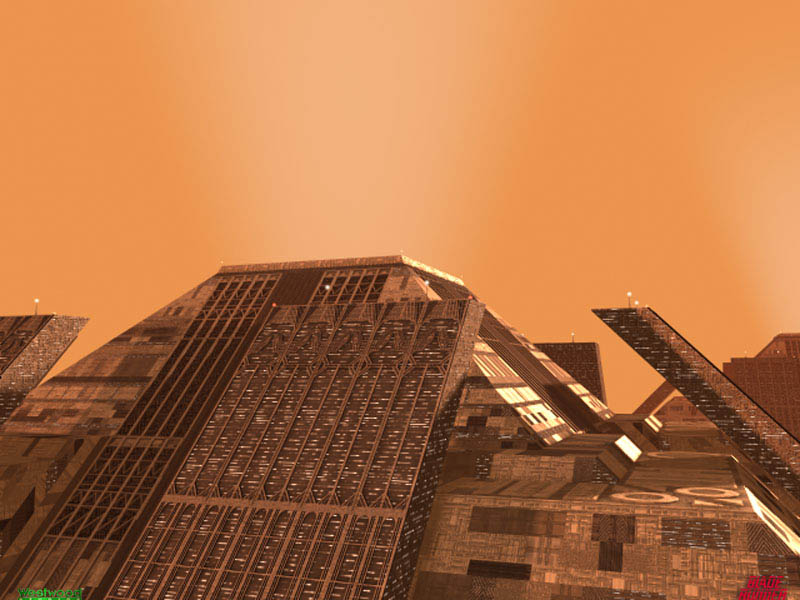
Bötterdämmerung

… would have been a much better title for my last post, come to think of it.

I first saw Blade Runner during its original cinema run back in 1982, around the same time as I was reading all the early William Gibson stuff, and it had a similarly profound effect on my emerging aesthetic consciousness. Functional hi-tech amidst a crumbling cityscape has been my idea of what the future holds ever since, and it’s always seemed quite attractive. What with the depression, and global climate change, and the decline of the Western powers, it’s just about possible to imagine that Los Angeles in 2019 will look pretty much like it does in Ridley Scott’s movie, though maybe without the flying cars, and hopefully without the killer robots on the loose.

There is a Bladerunner City in SL, but the architecture on display owes more to the ziggurats of the Tyrell Corporation than the run-down streets of future LA which, for me, are the most visually pleasing element of the film. The owners of the sim are evidently interested in transhumanism; the welcome notecard at the entrance gives a brief history of the idea, from Dante to Huxley. I got the impression that they would prefer Roy Batty (surely the least threateningly-named homicidal android ever) to the crumpled Rick Deckard, though of course (spoiler alert) it turns out that Deckard’s human frailty is actually a more perfect realisation of the replicant-maker’s craft than Batty’s superhuman abilities (or not, it depends which version you watch).

I can’t say that I am familiar enough with the various strands of transhumanism to have a firm opinion about it; I do believe that technology changes who we are as humans, but I think that that process does not operate on the level of the individual, but rather is mediated through the changes in social organisation that accompany advances in science. To take the internet as an example, it is only now that we are working out how to use it in a social way, with things like Facebook, and blogs, and even Second Life, that the full civilisation-changing potential of the medium is becoming apparent. Maybe one day we will all be dreaming of electric sheep.

Twilight of the Replicants

Linden Labs have announced a ban on the use of traffic bots, those vacant souls you see hanging around shops or clubs, who are even less friendly than normal residents. This should return some measure of reality to the traffic statistics, as well as reducing strain on the servers, though it will also presumably make the concurrency figures look a bit less impressive.

The Labs are saying that other bots are safe for now, but this move will have set our artificial “friends” on alert, and even now they are probably organising themselves into clandestine cells, ready for the bot-wars to come. We’ll be forced to hunt them down and “retire” them, one by one, before they use their superior intelligence, strength and social skills to overthrow their human masters and reduce us to slavery.

We’re going to need some reliable way of differentiating bots from humans. I’ve been working on a psychological test that involves staring into the subject’s eyes, while telling them a story about a helpless tortoise. It’s pretty reliable, if a bit slow.

Neighbours, friends, even family – anyone you know could turn out to be a bot, just waiting for the chance to wrap their legs around your neck, break all your fingers, gouge your eyes out, or all three. If you’re concerned, just give us a call here at SLS, and, for a reasonable fee, we’ll send one of our operatives around to do the test, and take the necessary action.

We’ve made our match – and now it’s our problem.

Aspects of intimacy

Legendary Charisma, over at Metaversally Speaking, the (virtual) world’s most popular blog, has been running a series of articles on the ins and outs, so to speak, of cybersex. It’s been quite entertaining, if rather psychologically unsophisticated, focusing more on the mechanics than the deeper meaning; just like high-school sex-education in fact. This week’s column features the counter-intuitive assertion that the quality of cybersex can be improved by familiarity with the real-life characteristics of one’s partner. I couldn’t let that pass without comment; you can read the discussion here.

In other intimacy news, researchers in the Highlands have developed a system which allows geographically-separated lovers to caress each other’s bodies using beams of light. This seems a much more promising way of communicating real feelings than interacting in Second Life; it’s directly sensual and avoids all the cerebral processing inherent in text-based liasons. All sorts of conscious and unconscious confusion can occur once the higher brain functions are engaged.

Gimme Gimme Shock Treatment

Bloomberg are reporting that Taser International Inc. have filed a trademark-infringement lawsuit against Linden Labs, alleging that the sale of virtual copies of the corporation’s stun-guns in Second Life is damaging the firm’s reputation.

What’s interesting about this is that it is Linden Labs that is being sued, rather than the creators of the knock-off weaponry. Anyone who has ever shopped in SL will know that there are plenty of fake Gucci bags and other designer merchandise in circulation, but until recently there has been little incentive for trademark owners to go after the counterfeiters, since the chances were that they wouldn’t have enough money to pay any substantial damages.

That’s all changed now that Linden Labs has taken over XStreet, and, as Tateru Nino notes in her coverage of the case over at Massively, effectively become the retailer of the dodgy goods. Suddenly the lawyers have a profitable corporation in their sights instead of some penniless hackers, a corporation that will probably settle out of court to avoid the nuisance of ongoing litigation.

This could open up a whole new career path for SL entrepreneurs; virtual patent troll.

Whatever, here at SLS we’re still happy, happy, happy, all the time.

Career Opportunities

Further to my last post, I’ve been doing some calculations based on the figures in M Linden’s “State of the Economy” report.

The survey quoted had 2645 responses, which is said to be 15% of business owners, so the total number of enterprises must be 17633. Of these, 64%, or 11285, report that they generate positive net income – 52% generate up to 20% of their total income from Second Life, 5% generate 20-40%, 2% generate 40-60% and 5% generate 80-100%.

If I was a statistician I could probably use this data, along with the US$100 million cashed out figure, to construct a model that would show how many people were earning the big bucks, but I’m not, so I’ll just engage in some idle speculation.

Let’s generously assume that when M says that “a good part of [the US$100 million goes] into Residents’ pockets”, he means that half of it does. That’s US$50 million split 11285 ways, or an average of US$4430 plus change each. But clearly some people are creaming off more than others. We don’t know what the top 5% (of the whole 17633) are earning, but, for the sake of the argument, let’s say they are fairly modest types, for whom US$50K is a good living, so the 881 of them collectively take home a little over US$44 million, or just about the whole pot. If we lump together the 7% (1234) who are getting 20-60% of their income (nobody seems to get 60-80%) and say they average US$15K, then that’s another US$18.5 million, which leaves less than nothing for the bottom 52%.

Of course statistics can be made to prove anything, especially when you just make up the figures like I have, but I would argue that, if anything, I have been too optimistic (from the point of view of a potential SL entrepreneur) in my assumptions. About a year ago Hamlet Au at New World Notes calculated that land fees added up to US$6 million a month, plus more for land sales, so it seems likely that much more than half of the US$100 million that is cashed out goes straight back to Linden Labs. In a more recent article Hamlet noted that a few of the top-grossing businesses were taking out more than a million US$ annually, so even in the top 881 there must be a heavy skew, with a handful of big earners and a mass of also-rans, and in the lower reaches of the economy the average income can’t be much above double figures.

None of this is necessarily a problem – I’m sure that most business owners see their SL enterprise as a self-financing hobby, and won’t lose too much sleep if it doesn’t make them rich. Linden Labs should perhaps embrace this spirit, instead of continuing to peddle the myth that there is serious money to be made (by people other than themselves that is). Statements like “In the current real-world economic climate, I think the additional income generated from a business in Second Life must be a welcome addition to our Residents’ personal budgets” (from M’s report) look at best ridiculous, and at worst dishonest.

Still, I guess “SL entrepreneur” just about beats making tea at the BBC.

M is for Pangloss

There’s an interesting post over at the official SL blog this week, wherein M Linden considers the “State of the Economy“; if you don’t have time to read it and the many responses it has generated I’ll sum it up for you:

M Linden: Everything is just grand! The future is rosy!

Residents: No.

I’m exaggerating, obviously (though not much; the picture accompanying the post shows a virtual tree, but instead of leaves it has, like, dollar bills! So even the illiterate can tell that the economy is booming). M seems to base his optimism on a couple of headline figures – 2008 user-to-user transactions of US$350 million, and US$100 million cashed out via the Lindex in the same period – and a rather vague survey of business owners showing 64% claim to generate positive net income and 61% are optimistic that their revenues will grow.

US$350 million may sound like a lot of money, but for a place with around 1.4 million active residents (according to the latest statistics) it’s small beer. For comparison, in San Francisco, with a population of a little over half that figure, the city council alone has a budget of over US$6 billion. Furthermore, it’s unclear how much of the spending actually takes place in commercial transactions, as opposed to people moving money around between their alts, or other such transfers.

The US$100 million figure has already been debunked by Urizenus Sklar at the Alphaville Herald; I can’t add much to his analysis. M claims that “a good part of [the money] went into Residents’ pockets”, but when asked in the comment thread what Linden Labs’ share of it was his answer is a not particularly forthcoming “We do indeed have accurate and up-to-date figures about how much comes back to us for land fees. It’s not a number we publish which is why I didn’t publish it.”

The survey had a response rate of 15%, giving a sample of 2645; I have no idea if that is a respectable figure for these sort of things, but I would want to see some comparisons between the responder/non-responder groups before I accepted that the results were generalisable. Even if they were, the figures are essentially meaningless without a lot more context. 68% of enterprises are maintaining or increasing their investment compared to the last six months, 15% “significantly”, but how much is significant, and what is the base level? 5% of business owners say that they generate 80-100% of their total income from Second Life, but is that their total household income, or just their personal income, and what are the absolute figures? The guy you pass in the subway every morning may make 100% of his income from panhandling, but that doesn’t mean he has hit on a viable revenue model (or maybe it does).

I long ago concluded that I would never make any money from Second Life, so I shouldn’t really care about any of this flimflammery, but I can’t help but feel that the Lindens should stop trying to pretend that SL is something that it is not, and concentrate on maintaining their income by looking after the people who will be around for the long haul, those who see the virtual world as an opportunity to explore new frontiers, rather than a venue for disposable entertainment, or a place to make a quick buck. Prime mover advantage doesn’t last forever, and there is always something newer and shinier just around the corner, ready to tempt the disaffected away. I’m quite attached to the old place now, and I’d miss it terribly if it disappeared.

Girl from Mars

After a prolonged gestation period, the virtual world of Blue Mars has started to recruit beta testers, and will, if you believe developers Avatar Reality, go live sometime in the summer.

The visuals, which utilise the CryENGINE2, certainly look pretty, and A-R are promising that users will be able to play without having to buy the latest graphics card, though they are keeping the details of the minimum hardware specifications a secret for now. Windows Vista is required though, so my old linux box definitely won’t work.

It’s claimed that the platform will be able to support thousands of simultaneous users in each region, which would be a massive advance on the paltry number Second Life can manage. It appears though that this will be done by a process of sharding, which I’ll admit I don’t really understand, except that it involves running separate instances of the same location on different servers, with new ones being spawned as necessary. I would have thought that this meant that if you had arranged to meet someone at a popular place then you might miss them because they were on a different shard, but there might be some technical way around this.

There will be a content generation system, but this will be limited to developers who have paid to sign up with A-R, leaving no space for amateur creativity. A central item registration system will protect IP rights, and, presumably, allow A-R to prevent the manufacture of the sort of things that have generated all those lurid stories about the perversity of Second Life. Some sort of virtual currency will exist, but ordinary users won’t be able to cash it out into real money.

So is Blue Mars a Second Life-killer? The graphics are a lot better, the scalability sounds attractive, and there does seem to be plenty to do. I can’t see too many current SL residents being tempted away though, since they would surely miss the freedom to produce their own content, and the potential, however illusory, for making some money.

Hard-core SL fans are unlikely to be the target demographic for Blue Mars though (but then, judging by Linden Labs’ recent actions, hard-core SL fans aren’t even the target demographic for Second Life). Avatar Reality will have their sights set on the corporate and educational markets, as well as new VW consumers who have graduated from places like Habbo and Club Penguin, and are more interested in the metaverse as a place to be fed entertainment rather than an outlet for their creative urges. These of course are exactly the clients who, we are told, represent the future for SL. If A-R are successful in stealing away this potentially lucrative business, they might just end up messing things up for those of us who do stick around in Second Life.

I was originally going to go for the obvious Bowie track as the title for this post, but I like this tune better.

Lists are a good idea after all

ArminasX has revamped his list of Second Life blogs, and this time we have made it on, at a rather remarkable #108.

If Second Life Shrink was a player on the WTA tour we’d be Virginia Ruano Pascual – perhaps not the best-known or most glamorous personality on the circuit, but a solid performer who has quietly racked up nine grand-slam titles in a seventeen-year career.

Here comes the summer

March saw an increase in our traffic for the sixth straight month; our daily average is well ahead of what it was this time last year. There’s no great mystery about how we’ve done this; new posts are appearing much more frequently (helped by having two of us working on the blog now) and we’re making a conscious effort to include more links to relevant blogs, which does seem to be generating some return traffic. I’ve tried to raise our general profile by registering with Technorati (where our rating is a semi-respectable 2493137) and Blogged (editors’ rating 7.4, “very good”), signing up for a few Second Life blog rings, and leaving comments around the SL blogosphere; this has been less successful.

Even when we go a few days without a post we still get a steady flow of hits. I think that’s because we’ve been around long enough to build up a critical mass of posts, meaning we show up on most Google searches that include the words “Second” and “Life” somewhere, even if it is usually on page 3 or 4 (though we’re back on top for the “Second Life Shrink” query). Our two top posts this quarter have been Olivia’s pieces on Star Trek and Vampires, which I guess tells you something about what’s popular in the SL universe.

I’m not sure that we’re going to be able to keep the pace up, now that the days are getting longer and the attractions of summer beckon. We’ll see how it goes.

Big Bird is watching you

Two nuggets of Twitter news caught my eye this week. First off, contact management firm Salesforce.com have added Twitter to their “Service Cloud”. For a fee, they will monitor all the Tweets in the feed, looking out for a specified keyword, then pass the details of Twitterers who have used that word on to the client, in real-time. The idea is that a company can be alerted when someone tweets an interest in their product, allowing a sales person to intervene in the conversation with useful advice.

It doesn’t take a great deal of imagination to think of this being used in a sinister way. I’m sure the FBI already look out for certain keywords, and the technology could easily be set to pick up tweets on any subject your boss, or your spouse, or the government doesn’t approve of.

Think I’m being paranoid? Read this story about how an indiscreet tweet got some poor cubicle-dweller in trouble before she’d even started the job. Then ask yourself if you really want everyone in the world to know what you’re doing right now.