Explosive talent

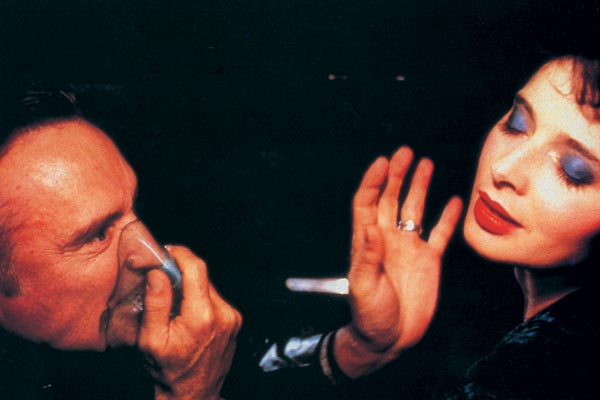
I can’t mention Blue Velvet without noting that Dennis Hopper, who fully inhabited the role of Frank Booth in that movie, passed away this week.

Hopper was a complex character, and was evidently not much fun to be around in the 70’s, but it’s difficult not to have some respect for the guy who directed Easy Rider, and was hard enough to round off a lecture to film students by blowing himself up.

That gum you like is going to come back in style

I don’t look at the TV much these days, and I very rarely find myself following an episodic drama series. The last time I even partially got into a show was when I caught most of the first season of The Wire, which I quite liked, but the effort of committing myself to regular appointments with the box was too much, and I never made it past the first episode of season two.

I was thinking about this the other day when I read an article at the AV Club which considered the cultural impact of David Lynch’s cult 90’s series Twin Peaks. It reminded me not just of how slavishly I had followed that programme, but of the way that even left-field shows like Lynch‘s unsettling masterpiece could attract mass audiences at that time.

Compared with today it was both easier and harder for a show to be a big hit back then; easier because there was less competition for the audience’s attention – the UK had only four terrestrial channels to choose from, satellite and cable were niche products, and there was no internet – and harder because there was no way to see things other than by sitting down in front of the TV at a set time – no DVD box-sets, no Tivo, and no internet TV. We did have VHS recorders I guess, though the elderly model I had at the time was much too unreliable to trust with an unmissable event like that week’s Twin Peaks.

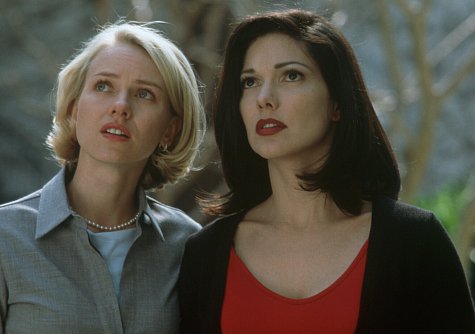
I had been a big David Lynch fan since I saw Eraserhead late one night on TV, and I’ve liked everything he’s done since (even Dune), especially Blue Velvet and Mulholland Drive (the latter is in the running for my favourite film of all time), so it was always likely I was going to be a Twin Peaks devotee, but what confirmed my addiction was the community that grew up around the show on campus. I was already hanging out with most of what became the Twin Peaks crowd, but we certainly bonded that little bit more over long evenings of coffee and cherry pie (actually, “coffee” and “cherry pie”) discussing our various theories of what the story was about. I’d like to say that we still get together every year to reminisce, but, with a couple of exceptions, I haven’t talked to any of those people in the best part of twenty years. Probably best to leave the memories undisturbed.

Anyway, the point that I’m meandering towards is that often what sticks with you about a cultural experience is not so much the event itself, but more the social connections that surrounded it. What’s changed since my Twin Peaks days is that, thanks to the wonder of the interwebs, it’s no longer necessary to be geographically co-located with your fellow fanatics to feel part of a community.

Certainly my experience over the last three years has been that, while it was the virtual eye-candy that initially pulled me into Second Life, what’s kept me around is the narrative that unfolds in the relationships between residents, played out partly in-world, but mostly in the SL blogosphere.

I don’t want to overstate the profundity of the SL storyline – it’s more potboiler than classic literature – but it’s diverting, harmless, and, best of all, it creates a pleasing illusion of interactivity. I can tell myself that I am involved in writing this tale, in my own small way, and that makes me just committed enough to stick with it through the many, many dull patches.

There’s an interesting paper by Wanenchak in the latest edition of Game Studies entitled Tags, Threads, and Frames: Toward a Synthesis of Interaction Ritual and Livejournal Roleplaying. It’s well worth reading in its entirety, but the part pertinent to this discussion is the brief review of Goffman‘s frame analysis as it applies to a collaborative online narrative:

… frames allow players to engage with the gameworld in such a way that their narrative construction and interactions become sensible to themselves and to each other.

What I find most fascinating about the Second Life narrative (and what I think gives it a claim to being a unique cultural phenomenon) is the fact that the frames that people are using are often unclear, shifting and overlapping. To put it in different terms, although they are operating in the same “gameworld”, which includes not just the SL grid but also the associated blogs, tweets and what have you, people are engaged with often wildly differing levels of immersion.

The effect of this is, more often than not, to render the meta-story unintelligible, but occasionally it all comes together to produce an instant of dream-like clarity that makes the whole project seem worthwhile. I would give some examples of this, but I suspect that, like real dreams, the beauty of these moments is highly subjective, and that any description I attempted would sound hopelessly prosaic.

Which brings us back to David Lynch. What I think he does better than any other director is capture the fractured reality of dreams and nightmares, in a way that is at once unsettling and beguiling. Sometimes – just sometimes – being part of the world of Second Life is like living in Twin Peaks.

Digital Death Day

Last Thursday was Digital Death Day, marked by a conference at the Computer History Museum in Mountain View, California. The event was a spin-off from the biannual Internet Identity Workshop, which is generally concerned with the technical and commercial aspects of online identity, rather than philosophical issues, and the DDD meeting was explicitly aimed at “Death Care Professionals … Estate Planners … [&} Death Attorneys” which would seem to indicate that the participants were inclined to grapple with practical matters rather than existential themes.

Nevertheless, even consideration of strictly material questions like the heritability of virtual assets and the ownership of online identity cannot help but make one think about the way that social media have influenced the experience of bereavement and grieving in the modern world. News reports of the death of a young person almost invariably mention friends and family paying virtual tribute to the deceased via Facebook or Twitter, and the concept of the social network page as a persistent memorial is well established. There is no doubt that this phenomenon can have a powerful emotional effect, as these personal accounts show.

Is this a healthy development? The persistent nature of an online presence can give mourners a chance to bid their farewells to the dead in their own time, reducing the trauma of a sudden departure. It also maintains the focus on the whole of the life that has been lived, rather than just on the death itself. All this can help give meaning to what might otherwise seem like a senseless tragedy, which in turn may aid the grieving process for those left behind.

This is perhaps not as new as we might think. In many ways it is a return a concept of death that our ancestors might have recognised, a communal experience, rather than a private matter for the immediate relatives of the deceased, after a century in which the end of life had been increasingly hidden away.

Of course it can also be argued that this process trivialises death and loss, that it is impossible to pay respectful tribute to the dead in 140 characters, that death has become just another commodified experience to be vicariously consumed. There is some truth in this – one can hardly deny that one’s reaction to the passing of someone that one has no real connection to will be driven more by one’s own internal dynamics than any genuine feeling for the deceased. (We explored this phenomenon in relation to Second Life in a previous post). On the other hand, expressions of sympathy from complete strangers, whatever their motivation, can be immensely comforting to the bereaved. At the most basic level they are an affirmation of our common humanity, a recognition that we are all bound together by our inevitable mortality, and it is that sense of solidarity that can carry us through our darkest hours.

Reality is overrated

Well, my sojourn in the real world turned out to be pretty depressing, sending me scurrying back to the synthetic succour of Second Life, to the comforting predictability of the rampant paranoia and gripes about the Lindens.

I guess that the new political situation will be taking up more of my real-life attention in the immediate future, but I’m going to try to keep it out of this blog, in favour of more inconsequential musings on SL culture and the like. I need to preserve a little oasis of fantasy in a world that looks set to become increasingly unforgiving.

Cinco de Mayo

I first became aware of the significance of this date for the Latino community in the US nearly 20 years ago now, when I found myself in San Antonio, and came across an impromptu fiesta at a traditional icehouse on one of the dusty streets in the insalubrious part of town where I was staying. Twenty-four hours, many new friends, numerous beers and a lot of good weed later I was a convert. Good times.

Прощай Woodbury

On the very day that it emerged that Linden Lab was facing a lawsuit accusing them, among other things, of failing to respect the property rights of Second Life residents, it was also reported that the Lindens had been flexing their absolutist muscles by summarily terminating several sims connected with Woodbury University, as well as banning numerous individuals allegedly associated with the group.

I’m not going to get into the debate about the guilt or otherwise of the WU; it’s easy to find stories of their alleged crimes, as well as more positive accounts of their activities. The bigger point is that a virtual world that purports to respect the values of bourgeois society should have a rather more transparent system for the administration of justice, instead of the secretive Star Chamber that hands out punishment at the moment.

Whatever the truth in the accusations of griefing, I’m sorry to see the Woodbury sims go. I’m not usually a big fan of Soviet-chic, especially when it is entirely devoid of political content (for the WU are not communists, or even particularly left-leaning, whatever Prok says), but I liked their big Hall of People’s Deputies or whatever it was, and the submarine, and the big bear. The grid will be a slightly duller place without them.

Happy 4/20!

We haven’t had a marijuana-themed post for a while, mainly because my life is far too burdened with responsibility to allow me to smoke much these days, and when I do blogging is the last thing on my mind, but I couldn’t let International Stoner Day go by without some mention of the noble weed.

None of the main parties contesting the UK election are unequivocally in favour of legalising cannabis, but the Liberal Democrats, currently riding high in the polls, have historically been open to the idea of decriminalisation at least. Their manifesto does promise that their drugs policy in government would follow scientific advice, which is increasingly coming out against prohibition.

It would be nice to think that the Nick Clegg is a secret toker who would make legalisation of pot a red-line issue in the coalition negotiations that would occur in the event of a hung parliament, but sadly this seems unlikely.

There are more promising developments across the Atlantic in California, where a ballot initiative proposing the legalisation of marijuana is due to be voted on in November. One of the driving forces behind the measure is the Golden State’s ballooning budget deficit; supporters claim that regulating and taxing pot sales could raise up to $1.4 billion annually. If the bill passes and the money starts rolling in it may be hard for a cash-strapped government over here to resist the temptation to grab a piece of the action.

The final piece of the puzzle may, paradoxically, be the emerging evidence that links cannabis with serious mental health problems. This was the rationale given by the Home Secretary when harsher penalties for cannabis possession were reintroduced in 2008, against the advice of the government’s own advisers. However the counter-argument, that the risks associated with cannabis make it imperative that it is properly regulated, and treated as a matter of public health rather than criminal justice, will hopefully gain ground, especially if our Californian cousins lead the way.

These things move slowly though, and I doubt that we’ll be able to light up legally by next April 20th, whoever wins the election. I can only hope that it doesn’t take too long, and my dreams of spending my retirement tending my own little patch of green can come true.

Like Pompeii (or Herculaneum)

The skies have been unusually quiet today, as the ash plume from the volcano below the Eyjafjallajokull glacier in Iceland has spread over northern Europe, closing UK airspace to commercial aviation.

This evening the sky has turned a deep red. Those of a superstitious nature might take this as a positive omen for the left in the coming elections, but it may take more than intervention from Loki to swing things towards Labour. Perhaps the picture will be a little clearer after the leaders’ TV debate tonight.

My first thought for musical accompaniment to this post was something by Ash, but that seemed a bit obvious, so here’s something appropriate by the B-52’s.

Never Mind the Bollocks

Another week, another of the icons of my generation’s popular culture has passed away. This time we’re mourning Malcolm McLaren, self-mythologising father of British punk.

I’m sure that there will be plenty of obituaries published over the next few days, so I’ll just link to McLaren’s most famous protégés in their finest hour.

Big Star

Well this is sad news; Alex Chilton died earlier this week, at the tragically young age of 59, just days before Big Star were due to play a reunion gig at SXSW.

I came to Big Star via Teenage Fanclub, who were heavily influenced by the harmonies of the Memphis-based band. Thirteen, the Fannies 4th album, is named for this classic Big Star track.

I’ve not listened to #1 Record for a while – although it came out in 1972, in my mind it’s associated with the mid-90’s, when I had it on a lot. I’ll get it out and enjoy some good memories – just a shame I’ve been reminded of them in such sad circumstances.