Off the wall

I don’t want to sound too disrespectful at this sad time, but I can’t help thinking that my most abiding memory of the late Michael Jackson will be of the time he appeared at the Brit Awards in 1996, and his Christ-impersonation was interrupted by a drunken Jarvis Cocker leaping on to the stage to expose his bottom. That event, or more accurately the public response to it, which was overwhelmingly in favour of Cocker, marked the point when the balance between those who saw Jackson as a talented entertainer with some charming eccentricities, and those who thought of him as a creepy weirdo who could sing a bit, shifted irrevocably in favour of the latter.

Sunny Afternoon

The weekend just past reminded me that experiences don’t come much more immersive than sitting in the garden on a warm summer day, watching the bees buzz around the fragrant flowers, listening to the birds twitter, feeling the gentle breeze and enjoying the taste of an ice-cold beer.

This blog pretty much died a death last summer, and I can see the same thing happening this year. It took the US elections to shake us out of our torpor; there may be a general election coming here, but probably not before October, so that leaves a few months to fill in.

Both Olivia and I are too old, and too encumbered by adult responsibilities, to go to summer festivals any more, so we were thinking of checking out the Second Life equivalents, like the virtual Woodstock, or Burning Life, but, to be honest, they look pretty dull, so we’ll probably stick to our usual festival simulation – going to the park with some friends, a bottle of wine, a bag of weed and an iPod.

No man is an island

A curious tale has been rippling across the surface of the Second Life blogosphere over the last few weeks; to some it is an awful tragedy, to others a monstrous hoax, but ultimately perhaps it serves best as an opportunity to reflect on the essentially solipsistic nature of life in the metaverse.

The facts, such as they are, concern Rheta Shan, a well-known name around the grid, well-known enough at least that even a semi-engaged observer like me had heard of her. I had come across her essay “The World Philip Made” last year, when I was trying to work out whether I was an immersionist or an augmentationist; it was often cited as an important contribution to that debate. I subsequently discovered that she was also celebrated for her coding skills, producing an award-winning alternative SL viewer, and she seems to have been well thought of by those who had regular contact with her.

Rheta stopped logging on to SL at the end of March; nothing was heard of her until mid-May, when a post on her blog, apparently authored by a friend, conveyed the news that Valérie, as she was known in real life, had been killed in a road accident a few weeks previously.

Such events, while undoubtedly tragic for the close associates of those involved, are sadly inevitable; if we take the population of regular SL users to be about one million, and assume that they are mostly aged 16-29 and living in developed countries, then we can expect around 700 deaths every year, or about 2 each day.

The announcement of Rheta’s death triggered a variety of responses; on the one hand there were heartfelt tributes from those who knew her, and more than a few who had never encountered her but were moved by the story; but there was also some scepticism, articulated most clearly in Prokofy Neva’sOpen Letter to Rheta Shan“, wherein, in his inimitable style, SL’s premier contrarian accuses Rheta not only of being alive, but of not being a woman, on the somewhat flimsy grounds that “women don’t code viewers like the one that [won the] contest”.

These reactions, of sympathy and hostility, may seem to be diametrically opposed, but they share a common thread; they are not concerned with the reality of Valérie’s life and death, but rather use “Rheta” as a screen upon which can be projected the preoccupations of the writer. For Thdast Schwarzman, Rheta’s SL partner, it is the opportunity to experience the intensity of love and loss, for Prok it is the chance to burnish his reputation as a controversial free-thinker, for the others it may be a more or less conscious desire to be part of something that appears to have an emotional depth not often encountered in day-to-day life, on or off the grid. For me, Valérie/Rheta is just a convenient peg that I can hang this post on, though in my defence I would say that I am aware enough of what is going on to feel some degree of guilt about it.

Ultimately all our relationships are exploitative in this way; even in real life we don’t truly interact with other people, but only with our internalised representations of them. Everyone you know is just an object in your private world, an actor in a drama that has meaning just for you, with a character that may or may not correspond to what they would see as their “real” selves. Second Life throws this process into sharp relief; however much we want to believe there is a living world out there in the ether, nearly everything of psychological significance happens on our own side of the screen. When someone from that world disappears we mourn; but what we are really mourning is the loss of the part of ourselves that was projected on to the departed. It’s not so obvious in the real world, but it is true nevertheless; in the final analysis all grief is despair at our own mortality. John Donne was right when he warned us to never send to know for whom the bells tolls; it tolls for thee.

[Update: read this clarification.]

Do boys make passes at avatars with glasses?

The papers this week have been reporting the results of a study done at King’s College in London, which apparently shows that intelligent women have more satisfying sexual relationships. The headlines, which have all been some variation on “Smart girls have better sex”, are actually misleading, since the measure in question is not global intelligence, but the rather different concept of emotional intelligence. The findings are not really very surprising; one would expect people who score highly on a scale designed to measure, among other things, the ability to manage the emotional aspects of interpersonal relationships to also do well in areas of life that benefit from such skills.

What I found more interesting was that many of the publications that carried this story chose to illustrate it in the same way; with a picture of an attractive young woman wearing glasses (though some were more subtle than others). The use of spectacles as a visual shorthand for cleverness is well established of course, but the image also conjures up another potent male fantasy; that of uninhibited sexuality lurking beneath a prim exterior. This owes its popularity to its ability to contain the threat to the male ego presented by articulate, confident, intelligent women by reducing them to objects of sexual desire – or, if you want to be a bit more analytical, it can be seen as a reaction to the feminising/emasculating effects of civilisation, as represented by, say, librarians. The use of this archetype, as well as the general tone of the reporting, turns the message of the study on its head; instead of worrying male readers by suggesting they are not the most important factor in their partners’ sexual pleasure, it reassures them that those scary brainy chicks are really just sex kittens at heart.

I haven’t seen a lot of girls with glasses in Second Life – but then “repressed sexuality” doesn’t inform too many avatars’ wardrobe choices, female or male. Olivia has a nice set of frames, but she tends only to wear them when she wants to look serious in a photograph. I’ll have to ask her if she gets more attention, and what kind of attention, when she’s got them on.

Ferrisburg, Vermont

Award-winning Second Life artist AM Radio has a new work, “The Red and the Wild” on display at the Institute for Digital Intermedia Arts.

An empty house and a steam locomotive float eerily on the surface of a shallow sea. A dynamic red mass surges out of, or perhaps into, the upper storey of the building, exploding over the landscape. Cables radiate out from the house, leading to boxes containing mysterious artefacts. In the distance stands a row of water towers, brooding over the horizon.

red-wild01

What does it all mean? In a Freudian analysis, a house would symbolise the human body, the open window suggesting a female form, while the locomotive and the water towers seem clearly phallic. The scarlet substance may be blood, or perhaps a representation of energy of some kind. Is it emanating from the building, or penetrating it? Are we witnessing an escape, or an intrusion?

I may be over-analysing this. Mr Radio, in the interviews he has given about the piece, says it was inspired in part by “Breakfast at Tiffany’s“, where Holly Golightly visualises her anxiety as a “mean red”. He also mentions that the house is based on one that he remembers from childhood. Looking inside the building reveals that the red has its origin in what looks like a crystal radio set. So maybe there is a message about containing anxiety by constructing your own reality/identity, something that Second Life is well suited to.

Or not. The ambiguity of the piece is a large part of its attraction. It’s like a Rorschach ink blot. My sexualised interpretation tells you more about me than it does about the artist or the work.

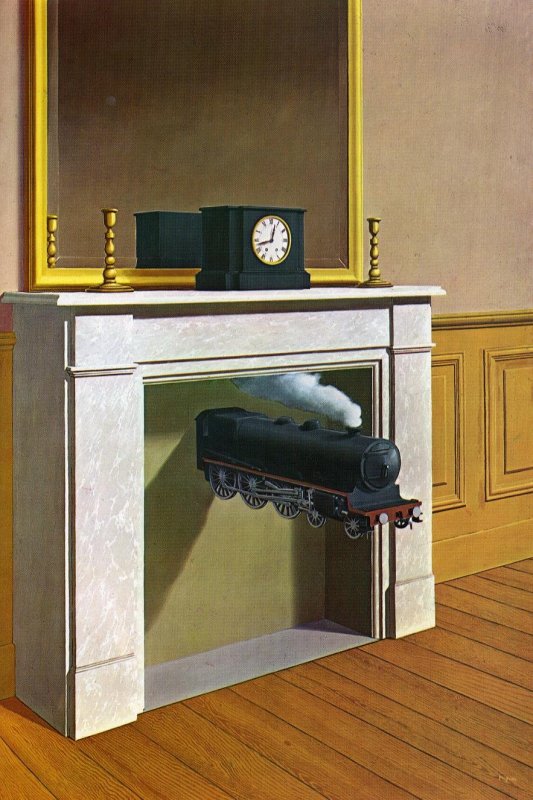
I’ve read a couple of pieces about AM Radio, but I haven’t heard him discuss his influences. I would say that his installations give more than a nod in the direction of surrealism, particularly the work of René Magritte. Doorways, windows, locomotives, are all recurring themes.

(As an aside, I vaguely remember seeing somewhere that someone had created an avatar with an apple for a face, after Magritte’s famous image. If I only imagined that, and no one has actually done it, I want to claim credit for the idea right now).

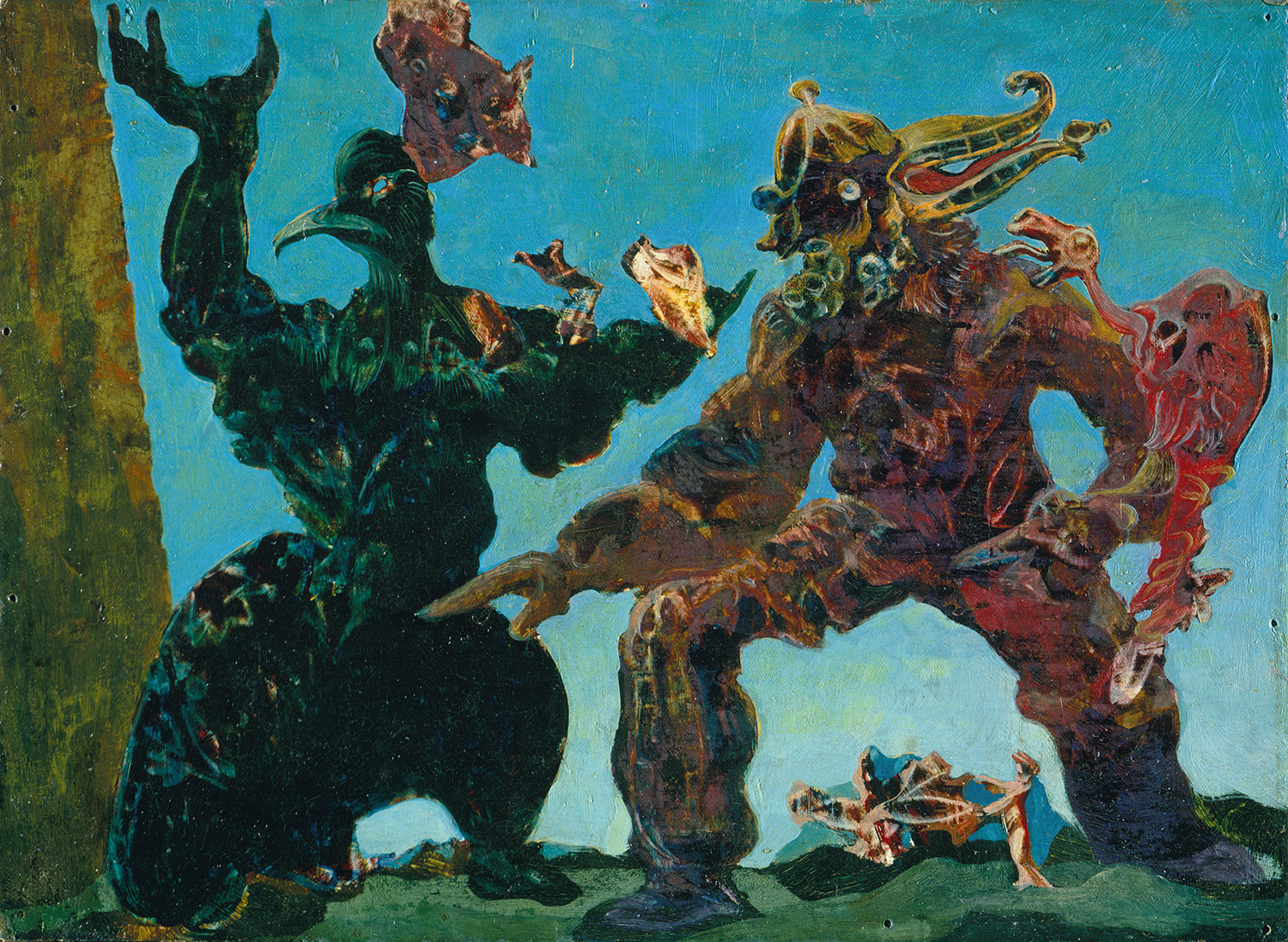
I like AM’s stuff, though I find it mostly intriguing rather than unsettling in the way that the best surrealist works are. I think the Second Life aesthetic is too clean to really invoke that dream/nightmare feeling that you get from someone like Max Ernst.

My favourite is probably the “Lost Highway” segment of “The Space Between these Trees“:

space01

Doors again. The Doors of Perception perhaps. I should drop some mescaline next time I log on, I might get more of a nightmare thing going.

Like tears in rain

After my last two posts I had to dig out my copy of Blade Runner to see if it was as good as I remembered. Now I’m getting older the themes of identity and mortality are probably a bit more relevant than they were in the past, which may go some way towards explaining why the film seems to be more profound every time I watch it.

During the climatic rooftop scene, where the android Batty is mourning the ephemeral nature of his memories, I found myself thinking that, if he wanted to preserve his experience for posterity, what he needed was a blog, or, even better, a Twitter account:

roybatty I’m watching attack ships on fire off the shoulder of Orion. 2 minutes ago

I’d be the first to admit that my blogging is at least partially motivated by a desire to leave some permanent trace of my existence. It’s the equivalant of stone-age man leaving hand prints on a cave wall; perhaps future archeologists will be as puzzled by the significance of my random jottings as we are by the daubings that were the social media of our Neolithic forebears:

Grod @Zoug I can has mammothburger? 12000 years ago

Bötterdämmerung

… would have been a much better title for my last post, come to think of it.

I first saw Blade Runner during its original cinema run back in 1982, around the same time as I was reading all the early William Gibson stuff, and it had a similarly profound effect on my emerging aesthetic consciousness. Functional hi-tech amidst a crumbling cityscape has been my idea of what the future holds ever since, and it’s always seemed quite attractive. What with the depression, and global climate change, and the decline of the Western powers, it’s just about possible to imagine that Los Angeles in 2019 will look pretty much like it does in Ridley Scott’s movie, though maybe without the flying cars, and hopefully without the killer robots on the loose.

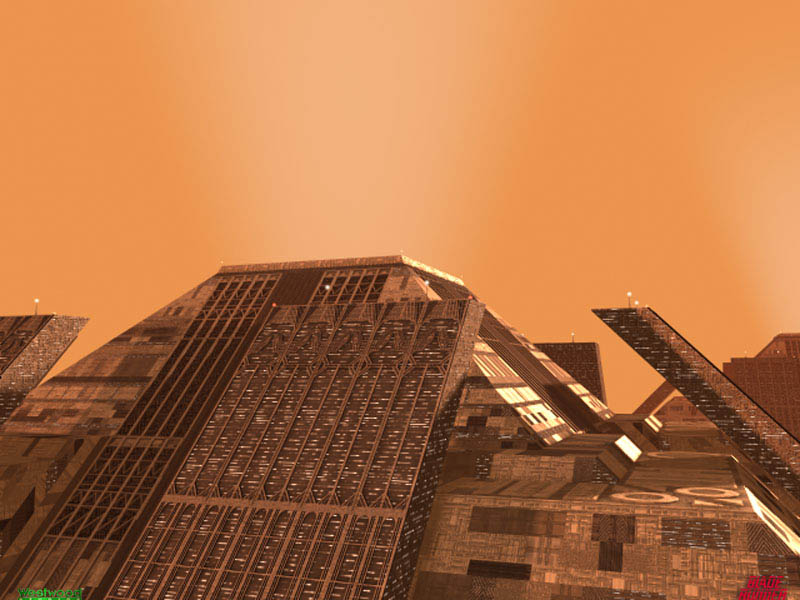
There is a Bladerunner City in SL, but the architecture on display owes more to the ziggurats of the Tyrell Corporation than the run-down streets of future LA which, for me, are the most visually pleasing element of the film. The owners of the sim are evidently interested in transhumanism; the welcome notecard at the entrance gives a brief history of the idea, from Dante to Huxley. I got the impression that they would prefer Roy Batty (surely the least threateningly-named homicidal android ever) to the crumpled Rick Deckard, though of course (spoiler alert) it turns out that Deckard’s human frailty is actually a more perfect realisation of the replicant-maker’s craft than Batty’s superhuman abilities (or not, it depends which version you watch).

I can’t say that I am familiar enough with the various strands of transhumanism to have a firm opinion about it; I do believe that technology changes who we are as humans, but I think that that process does not operate on the level of the individual, but rather is mediated through the changes in social organisation that accompany advances in science. To take the internet as an example, it is only now that we are working out how to use it in a social way, with things like Facebook, and blogs, and even Second Life, that the full civilisation-changing potential of the medium is becoming apparent. Maybe one day we will all be dreaming of electric sheep.

Twilight of the Replicants

Linden Labs have announced a ban on the use of traffic bots, those vacant souls you see hanging around shops or clubs, who are even less friendly than normal residents. This should return some measure of reality to the traffic statistics, as well as reducing strain on the servers, though it will also presumably make the concurrency figures look a bit less impressive.

The Labs are saying that other bots are safe for now, but this move will have set our artificial “friends” on alert, and even now they are probably organising themselves into clandestine cells, ready for the bot-wars to come. We’ll be forced to hunt them down and “retire” them, one by one, before they use their superior intelligence, strength and social skills to overthrow their human masters and reduce us to slavery.

We’re going to need some reliable way of differentiating bots from humans. I’ve been working on a psychological test that involves staring into the subject’s eyes, while telling them a story about a helpless tortoise. It’s pretty reliable, if a bit slow.

Neighbours, friends, even family – anyone you know could turn out to be a bot, just waiting for the chance to wrap their legs around your neck, break all your fingers, gouge your eyes out, or all three. If you’re concerned, just give us a call here at SLS, and, for a reasonable fee, we’ll send one of our operatives around to do the test, and take the necessary action.

We’ve made our match – and now it’s our problem.

Gimme Gimme Shock Treatment

Bloomberg are reporting that Taser International Inc. have filed a trademark-infringement lawsuit against Linden Labs, alleging that the sale of virtual copies of the corporation’s stun-guns in Second Life is damaging the firm’s reputation.

What’s interesting about this is that it is Linden Labs that is being sued, rather than the creators of the knock-off weaponry. Anyone who has ever shopped in SL will know that there are plenty of fake Gucci bags and other designer merchandise in circulation, but until recently there has been little incentive for trademark owners to go after the counterfeiters, since the chances were that they wouldn’t have enough money to pay any substantial damages.

That’s all changed now that Linden Labs has taken over XStreet, and, as Tateru Nino notes in her coverage of the case over at Massively, effectively become the retailer of the dodgy goods. Suddenly the lawyers have a profitable corporation in their sights instead of some penniless hackers, a corporation that will probably settle out of court to avoid the nuisance of ongoing litigation.

This could open up a whole new career path for SL entrepreneurs; virtual patent troll.

Whatever, here at SLS we’re still happy, happy, happy, all the time.

Career Opportunities

Further to my last post, I’ve been doing some calculations based on the figures in M Linden’s “State of the Economy” report.

The survey quoted had 2645 responses, which is said to be 15% of business owners, so the total number of enterprises must be 17633. Of these, 64%, or 11285, report that they generate positive net income – 52% generate up to 20% of their total income from Second Life, 5% generate 20-40%, 2% generate 40-60% and 5% generate 80-100%.

If I was a statistician I could probably use this data, along with the US$100 million cashed out figure, to construct a model that would show how many people were earning the big bucks, but I’m not, so I’ll just engage in some idle speculation.

Let’s generously assume that when M says that “a good part of [the US$100 million goes] into Residents’ pockets”, he means that half of it does. That’s US$50 million split 11285 ways, or an average of US$4430 plus change each. But clearly some people are creaming off more than others. We don’t know what the top 5% (of the whole 17633) are earning, but, for the sake of the argument, let’s say they are fairly modest types, for whom US$50K is a good living, so the 881 of them collectively take home a little over US$44 million, or just about the whole pot. If we lump together the 7% (1234) who are getting 20-60% of their income (nobody seems to get 60-80%) and say they average US$15K, then that’s another US$18.5 million, which leaves less than nothing for the bottom 52%.

Of course statistics can be made to prove anything, especially when you just make up the figures like I have, but I would argue that, if anything, I have been too optimistic (from the point of view of a potential SL entrepreneur) in my assumptions. About a year ago Hamlet Au at New World Notes calculated that land fees added up to US$6 million a month, plus more for land sales, so it seems likely that much more than half of the US$100 million that is cashed out goes straight back to Linden Labs. In a more recent article Hamlet noted that a few of the top-grossing businesses were taking out more than a million US$ annually, so even in the top 881 there must be a heavy skew, with a handful of big earners and a mass of also-rans, and in the lower reaches of the economy the average income can’t be much above double figures.

None of this is necessarily a problem – I’m sure that most business owners see their SL enterprise as a self-financing hobby, and won’t lose too much sleep if it doesn’t make them rich. Linden Labs should perhaps embrace this spirit, instead of continuing to peddle the myth that there is serious money to be made (by people other than themselves that is). Statements like “In the current real-world economic climate, I think the additional income generated from a business in Second Life must be a welcome addition to our Residents’ personal budgets” (from M’s report) look at best ridiculous, and at worst dishonest.

Still, I guess “SL entrepreneur” just about beats making tea at the BBC.