(Don’t) Gimme Gimme Shock Treatment

Asia is far ahead of the West in the recognition and treatment of internet addiction. While we agonise over whether the condition exists at all, the authorities in the East are already taking action; the South Korean government has made tackling cyberaddiction a national health priority, and the splendidly-named Chinese Teenager Mental Growth Base of the General Hospital of the Beijing Military Area Command of the PLA has issued guidelines on “Preventing Network Addiction at Home” (to be read in conjunction with “Basic Principles for A Harmonious Family”).

Unfortunately I have been unable to track down a translated version of the Chinese guidelines, so I don’t know what they recommend, but apparently the treatment options don’t include electroshock therapy, since the Chinese Ministry of Health has just ordered a clinic in Shandong province to stop using the method to discourage teenagers from spending too much time on the net. As a report in the Wall Street Journal notes, the efficacy of the treatment was called into question by the fact that disgruntled ex-patients had chosen to register their dissatisfaction with the clinic by setting up an online protest group.

I do believe that internet addiction exists, though I think it is more useful to conceptualise it as an impulse control disorder than an addiction as such. In my, fairly limited, experience of managing the condition CBT is the treatment of choice, along with pharmacological therapy for any co-morbid mood or anxiety disorder.

I’m not sure that everyone would agree with that though…

No man is an island

A curious tale has been rippling across the surface of the Second Life blogosphere over the last few weeks; to some it is an awful tragedy, to others a monstrous hoax, but ultimately perhaps it serves best as an opportunity to reflect on the essentially solipsistic nature of life in the metaverse.

The facts, such as they are, concern Rheta Shan, a well-known name around the grid, well-known enough at least that even a semi-engaged observer like me had heard of her. I had come across her essay “The World Philip Made” last year, when I was trying to work out whether I was an immersionist or an augmentationist; it was often cited as an important contribution to that debate. I subsequently discovered that she was also celebrated for her coding skills, producing an award-winning alternative SL viewer, and she seems to have been well thought of by those who had regular contact with her.

Rheta stopped logging on to SL at the end of March; nothing was heard of her until mid-May, when a post on her blog, apparently authored by a friend, conveyed the news that Valérie, as she was known in real life, had been killed in a road accident a few weeks previously.

Such events, while undoubtedly tragic for the close associates of those involved, are sadly inevitable; if we take the population of regular SL users to be about one million, and assume that they are mostly aged 16-29 and living in developed countries, then we can expect around 700 deaths every year, or about 2 each day.

The announcement of Rheta’s death triggered a variety of responses; on the one hand there were heartfelt tributes from those who knew her, and more than a few who had never encountered her but were moved by the story; but there was also some scepticism, articulated most clearly in Prokofy Neva’sOpen Letter to Rheta Shan“, wherein, in his inimitable style, SL’s premier contrarian accuses Rheta not only of being alive, but of not being a woman, on the somewhat flimsy grounds that “women don’t code viewers like the one that [won the] contest”.

These reactions, of sympathy and hostility, may seem to be diametrically opposed, but they share a common thread; they are not concerned with the reality of Valérie’s life and death, but rather use “Rheta” as a screen upon which can be projected the preoccupations of the writer. For Thdast Schwarzman, Rheta’s SL partner, it is the opportunity to experience the intensity of love and loss, for Prok it is the chance to burnish his reputation as a controversial free-thinker, for the others it may be a more or less conscious desire to be part of something that appears to have an emotional depth not often encountered in day-to-day life, on or off the grid. For me, Valérie/Rheta is just a convenient peg that I can hang this post on, though in my defence I would say that I am aware enough of what is going on to feel some degree of guilt about it.

Ultimately all our relationships are exploitative in this way; even in real life we don’t truly interact with other people, but only with our internalised representations of them. Everyone you know is just an object in your private world, an actor in a drama that has meaning just for you, with a character that may or may not correspond to what they would see as their “real” selves. Second Life throws this process into sharp relief; however much we want to believe there is a living world out there in the ether, nearly everything of psychological significance happens on our own side of the screen. When someone from that world disappears we mourn; but what we are really mourning is the loss of the part of ourselves that was projected on to the departed. It’s not so obvious in the real world, but it is true nevertheless; in the final analysis all grief is despair at our own mortality. John Donne was right when he warned us to never send to know for whom the bells tolls; it tolls for thee.

[Update: read this clarification.]

Do boys make passes at avatars with glasses?

The papers this week have been reporting the results of a study done at King’s College in London, which apparently shows that intelligent women have more satisfying sexual relationships. The headlines, which have all been some variation on “Smart girls have better sex”, are actually misleading, since the measure in question is not global intelligence, but the rather different concept of emotional intelligence. The findings are not really very surprising; one would expect people who score highly on a scale designed to measure, among other things, the ability to manage the emotional aspects of interpersonal relationships to also do well in areas of life that benefit from such skills.

What I found more interesting was that many of the publications that carried this story chose to illustrate it in the same way; with a picture of an attractive young woman wearing glasses (though some were more subtle than others). The use of spectacles as a visual shorthand for cleverness is well established of course, but the image also conjures up another potent male fantasy; that of uninhibited sexuality lurking beneath a prim exterior. This owes its popularity to its ability to contain the threat to the male ego presented by articulate, confident, intelligent women by reducing them to objects of sexual desire – or, if you want to be a bit more analytical, it can be seen as a reaction to the feminising/emasculating effects of civilisation, as represented by, say, librarians. The use of this archetype, as well as the general tone of the reporting, turns the message of the study on its head; instead of worrying male readers by suggesting they are not the most important factor in their partners’ sexual pleasure, it reassures them that those scary brainy chicks are really just sex kittens at heart.

I haven’t seen a lot of girls with glasses in Second Life – but then “repressed sexuality” doesn’t inform too many avatars’ wardrobe choices, female or male. Olivia has a nice set of frames, but she tends only to wear them when she wants to look serious in a photograph. I’ll have to ask her if she gets more attention, and what kind of attention, when she’s got them on.

Unrewarded talent

In a thread over at Metaversally Speaking headed (surely ironically) “Entitlement”, various luminaries of the SL fashion scene muse once again on the inexplicable reluctance of the public to pay more than token sums for their virtual creations. The problem is identified as an unwarranted sense of “entitlement” among consumers, who fail to recognise the importance of rewarding creative types handsomely, lest they take their talents elsewhere. Freebie culture is the villain of the piece; the remedies suggested include a price-fixing fashionista cartel, and state (or Linden) intervention to maintain price stability. (Regular readers will recall that I have my own theory about the determinants of value in SL; if you don’t like that one then I’ve got another).

I might find all this a little less ridiculous if I believed that the distressed designers were the sort to visit their local farmers’ market rather than Wal-Mart, drink nothing but fair-trade coffee, and make sure that their clothes don’t come from sweatshops. Maybe they are, but I can’t help thinking that the these virtual entrepreneurs are more likely to be the type who worship the free-market (except of course when it works against their interests).

There is also some irony in the fact that virtual worlds like Second Life could never have come into existence without the collapse in hardware costs over the last decade, which in turn has depended on wholesale exploitation of workers in developing countries. If the SL fashion crowd want to know about being inadequately rewarded for their labour they should talk to the people who inhale toxic fumes in Chinese factories while producing the cheap computers, routers and flat screens that we in the west feel “entitled” to.

It all raises the question of why people are getting so bothered about something that seems fairly inconsequential. The figures from the Lindens, backed up by a survey reported in the Herald last week, show that only a very few people are earning more than a pittance from virtual commerce, so it’s not as if anyone’s livelihood is at stake.

What is at stake is self-image. Are you really a fashion designer, or are you just playing the part of one in a game? If you’re happy to accept that it’s all just role-play, then the in-game pay-off of L$ and attention from other players will be reward enough. If however part of your real-life identity is invested in your virtual activity, then you will want something more tangible, like crisp US$ bills, that you can show to your friends to convince them, and of course yourself, that your Second Life status is actually worth something in the world beyond the SL blogosphere.

When the material recognition of your virtual talent is unforthcoming, as it generally is, you have two choices – you can get angry with the world for failing to give you due respect, or, more productively, you can reassess your goals, ask yourself if it’s really worth getting so bothered about a game, and redirect your energy into something that is more likely to make you happy.

Ferrisburg, Vermont

Award-winning Second Life artist AM Radio has a new work, “The Red and the Wild” on display at the Institute for Digital Intermedia Arts.

An empty house and a steam locomotive float eerily on the surface of a shallow sea. A dynamic red mass surges out of, or perhaps into, the upper storey of the building, exploding over the landscape. Cables radiate out from the house, leading to boxes containing mysterious artefacts. In the distance stands a row of water towers, brooding over the horizon.

red-wild01

What does it all mean? In a Freudian analysis, a house would symbolise the human body, the open window suggesting a female form, while the locomotive and the water towers seem clearly phallic. The scarlet substance may be blood, or perhaps a representation of energy of some kind. Is it emanating from the building, or penetrating it? Are we witnessing an escape, or an intrusion?

I may be over-analysing this. Mr Radio, in the interviews he has given about the piece, says it was inspired in part by “Breakfast at Tiffany’s“, where Holly Golightly visualises her anxiety as a “mean red”. He also mentions that the house is based on one that he remembers from childhood. Looking inside the building reveals that the red has its origin in what looks like a crystal radio set. So maybe there is a message about containing anxiety by constructing your own reality/identity, something that Second Life is well suited to.

Or not. The ambiguity of the piece is a large part of its attraction. It’s like a Rorschach ink blot. My sexualised interpretation tells you more about me than it does about the artist or the work.

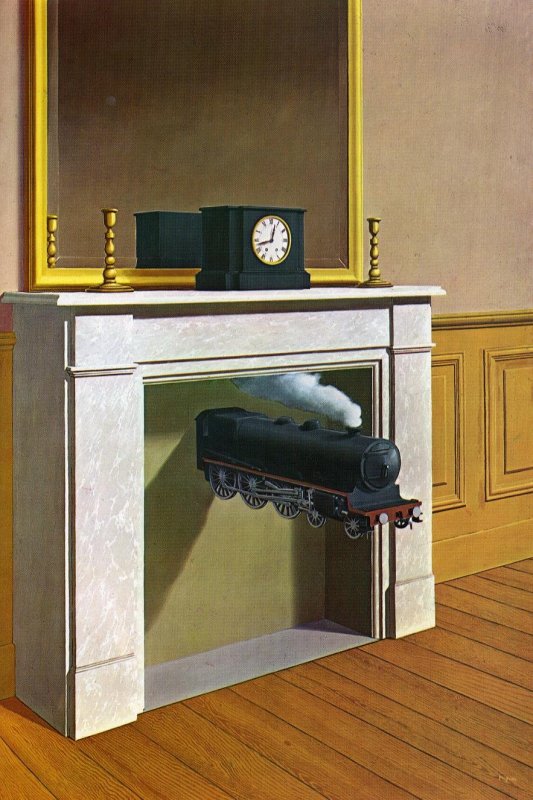
I’ve read a couple of pieces about AM Radio, but I haven’t heard him discuss his influences. I would say that his installations give more than a nod in the direction of surrealism, particularly the work of René Magritte. Doorways, windows, locomotives, are all recurring themes.

(As an aside, I vaguely remember seeing somewhere that someone had created an avatar with an apple for a face, after Magritte’s famous image. If I only imagined that, and no one has actually done it, I want to claim credit for the idea right now).

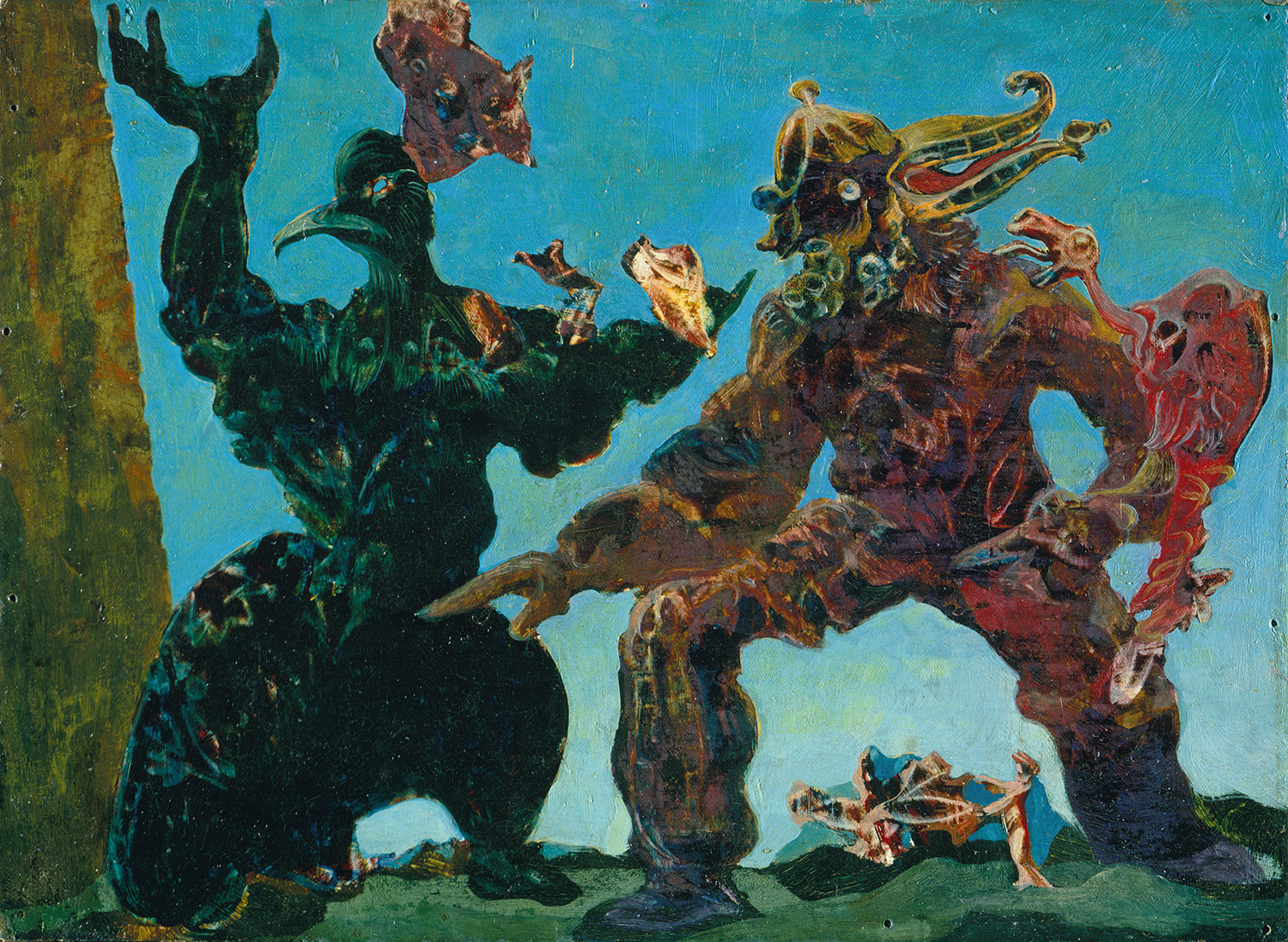
I like AM’s stuff, though I find it mostly intriguing rather than unsettling in the way that the best surrealist works are. I think the Second Life aesthetic is too clean to really invoke that dream/nightmare feeling that you get from someone like Max Ernst.

My favourite is probably the “Lost Highway” segment of “The Space Between these Trees“:

space01

Doors again. The Doors of Perception perhaps. I should drop some mescaline next time I log on, I might get more of a nightmare thing going.

Like tears in rain

After my last two posts I had to dig out my copy of Blade Runner to see if it was as good as I remembered. Now I’m getting older the themes of identity and mortality are probably a bit more relevant than they were in the past, which may go some way towards explaining why the film seems to be more profound every time I watch it.

During the climatic rooftop scene, where the android Batty is mourning the ephemeral nature of his memories, I found myself thinking that, if he wanted to preserve his experience for posterity, what he needed was a blog, or, even better, a Twitter account:

roybatty I’m watching attack ships on fire off the shoulder of Orion. 2 minutes ago

I’d be the first to admit that my blogging is at least partially motivated by a desire to leave some permanent trace of my existence. It’s the equivalant of stone-age man leaving hand prints on a cave wall; perhaps future archeologists will be as puzzled by the significance of my random jottings as we are by the daubings that were the social media of our Neolithic forebears:

Grod @Zoug I can has mammothburger? 12000 years ago

Bötterdämmerung

… would have been a much better title for my last post, come to think of it.

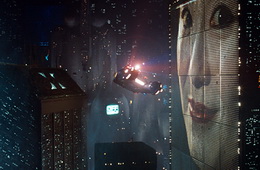
I first saw Blade Runner during its original cinema run back in 1982, around the same time as I was reading all the early William Gibson stuff, and it had a similarly profound effect on my emerging aesthetic consciousness. Functional hi-tech amidst a crumbling cityscape has been my idea of what the future holds ever since, and it’s always seemed quite attractive. What with the depression, and global climate change, and the decline of the Western powers, it’s just about possible to imagine that Los Angeles in 2019 will look pretty much like it does in Ridley Scott’s movie, though maybe without the flying cars, and hopefully without the killer robots on the loose.

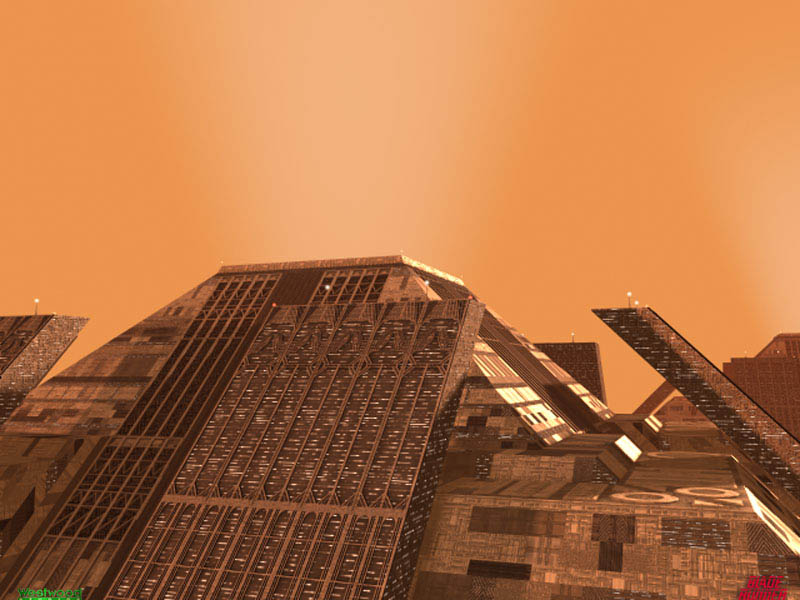
There is a Bladerunner City in SL, but the architecture on display owes more to the ziggurats of the Tyrell Corporation than the run-down streets of future LA which, for me, are the most visually pleasing element of the film. The owners of the sim are evidently interested in transhumanism; the welcome notecard at the entrance gives a brief history of the idea, from Dante to Huxley. I got the impression that they would prefer Roy Batty (surely the least threateningly-named homicidal android ever) to the crumpled Rick Deckard, though of course (spoiler alert) it turns out that Deckard’s human frailty is actually a more perfect realisation of the replicant-maker’s craft than Batty’s superhuman abilities (or not, it depends which version you watch).

I can’t say that I am familiar enough with the various strands of transhumanism to have a firm opinion about it; I do believe that technology changes who we are as humans, but I think that that process does not operate on the level of the individual, but rather is mediated through the changes in social organisation that accompany advances in science. To take the internet as an example, it is only now that we are working out how to use it in a social way, with things like Facebook, and blogs, and even Second Life, that the full civilisation-changing potential of the medium is becoming apparent. Maybe one day we will all be dreaming of electric sheep.

Twilight of the Replicants

Linden Labs have announced a ban on the use of traffic bots, those vacant souls you see hanging around shops or clubs, who are even less friendly than normal residents. This should return some measure of reality to the traffic statistics, as well as reducing strain on the servers, though it will also presumably make the concurrency figures look a bit less impressive.

The Labs are saying that other bots are safe for now, but this move will have set our artificial “friends” on alert, and even now they are probably organising themselves into clandestine cells, ready for the bot-wars to come. We’ll be forced to hunt them down and “retire” them, one by one, before they use their superior intelligence, strength and social skills to overthrow their human masters and reduce us to slavery.

We’re going to need some reliable way of differentiating bots from humans. I’ve been working on a psychological test that involves staring into the subject’s eyes, while telling them a story about a helpless tortoise. It’s pretty reliable, if a bit slow.

Neighbours, friends, even family – anyone you know could turn out to be a bot, just waiting for the chance to wrap their legs around your neck, break all your fingers, gouge your eyes out, or all three. If you’re concerned, just give us a call here at SLS, and, for a reasonable fee, we’ll send one of our operatives around to do the test, and take the necessary action.

We’ve made our match – and now it’s our problem.

Aspects of intimacy

Legendary Charisma, over at Metaversally Speaking, the (virtual) world’s most popular blog, has been running a series of articles on the ins and outs, so to speak, of cybersex. It’s been quite entertaining, if rather psychologically unsophisticated, focusing more on the mechanics than the deeper meaning; just like high-school sex-education in fact. This week’s column features the counter-intuitive assertion that the quality of cybersex can be improved by familiarity with the real-life characteristics of one’s partner. I couldn’t let that pass without comment; you can read the discussion here.

In other intimacy news, researchers in the Highlands have developed a system which allows geographically-separated lovers to caress each other’s bodies using beams of light. This seems a much more promising way of communicating real feelings than interacting in Second Life; it’s directly sensual and avoids all the cerebral processing inherent in text-based liasons. All sorts of conscious and unconscious confusion can occur once the higher brain functions are engaged.

Plunging Necklines

Nosferatu-fever seems to be everywhere these days, what with True Blood, and Twilight, and of course Bloodlines, so I thought I would try to try to secure my very own Interview with the Vampire.

I got myself a nice Mina Harker-style dress, dyed my hair jet-black and headed off in search of some blood-suckers:

vampire02

[Dress, boots and accessories from Crimson Shadow, graveyard at Vampire City.]

Typing “vampire” into the in-world search threw up a few leads. The first couple of places I visited turned out to be undead-themed combat sims (as far as I could tell, since the welcome notes I got were in Portuguese), and I also came across several gothic clothing stores, but I eventually got lucky and landed up at the home base of one of the larger Bloodlines clans.

Half a dozen or so tall, dark, caped figures were gathered in the courtyard of a Medieval-style castle. They seemed to be waiting for something to happen, so I went over to take a look. I wasn’t sure about vampire etiquette, so I didn’t say anything at first, but after five minutes of silent inactivity I decided to break the ice.

“Are they going to like, fight, or something?” I asked the man standing next to me, gesturing towards the two heavily-armed figures at the centre of the group, who appeared to be squaring-up to one another. “I don’t know,” he replied, turning to face me. He reminded me of Christopher Lambert in Highlander 3, his trench-coat accessorised with a samauri sword. We got chatting, and he told me he had been in the clan for just a few days, having previously been a Gorean slave-master. “I got bored with all the submissiveness” he said, making me wonder what his expectations of that role had been, “so I decided to get back to my vampire roots.” “You prefer the assertive vampire girls then?” I asked, trying to sound flirtatious, but he wanted to tell me about how far he’d progressed in the vampire fighting ranks, and we ended up talking about our experiences playing D&D, which killed the moment a bit.

I had been led to believe that these Bloodlines fanatics would leap at a girl’s throat at the drop of a hat, so I was a little offended that the crowd seemed more interested in the non-existent fight than me. The awkward silence was broken by the arrival of a junior member of the clan, accompanied by a girl in a decidedly non-gothic spotty dress, who was evidently a new recruit.

One of the combatants, who turned out to be the head of the clan, broke off from the staring contest, or whatever it was, to greet the newcomers. After some small talk it was decided that we should all head off to the Turning Chamber for the Initiation Ceremony. I asked the new girl if she minded me tagging along, and she was cool with that, so I followed the others into the castle.

Now I don’t know what springs to your mind when you hear the words “Vampire Initiation Ceremony”, but I think of vintage Dracula flicks, where louche ghouls overwhelm swooning maidens in scenes of barely repressed sensuality, or, if I’m feeling particularly excitable, Catherine Deneuve and Susan Sarandon in The Hunger. At the very least I was expecting some sort of occult ritual, with a soundtrack of sinister Latin chanting.

You may imagine my disappointment then, when I discovered that the Turning Chamber resembled nothing more than a brightly-lit pub basement. The barrels that lined the walls were full of blood rather than beer, but the ambiance was definitely more functional than spooky. The focus of the room was not some unholy altar dripping with virginal blood, but a vending machine dispensing various Bloodlines products. After instructing the convert to buy several items (which cost about L$1000) the clan chief departed, leaving the actual biting to his minions. They didn’t seem to know what they were doing, and it took an age of searching in inventories and unpacking boxes, during which the poor girl had to log out and log in again twice, before her lifeblood finally began to drain away, very slowly. I asked Christopher Lambert how long this was going to take. “I don’t know, this is my first one” he said.

I chatted with the new vampire girl while we waited. What had attracted her to the blood-sucking lifestyle? The fashion sense and the romance it seemed. She was hoping it would get a bit better.

Christopher eventually got round to asking me if I would like to join the clan too, but I politely declined. If I ever give up my virtual soul I want it to be more meaningful than a cold transaction in a characterless cellar. The rich symbolism of the vampire myth deserves more respect.

(I know it’s unfair to dismiss Second Life Vampire culture based on a brief visit to one sim, so I’m open to suggestions of places I should visit for a more satisfying experience. Post them to mail@secondlifeshrink.com, and I’ll review them in a future post, if they’re any good).