Comic archetypes

Back in what seem like the mists of time, but in fact just the early 90’s, I was fortunate enough to have a well-paid job and practically no responsibilities, allowing me to take numerous extended vacations, several of which I spent touring around the US. I tended to travel quickly, too quickly in retrospect, which allowed me to cover a lot of ground (I think I managed 28 of the contiguous states, plus DC), but not really get to know anywhere well. I found myself in a near-continuous state of dislocation, and consequently latched on to anything that could give me some sense of stability. In every new city I would purchase a newspaper and turn to the comics page, one thing I could depend on to be more or less constant no matter where I went.

There isn’t really a tradition of serial comic strips in the serious papers here, so I thought no more of these stories until a couple of years ago, when I began following them again, courtesy of the excellent online comic page at the Houston Chronicle. I’ll admit that my original motivation for this was to be able to better enjoy the snarky (and very funny) commentary over at The Comics Curmudgeon, but as time has passed I have come to appreciate the qualities of a good serial narrative in their own right. I particularly like the slow pace of the comics page, where the events of one afternoon can be spun out over months of three-panel strips, providing a calming antidote to the frenetic tempo of modern culture. Of course the politics, particularly on gender issues, of most of the strips seems to have been frozen around 1952, but I guess that just contributes to the ironic charm.

Conservative they may be, but the traditional serials can still serve up surprises. Just this week, for example, we discovered that Mary Worth is a Jungian. I can’t say that I saw that coming.

On the unreliability of memory

There is a lot to be said for the traditional summer break of the professional middle classes; decamping from the hot, busy city to a quiet rural retreat, there to enjoy the simple peasant lifestyle. Of course I am referring to that fantasy peasant lifestyle that involves loafing around, consuming copious quantities of artisanal foodstuff and quaffing the local intoxicant, rather than any actual peasant lifestyle of unremitting toil, but it’s nice to imagine that one is getting back in touch with the slower pace of life enjoyed by our forefathers.

I always come back from my summer holiday determined to escape the rat race by finally getting down to writing the classic novel that I am convinced dwells within me. For a couple of weeks I spend my lunchtimes in the coffee shop tapping at my laptop, then life starts to intrude, and my grand projects fade away for another year.

In some ways it’s reassuring that my life is interesting enough that I don’t really have time to devote to literary endeavour, but it’s also a little frustrating to think that with some more application I could produce something a bit more impressive than this blog.

A few times in the last year, most recently just a couple of months ago, I’ve resolved to post less about Second Life, and more about interesting things, like politics, or literature, or music, but every time I seem to have found myself coming back to commenting about the virtual world. I think there’s some avoidance going on on my part; it’s easier to recycle the same old stuff about SL than take a chance on trying something new.

I spent several evenings last week reading my old copies of American Splendor, and thinking that, if Harvey Pekar could get it together to present slices of his life experience to the world back in the 70’s, when self-publishing was a real challenge, I should be able to do something more productive with this space, with which, in theory at least, I could reach a worldwide audience of millions with a couple of clicks of a mouse.

I have over the years posted a few vaguely Pekaresque pieces (mostly tagged “Nostalgia”), but I find it hard to be completely accurate in my recollection. It’s not that I actively make stuff up – the basic facts are all there – but when I try to reconstruct the subjective elements, like the emotions and motivations that were associated with these past events, I can’t help but be aware that my memories will have been extensively edited by my unconscious in the light of my subsequent life experience. I can’t put myself back into the mind of my past self, only the mind of my present self thinking about the past, and I know that means that what seem like solid memories are really projections of my current preoccupations woven out of carefully selected snippets of history.

The drive is to create a narrative, to give meaning to what, on more objective analysis, I would have to admit was an essentially random existence. Like an author foreshadowing significant events in a story, I give weight to certain memories, while suppressing others, to convince myself that my current situation is a point on a consciously planned journey, rather than the culmination of a series of individually insignificant choices that have gradually limited my options in ways I can only vaguely grasp.

Does it matter that my thoughts about the past may not entirely correspond with reality? Human memory is not a simple recording device; it is a dynamic psychological tool that allows us to adapt to the present and anticipate the future by utilising our processed experience. Excessive verisimilitude in our recollections can get in the way of efficient functioning, and a little mnemonic creativity is essential to our continued sanity.

One way to conceptualise the self is to see it as, at any given moment, the sum of the biographical memories that seem relevant to our present circumstances, the story we tell ourselves about who we are. We take the continuity of our self as a given, but our memory of who we were yesterday is under the control of our present selves, and we may distort it to preserve the illusion of stable identity. Of course we can observe that other people seem more or less the same from day to day, which may reassure us that we don’t change much either, but there is always the suspicion that the unconscious is our own personal Ministry of Truth.

Anyway, the conclusion that I draw from all this is that the past is gone and probably wasn’t how I remembered it anyhow, the future is uncertain and will take care of itself, and the best thing to do is just live in the now. I guess that’s why I never manage to get anything done. Maybe I should give up on the literary pretensions, and start writing self-help books instead.

Après le déluge

Having spent rather too much time over the last few days reading all the web has to offer on the subject of the Linden layoffs, I can report that the consensus view is somewhat downbeat. If blogger opinion is at all authoritative (and what reason is there to distrust the gaggle of ill-informed scribblers who make up the SL chatterati?) the future of the grid is grim indeed.

I am inclined to agree with this viewpoint; M Linden may talk of a carefully planned reorganisation, but I’m sure such restructuring would be best carried out by quiet redeployment and natural wastage, especially if, as M claims, there was no financial pressure driving the cuts. Instead we have had a headline-grabbing massacre which has spooked the very customers who M himself has identified as being key to the Lab’s revenue model. I can’t imagine that many people will be making long-term investments in Second Life until the smoke clears and the future of the platform looks more certain.

I find myself looking upon the prospect of Second Life‘s demise with a certain degree of equanimity though. As I have previously expressed, I believe that much of the attraction of metaversal life lies not in the rather mundane virtuality of the grid itself, but in the intellectual space of the community that has grown up around it. Perhaps that community will disperse if and when the world dies, but the years of Second Life‘s existence may just have been long enough to build a critical mass of text and links that will allow the spirit of SL to outlive its physical manifestation. Like the myths of Ancient Greece or the poems of Rimbaud, the Second Life experience will serve as an inspiration for future exploration of the mysteries of human consciousness.

Though probably not. Our attention spans attenuated by the onslaught of ubiquitous media, we’ll likely be blogging and tweeting about the next new shiny thing within minutes of Linden Lab pulling down the shutters. So it’s probably best to enjoy the ride while we can.

That gum you like is going to come back in style

I don’t look at the TV much these days, and I very rarely find myself following an episodic drama series. The last time I even partially got into a show was when I caught most of the first season of The Wire, which I quite liked, but the effort of committing myself to regular appointments with the box was too much, and I never made it past the first episode of season two.

I was thinking about this the other day when I read an article at the AV Club which considered the cultural impact of David Lynch’s cult 90’s series Twin Peaks. It reminded me not just of how slavishly I had followed that programme, but of the way that even left-field shows like Lynch‘s unsettling masterpiece could attract mass audiences at that time.

Compared with today it was both easier and harder for a show to be a big hit back then; easier because there was less competition for the audience’s attention – the UK had only four terrestrial channels to choose from, satellite and cable were niche products, and there was no internet – and harder because there was no way to see things other than by sitting down in front of the TV at a set time – no DVD box-sets, no Tivo, and no internet TV. We did have VHS recorders I guess, though the elderly model I had at the time was much too unreliable to trust with an unmissable event like that week’s Twin Peaks.

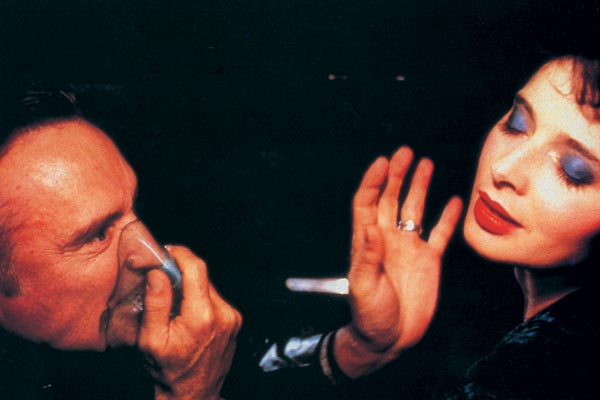
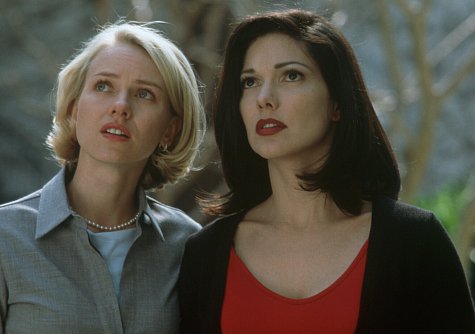
I had been a big David Lynch fan since I saw Eraserhead late one night on TV, and I’ve liked everything he’s done since (even Dune), especially Blue Velvet and Mulholland Drive (the latter is in the running for my favourite film of all time), so it was always likely I was going to be a Twin Peaks devotee, but what confirmed my addiction was the community that grew up around the show on campus. I was already hanging out with most of what became the Twin Peaks crowd, but we certainly bonded that little bit more over long evenings of coffee and cherry pie (actually, “coffee” and “cherry pie”) discussing our various theories of what the story was about. I’d like to say that we still get together every year to reminisce, but, with a couple of exceptions, I haven’t talked to any of those people in the best part of twenty years. Probably best to leave the memories undisturbed.

Anyway, the point that I’m meandering towards is that often what sticks with you about a cultural experience is not so much the event itself, but more the social connections that surrounded it. What’s changed since my Twin Peaks days is that, thanks to the wonder of the interwebs, it’s no longer necessary to be geographically co-located with your fellow fanatics to feel part of a community.

Certainly my experience over the last three years has been that, while it was the virtual eye-candy that initially pulled me into Second Life, what’s kept me around is the narrative that unfolds in the relationships between residents, played out partly in-world, but mostly in the SL blogosphere.

I don’t want to overstate the profundity of the SL storyline – it’s more potboiler than classic literature – but it’s diverting, harmless, and, best of all, it creates a pleasing illusion of interactivity. I can tell myself that I am involved in writing this tale, in my own small way, and that makes me just committed enough to stick with it through the many, many dull patches.

There’s an interesting paper by Wanenchak in the latest edition of Game Studies entitled Tags, Threads, and Frames: Toward a Synthesis of Interaction Ritual and Livejournal Roleplaying. It’s well worth reading in its entirety, but the part pertinent to this discussion is the brief review of Goffman‘s frame analysis as it applies to a collaborative online narrative:

… frames allow players to engage with the gameworld in such a way that their narrative construction and interactions become sensible to themselves and to each other.

What I find most fascinating about the Second Life narrative (and what I think gives it a claim to being a unique cultural phenomenon) is the fact that the frames that people are using are often unclear, shifting and overlapping. To put it in different terms, although they are operating in the same “gameworld”, which includes not just the SL grid but also the associated blogs, tweets and what have you, people are engaged with often wildly differing levels of immersion.

The effect of this is, more often than not, to render the meta-story unintelligible, but occasionally it all comes together to produce an instant of dream-like clarity that makes the whole project seem worthwhile. I would give some examples of this, but I suspect that, like real dreams, the beauty of these moments is highly subjective, and that any description I attempted would sound hopelessly prosaic.

Which brings us back to David Lynch. What I think he does better than any other director is capture the fractured reality of dreams and nightmares, in a way that is at once unsettling and beguiling. Sometimes – just sometimes – being part of the world of Second Life is like living in Twin Peaks.

Introducing the SLSBPI

There was an interesting post in the WordPress blog yesterday; you can follow the link if you want the details, but the essence of it is that Fortune has smiled upon one of our blogger brethren.

I reckon that this could be used as the basis of a one-item personality schedule for bloggers. Here’s the procedure:

  1. Ask the subject to carefully read the WordPress post, then study the blog to which it refers.
  2. Present them with this visual analogue scale:

    What is your predominant emotion at the present time?

    Vicariously Thrilled ————————— Bitterly Raging

  3. Score from -100 to 100, with 0 being the midpoint.

I scored +95. How about you?

Digital Death Day

Last Thursday was Digital Death Day, marked by a conference at the Computer History Museum in Mountain View, California. The event was a spin-off from the biannual Internet Identity Workshop, which is generally concerned with the technical and commercial aspects of online identity, rather than philosophical issues, and the DDD meeting was explicitly aimed at “Death Care Professionals … Estate Planners … [&} Death Attorneys” which would seem to indicate that the participants were inclined to grapple with practical matters rather than existential themes.

Nevertheless, even consideration of strictly material questions like the heritability of virtual assets and the ownership of online identity cannot help but make one think about the way that social media have influenced the experience of bereavement and grieving in the modern world. News reports of the death of a young person almost invariably mention friends and family paying virtual tribute to the deceased via Facebook or Twitter, and the concept of the social network page as a persistent memorial is well established. There is no doubt that this phenomenon can have a powerful emotional effect, as these personal accounts show.

Is this a healthy development? The persistent nature of an online presence can give mourners a chance to bid their farewells to the dead in their own time, reducing the trauma of a sudden departure. It also maintains the focus on the whole of the life that has been lived, rather than just on the death itself. All this can help give meaning to what might otherwise seem like a senseless tragedy, which in turn may aid the grieving process for those left behind.

This is perhaps not as new as we might think. In many ways it is a return a concept of death that our ancestors might have recognised, a communal experience, rather than a private matter for the immediate relatives of the deceased, after a century in which the end of life had been increasingly hidden away.

Of course it can also be argued that this process trivialises death and loss, that it is impossible to pay respectful tribute to the dead in 140 characters, that death has become just another commodified experience to be vicariously consumed. There is some truth in this – one can hardly deny that one’s reaction to the passing of someone that one has no real connection to will be driven more by one’s own internal dynamics than any genuine feeling for the deceased. (We explored this phenomenon in relation to Second Life in a previous post). On the other hand, expressions of sympathy from complete strangers, whatever their motivation, can be immensely comforting to the bereaved. At the most basic level they are an affirmation of our common humanity, a recognition that we are all bound together by our inevitable mortality, and it is that sense of solidarity that can carry us through our darkest hours.

Reality is overrated

Well, my sojourn in the real world turned out to be pretty depressing, sending me scurrying back to the synthetic succour of Second Life, to the comforting predictability of the rampant paranoia and gripes about the Lindens.

I guess that the new political situation will be taking up more of my real-life attention in the immediate future, but I’m going to try to keep it out of this blog, in favour of more inconsequential musings on SL culture and the like. I need to preserve a little oasis of fantasy in a world that looks set to become increasingly unforgiving.

Virtual Epiphany

I spent the best part of the weekend reading about the Woodbury saga on various blogs, until late on Sunday night, half-way through a particularly dense screed, I had a sudden Moment of Clarity. “Why,” I asked myself, “am I wasting my time with this nonsense?”

The really sad thing is that I have a good idea what the answer to that question is, as a result of one of the other Second Life-related projects that I am squandering my limited intellectual capital on, the psychological profiling of the typical SL resident. (I have a rough draft of this ready, but it may be some time before I get round to working it up into anything coherent enough to post, assuming I don’t get distracted in the meantime.)

Anyway, to shake this SL fever I’m going to take a break from obsessing about virtual events for a while, and pay a bit more attention to real life, specifically the election. The country may be standing on the verge of the biggest political realignment in a generation, which I guess will probably be of more lasting interest than the ephemera of Second Life.

Second Life demographics – a brief review

We received a rare response to our last piece, from T Linden himself no less. True, T had descended from Olympus to tell us that we were wrong about everything, but still, some attention is better than no attention.

Anyway, one part of his comment caught my eye – “Second Life is a diverse community”. This is a sentiment that is often heard around the SL blogosphere, but how true is it? I did a quick review of the literature to see if there was much evidence one way or the other.

There are three metaverse-related publications that I read regularly (or semi-regularly) – the Journal of Virtual Worlds Research, Cyberpsychology, Behavior, and Social Networking and Game Studies – but I couldn’t remember ever having seen a quantatative study focussing specifically on the demography of SL in these journals, and sure enough nothing turned up when I searched their archives. A further search through the biomedical, psychological and sociological databases that I have access to drew a similar blank. The closest thing to a scientific study on this topic that I could find is this piece of work presented back in 2007 on the SL Survey blog. The Second Life wiki does have a page entitled “Demographic Studies”, but this is marketing data rather than academic work.

There are quite a few studies that look at other MMORPGs; three that are often cited are Griffiths et al (2003) Breaking the Stereotype: The Case of Online Gaming, Griffiths et al (2004) Demographic Factors and Playing Variables in Online Computer Gaming and Yee (2006) The Demographics, Motivations and Derived Experiences of Users of Massively-Multiuser Online Graphical Environments. Yee’s study is particularly impressive, drawing on data gathered from over 30,000 players over 3 years in his epic Daedalus Project.

The earliest qualitative work that I’m aware of in this area are the case descriptions of MUD users (who were mostly also psychotherapy clients) in Sherry Turkle‘s 1995 book Life on the Screen. A work focussing more on interpersonal and group dynamics is John Suler‘s 1996 book The Psychology of Cyberspace, particularly the section covering his in-depth study of the early graphical MUD The Palace.

More recent qualitative studies include Yee (2006) Motivations for Play in Online Games, Bessière et al (2007) The Ideal Elf: Identity Exploration in World of Warcraft, Hussain and Griffiths (2009) The Attitudes, Feelings, and Experiences of Online Gamers: A Qualitative Analysis and Williams et al (2010) Behind the Avatar: The Patterns, Practices and Functions of Role Playing in MMOs. Good qualitative work dealing specifically with Second Life is harder to find; in fact I couldn’t find any at all. [Update: There is a good qualitative study; I had unaccountably overlooked Coming of Age in Second Life by anthropologist Tom Boellstorff.]

This brief review is not terribly systematic and certainly not comprehensive, but, having read these papers, as well as some of their references and citations, and a load of other work that I haven’t mentioned because it seemed only tangentially relevant, I feel I can hazard a qualified opinion on the question of diversity within the Second Life population, the qualification being that my impression is an overview based on a general familiarity with the source material rather than a rigorously evidence-based analysis.

SL residents may well vary along several dimensions, such as age, gender, nationality, education level and occupational status, but I suspect that a cluster analysis would resolve this seeming heterogenicity into a much smaller number of discrete groupings. Furthermore, I think that below this apparent diversity there may well be a large degree of psychological similarity; in other words, although residents may be different in terms of the demographic categories listed above, when one looks at their internal mental functioning they may have much more in common than one might expect.

If this last proposition is true then it should be possible to draw up a psychological profile of a typical Second Life resident, and to devise some sort of scale that would measure how likely it is that a subject would take to the SL experience, then see if that correlated with any particular personality types. I’m not aware that anyone has published any work like this, though I may well have overlooked it.

I’d be surprised if Linden Lab didn’t have a psychologist on their staff researching this kind of thing, since it would be very useful for marketing purposes, but I guess they wouldn’t want to put it into the public domain.

I have some ideas about the psychological features that one might expect to find in an average Second Life resident, and I’ll expand on these in a future post.

The Linden Principle

Towards the end of last year the BBC aired a documentary on the Great Banking Crisis of 2008, which featured various bankers, government ministers and officials recounting the emergency meetings where the decision was taken to nationalise large parts of the British financial system. The Royal Bank of Scotland, once one of the most successful institutions in the world, had, by late 2008, been reduced by an ill-advised expansion strategy to a virtual basket-case, and was only hours away from total collapse. Faced with the prospect of millions of citizens waking up to find their accounts frozen, the government called the RBS management into the Treasury to finalise the details of the deal that would eventually see the state acquire 84% of the bank. During the course of this meeting, officials realised that Fred Goodwin, RBS Chief Executive, seemed to have only the flimsiest grasp of the trouble his bank was in, believing that a modest cash injection would be enough to stabilise things. Goodwin retired shortly afterwards, with a generous pension, leaving the taxpayers to contemplate the lesson that, as Chancellor Alistair Darling ruefully noted, when it comes to running banks it’s a good idea to hire people who know what they are doing.

We tend to assume that, when someone reaches a position of responsibility, this must be as a result of some rational process that evaluated their competence for it. However we are often faced with evidence, like the poor decision making that led to the financial crisis, that contradicts this, and suggests that other, unknown factors must play a part in the selection of our leaders.

Laurence J. Peter, who died in 1990, is best known as the author of the Peter Principle, which states that “In a Hierarchy Every Employee Tends to Rise to His Level of Incompetence.” Workers who are good at their jobs are promoted until they are in a job they can’t do, at which point they get stuck. Since big organisations tend to find it difficult to get rid of people, eventually every position will be filled by someone who is incompetent to manage it.

I was thinking of all this when I read about Linden Lab’s latest marketing wheeze; an advertising campaign that seeks to dispel a supposed “Fat Naked Guy in a Basement Anti-Second Life Meme” by showcasing the attractive people behind selected avatars. This seems to me to be wrong-headed on so many levels that it does raise doubts about how well the Lab management understand their own product and what makes it attractive to their paying customers. One only has to google “Linden Lab incompetence” to come up with plenty other examples of Lab strategy that have proved unpopular with the resident community.

On the other hand, Mark Kingdon has an MBA from the Wharton School of Business, and years of experience in senior management, whereas I am an embittered loser with a blog (though, I must point out, reasonably slim, fully clothed, and currently resident above ground). Who would you trust to run a successful company?