Plunging Necklines

Nosferatu-fever seems to be everywhere these days, what with True Blood, and Twilight, and of course Bloodlines, so I thought I would try to try to secure my very own Interview with the Vampire.

I got myself a nice Mina Harker-style dress, dyed my hair jet-black and headed off in search of some blood-suckers:

vampire02

[Dress, boots and accessories from Crimson Shadow, graveyard at Vampire City.]

Typing “vampire” into the in-world search threw up a few leads. The first couple of places I visited turned out to be undead-themed combat sims (as far as I could tell, since the welcome notes I got were in Portuguese), and I also came across several gothic clothing stores, but I eventually got lucky and landed up at the home base of one of the larger Bloodlines clans.

Half a dozen or so tall, dark, caped figures were gathered in the courtyard of a Medieval-style castle. They seemed to be waiting for something to happen, so I went over to take a look. I wasn’t sure about vampire etiquette, so I didn’t say anything at first, but after five minutes of silent inactivity I decided to break the ice.

“Are they going to like, fight, or something?” I asked the man standing next to me, gesturing towards the two heavily-armed figures at the centre of the group, who appeared to be squaring-up to one another. “I don’t know,” he replied, turning to face me. He reminded me of Christopher Lambert in Highlander 3, his trench-coat accessorised with a samauri sword. We got chatting, and he told me he had been in the clan for just a few days, having previously been a Gorean slave-master. “I got bored with all the submissiveness” he said, making me wonder what his expectations of that role had been, “so I decided to get back to my vampire roots.” “You prefer the assertive vampire girls then?” I asked, trying to sound flirtatious, but he wanted to tell me about how far he’d progressed in the vampire fighting ranks, and we ended up talking about our experiences playing D&D, which killed the moment a bit.

I had been led to believe that these Bloodlines fanatics would leap at a girl’s throat at the drop of a hat, so I was a little offended that the crowd seemed more interested in the non-existent fight than me. The awkward silence was broken by the arrival of a junior member of the clan, accompanied by a girl in a decidedly non-gothic spotty dress, who was evidently a new recruit.

One of the combatants, who turned out to be the head of the clan, broke off from the staring contest, or whatever it was, to greet the newcomers. After some small talk it was decided that we should all head off to the Turning Chamber for the Initiation Ceremony. I asked the new girl if she minded me tagging along, and she was cool with that, so I followed the others into the castle.

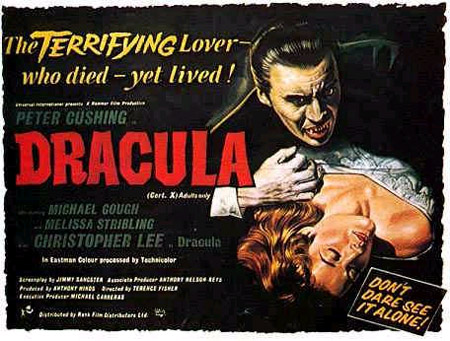
Now I don’t know what springs to your mind when you hear the words “Vampire Initiation Ceremony”, but I think of vintage Dracula flicks, where louche ghouls overwhelm swooning maidens in scenes of barely repressed sensuality, or, if I’m feeling particularly excitable, Catherine Deneuve and Susan Sarandon in The Hunger. At the very least I was expecting some sort of occult ritual, with a soundtrack of sinister Latin chanting.

You may imagine my disappointment then, when I discovered that the Turning Chamber resembled nothing more than a brightly-lit pub basement. The barrels that lined the walls were full of blood rather than beer, but the ambiance was definitely more functional than spooky. The focus of the room was not some unholy altar dripping with virginal blood, but a vending machine dispensing various Bloodlines products. After instructing the convert to buy several items (which cost about L$1000) the clan chief departed, leaving the actual biting to his minions. They didn’t seem to know what they were doing, and it took an age of searching in inventories and unpacking boxes, during which the poor girl had to log out and log in again twice, before her lifeblood finally began to drain away, very slowly. I asked Christopher Lambert how long this was going to take. “I don’t know, this is my first one” he said.

I chatted with the new vampire girl while we waited. What had attracted her to the blood-sucking lifestyle? The fashion sense and the romance it seemed. She was hoping it would get a bit better.

Christopher eventually got round to asking me if I would like to join the clan too, but I politely declined. If I ever give up my virtual soul I want it to be more meaningful than a cold transaction in a characterless cellar. The rich symbolism of the vampire myth deserves more respect.

(I know it’s unfair to dismiss Second Life Vampire culture based on a brief visit to one sim, so I’m open to suggestions of places I should visit for a more satisfying experience. Post them to mail@secondlifeshrink.com, and I’ll review them in a future post, if they’re any good).

Paranoid

Shortly after publishing my last post I tried to log on to Second Life, to meet up with Olivia, but I kept getting knocked back, with a message saying there was some unspecified “problem” with my log-in. Then Olivia emailed me to say that she wasn’t able to sign in either.

Suddenly it all became clear to me. The Lindens had been so badly stung by my criticism of their “adult content” proposals (and all my other subversive posts) that they had kicked both of us off the grid in retaliation. They were obviously logging all the traffic on this IP address. They probably had my phone bugged as well, and, come to think of it, the postman who delivered the mail this morning wasn’t the regular guy either – he must be working for them too…

I enjoyed my status as Linden Enemy #1, The Blogger They Could Not Silence, for five minutes, before reluctantly checking out the grid status page, and confirming that it was a universal glitch that was keeping everyone out.

Oh well, I can dream. At least it gives me an excuse to link to some vintage Black Sabb.

Brave New World

As readers will no doubt be aware by now, in an almost unbelievable development Linden Labs have announced the creation of a new “adult-themed” continent, to which all mainland businesses dealing in such merchandise will be required to relocate in the very near future. As it is worded the proposal seems to indicate that all adult-orientated activity will be confined to the new landmass, though various Lindens, contributing to the debate on the SL forums, have sought to reassure residents that the regulations will be interpreted in a way that will not affect what individuals do in the privacy of their own homes.

To say that reaction to this announcement has been negative would be somewhat of an understatement. I gave up reading the comments on the forum after 15 pages, but the feeling among residents was unmistakable – almost universally this is regarded as a terrible idea. Objections range from opposition in principle to the limitation of free expression, through doubts about the workability of the scheme (particularly the age verification element), to concerns from retailers worried that they will be forced to exchange their established prime locations for undesirable plots on the new continent. Just about everyone expects in-world trade to take a hammering, mainland land prices to collapse and a mass exodus of disaffected residents.

Linden Labs seem to be taking a massive risk with this move. At the moment they have a solid if limited business model – collecting subscriptions from a core of residents for whom the freedom to do what they want in SL is the main attraction. They may or may not actually engage in “adult” activity, but they like the idea that they could if they so desired – it’s a transgressive edge that is missing from their real lives. The Lindens are betting that the income they will lose as a result of alienating part of their current user base will be more than compensated for by new money from corporate and educational customers who are currently, so the theory goes, scared off by the reports of Second Life’s rampant perversity. I guess they have done some sort of research to back this up, but even so it’s a brave enterprise that will forego a proven revenue stream in pursuit of what may turn out to be an non-existent market.

On the margins

I don’t expect that my last post, in which I proposed that the value of virtual objects is effectively zero, will have caused a great deal of consternation in the SL commercial community, since I’m guessing that not many of them are overly impressed by Marxist economic analysis.

What if we take a look at the question from a more capitalism-friendly economic viewpoint? In general, non-Marxist analysis tends to reject the idea that commodities have intrinsic value (as is proposed by the labour theory of value) in favour of a more subjective formulation; the exchange-value of an object is what it will fetch in a free market, which in turn is dependent on the level of demand and supply.

This kind of theory is popular in financial circles, since it implies that value can be generated purely by the process of exchange, and that bankers and their ilk are actually wealth-creators, rather than parasites who have grown fat on the the toil of the labouring classes. (Though we’ve been hearing less of such triumphalist talk recently).

That aside, does a supply/demand model of value give us hope that Second Life commerce can be viable in the long-term? Sadly, no. The problem lies in the concept of marginal value. According to the theory, exchange-value is determined dynamically by the balance between the prospective buyer’s desire for an item and the level of supply. That desire is not constant though – it decreases as the buyer’s stock of an object increases. A man who has no oranges might be willing to buy them for a dollar each, but by the time he has bought ten he will probably be thinking of spending his next dollar on something else, though he may be persuaded to buy another if the price drops. The marginal value of an item is what a customer is willing to pay to get one more than he has already, and always trends towards zero. It may even go into negative territory if there is a cost associated with having too many items, such as storage charges.

The marginal value of most real-world items is maintained by their perishable nature. In Second Life though items last forever, so as residents age, and accumulate more stuff, their willingness to buy new things tends to decline. Even the most fanatical fashion-victims will eventually have enough clothes, shoes, or whatever, and retailers will have to drop their prices to tempt them into further purchases.

New avatars will still need to buy things of course, but since the percentage of people trying SL who go on to become long-term residents is quite small, it seems likely that the demographic will gradually mature, and the economy will stagnate. (There will be a subsection of the population for whom shopping is an end in itself, and for them the marginal value of new items will remain consistent, but I don’t think there are enough of them to maintain a growing economy).

So there you have it. Communists and Capitalists agree: the Second Life economy is doomed. People should stop wasting time trying to run businesses that have no future, and concentrate on exploiting the real potential of virtual worlds; the chance to create new kinds of art and entertainment, and to experience the myriad different forms of interaction that the grid gives us access to.

Less than zero

What determines the value of an object in Second Life? I’ve been thinking about that since reading this article a few weeks ago. The answer given in that post – the market strikes a balance between what a vendor wants to charge and what buyers are willing to pay, based on the perceived utility – has face validity, but also a number of problems. There are often glaring inconsistencies between price and usefulness (I got my house for free; Olivia paid L$600 for her boots), objects that are practically identical can have wildly different prices (she could have got a similar pair for L$200), and there is little price stability (this week they’re down to L$50). There are factors that partially explain these anomalies; the SL market is fragmented and inefficient, there are big differences in the usefulness of virtual objects and their real-life counterparts, and the low value of the Linden dollar compared with that of user time discourages shopping around for the best deal. Even so, the model seems rather unsatisfactory.

Is there a more objective method for calculating the intrinsic worth of virtual objects? Old Bolshevik that I am, I tend to fall back on the labour theory of value. We are interested in those objects that are produced for the purpose of exchange, that is those objects which are commodities; according to the theory the exchange-value of such items will be proportional to the socially necessary labour-time involved in their production. (Socially necessary meaning the time taken for the worker of average skill labouring under average conditions, rather than the time taken by any particular worker, who may be more or less efficient than average).

So far, so good. The value of an object appears to depend on how much work its creator puts into it, assuming they are of at least average skill, which seems fair. Virtual items are different from those in the real world in one crucial respect though – they may be copied with practically no effort. (By this I mean copied by their creator for sale, rather than pirated). However many hours of work go into making the prototype, the value of that labour is diluted, potentially infinitely, by reproduction. Thus the value of any one copy will trend towards zero.

To get around this a content creator could produce unique items, or at least very limited editions, which in theory could command premium prices. There are a couple of problems with this though; unless you are a virtual Yves Saint Laurent no one is going to pay significant sums for your work, and even if you do have exceptional prim-sculpting talent the market for such work is going to be so restricted that you are unlikely to be able to earn a living. (In the real-life fashion industry the top designers make relatively little from their haute couture collections, since the volumes they shift are tiny; the real money is in the diffusion lines). If your design skills are no better than average then you’re in an even worse spot; even if you don’t go down the mass-production route, as long as a few other producers of comparable goods do they will reduce the socially necessary labour-time for the creation of your product, and its value will inexorably decline.

Is there any empirical evidence that this theory is correct? It’s difficult to get hold of meaningful economic statistics regarding Second Life commerce, but anecdotally there does seem to be a feeling that the volume of low-price and free items available is increasing, and that the quality of the free stuff is much better than it used to be; it’s certainly significant enough to support a whole SL Freebie” blogging subculture.

Second Life is copying real life, at a characteristically accelerated pace; the declining rate of profit is on the verge of producing a crisis of over-production. In the real world the point of crisis can be postponed by expansion of credit, though when this comes unstuck, as it has done recently, things tend to go spectacularly wrong, and capitalism is forced to fall back on the traditional remedy of economic depression and/or global war, to destroy unproductive capital and create the conditions for a new round of accumulation.

I don’t think that the Second Life economy will actually collapse though; owners of chronically unprofitable virtual businesses are likely to subsidise them indefinitely, just so they can hold on to their dreams of escaping the real-life rat-race, and this constant inflow of capital should be enough to prevent a crisis. (So long as the non-virtual crisis doesn’t consume Linden Labs).

Is there a better way to solve things? My ideal would be Second Life (and real life too) operating as a cooperative, collectively owned by its residents, who would each receive a social wage, and would freely contribute their talents for the betterment of the whole virtual society. “From each according to his ability, to each according to his needs” as the saying goes. I’m sure there are a few sims running on this principle, but my feeling is that the prevailing political tendency in SL is Libertarianism rather than Communism, so it may be some time before the virtual proletarians throw off their chains.

Et in Arcadia ego

Back when I first started writing about Second Life I identified what I thought was the main factor limiting the potential for growth in the virtual economy, which was that residents could exist indefinitely without having to spend anything at all. Avatars never needed to eat or drink, clothes never wore out, and buying or renting a place to stay was entirely optional. Only two things were really driving commerce – discretionary purchase of fashion items and adult-themed entertainment – and this wasn’t broad enough to support more than a handful of businesses. The former suffered due to over-supply, poor quality and a limited customer base, and the latter had to compete with a large population of amateurs willing to give the product away for free.

I should perhaps have realised that this was a potentially valuable insight. Mars Braken, of Liquid Designs, the company behind SL vampire phenomenon “Bloodlines” was evidently thinking along the same lines, but unlike me he has figured out a way of turning the idea into cash.

Beneath all the pseudo-gothic jargon of the blood-sucking RPG lies a simple concept – players have a limited and decaying supply of a substance (“Sacred Blood” in this case, though it could be “hit points”, or “lifeforce”, or whatever) which they must constantly replenish, for if it falls to zero they will be expelled from the game. It’s possible to obtain free blood by soliciting donations from other residents, but this is slow and inefficient, thus creating a market in traded blood, over the supply of which Liquid Designs hold a monopoly (for the time being anyhow – no doubt we will soon be reading stories about how Chinese peasants are scraping a living collecting virtual blood to sell to western vampires).

The game has become popular enough to generate six-figure US$ revenues for Liquid Designs, according to New World Notes. It has also unleashed a plague of inconsiderate leeches, who are annoying the hell out of the normal population with their indiscriminate exsanguination.

There is probably an analogy to be drawn here with the operation of modern capitalism. Corporations play upon our insecurities to convince us that our social status depends on purchase of their products, and we fill their coffers trying to satisfy a need that we never even knew we had. I’ll just note the irony in the fact that “Bloodlines” players, in seeking to emulate creatures that never die, are voluntarily relenquishing the prelapsarian immortality that their avatars naturally possess.

Greenies may have invaded some time ago, we hear

Until not very long ago, if you searched Google for “Second Life Shrink” you would find that this blog was in second place on the results list. I’m glad to say that we are now number one (or we were when I wrote this), having overtaken the previous leader, a 2007 post in the long-dead “Technochondria” blog entitled “Greenies invade Second Life; Avatars Shrink to Size of Mice!“.

The post reproduces a press release promoting the opening of the Greenies Home, a sim set up by Rezzable to showcase the then-revolutionary sculpted prim. It’s still on the go, so I decided to pay a visit to our now-vanquished rival, only two years after it opened. Don’t say we’re not topical here at SLS.

Teleporting in, you arrive atop an oversized table in the centre of a open-plan apartment. From there you can start exploring by wandering around the sitting room:

rezzable02

and the kitchen:

rezzable03

coming across little green men and various other creatures:

rezzable04

You get the idea – you’re small, things are big. Exploring is mildly diverting for a while, but everything is static, so it’s more like a novelty museum than a fun park. There are giant hamster balls that you can roll around in, but I couldn’t figure out how to control them before my attention span gave out.

Other attractions include a fairly hip looking performance space, and a shop selling a wide range of Greenie avatars. The doll house in the background above apparently doubles as a fashion boutique, though it was shut for restocking when I dropped by. You can also pick up a free “/me ❤ prim” t-shirt (a real life version of this is available too – this is apparently Rezzable’s new SL monetisation strategy).

The place was fairly crowded by SL standards, with about a dozen people milling about, so I sought out some peace in the garden, where there was, well, more big stuff, including this rather fine dragonfly-powered boat:

rezzable08

There are a few other things to see at Rezzable, like the Tunnel of Light, a trippy tea-cup ride through a psychedelic light show, which would probably be best experienced projected on to a wall in a darkened room, while stoned.

rezzable05

Then there’s the ominously-named Carnival of Doom:

rezzable071

Be careful on the carnival rides, or you might end up in a David Lynch-style Hell:

rezzable11

Finally, Crimson Shadow, the vampire clothing emporium, where I got my new boots.

rezzable10

Now I know where to get the vampire outfits, I might try getting into the Bloodlines craze…

MMORPG mental health professional

In a bid to expand my knowledge of the metaverse beyond Second Life I’ve been reading a bit about EVE Online, which claims to be “the world’s largest game universe”, and sounds rather more action-packed than SL, if this BBC report is to be believed.

I was tempted to try out their 14-day free trial, especially when I saw that there was a linux client available (though it’s apparently going to be discontinued soon). I’m worried that I would end up hooked enough to start paying the €19.95 monthly fee though, not to mention the extra time I would waste online (the average weekly playtime is 17 hours apparently), which would be hard to justify. There do seem to be some interesting in-game dynamics – deception and subterfuge are an integral part of the experience – but I would struggle to convince myself that I was conducting some sort of serious psychological research rather than just playing a game.

When I was first thinking about setting up this blog I considered getting an account at Entropia, which at the time was getting more publicity than Second Life. Four things convinced me that SL was the way to go: Entropia seems more restricted in what there is to do, the creative possibilities provided by SL‘s building and scripting functions were interesting (though I have actually made very little use of them), SL supports linux, and finally, and most importantly, Entropia Shrink doesn’t really trip off the tongue.

Creative licence

Facebook, in response to general outrage, has been forced to abandon proposed new terms of service, which would, if you believe the detractors, have allowed the corporation to claim ownership of all material uploaded by users of the service, even those who had deleted their accounts This raises several interesting issues, including how social media blurs the distinction between personal and public space, and the extent to which users of services like Facebook and Twitter can expect to retain control over content they create.

I have always felt that it is prudent to regard the internet as being completely public, and to assume that anything that you put into the system will persist forever, indelibly marked with your digital fingerprints, and accessible to anyone who knows how to look for it. Accordingly I do my best to be discreet, but despite this I often, in retrospect, feel that I have been lulled by the apparent anonymity of the medium into revealing more about myself than I might have intended. There is a certain amount of narcissism involved in such worries; while it is technically possible to, say, link all the Google searches I have done to my IP address, I seriously doubt that anyone is going to bother. Similarly, it seems unlikely that Mark Zuckerberg was really planning to purloin millions of badly-exposed pictures of Facebook users grinning drunkenly during their works’ night out, for some nefarious purpose that only he can imagine; all he wants are your shopping preferences, so that he can sell advertising and convince the venture capitalists that he does have some sort of monetisation strategy. Still, the idea that once you join Facebook you can never leave makes it sound even more creepily cult-like than it did before.

On the face of it Second Life residents don’t have to worry about being creatively expropriated by the Lindens; the terms of service clearly state that copyright in content resides with the originator. As I’ve touched on before though, “creativity” in the metaverse isn’t limited to the production of discrete items. The very act of interacting with others on the grid is in itself a performance, one which can be observed and appropriated. Who, if anyone, “owns” this? You may not have to worry that the Lindens will claim control of your entire virtual life, like Facebook is trying to do, but perhaps you should be concerned that all the imaginative energy that you put into living your second life will end up providing free inspiration for some lurking writer.

Is Olivia a Punk Rocker?

We’ve changed a few things here at SLS this week.

We finally got around to registering the “secondlifeshrink.com” domain after months of dithering. This may well bring the wrath of the Lindens down on our heads, but we figured that we could reasonably claim that the blog is about the general concept of living a “second life” rather than any particular trademarked product. If that doesn’t wash, well we’re sure the freedom-loving SL-blogging community will rise in our defence.

From now on we’ll be posting under individual bylines, and we’re planning a basic division of labour; Olivia, who has more time to waste on the grid, will handle the Second Life travelogue pieces, while I’ll keep on churning out the pretentious, pseudo-intellectual analysis stuff.

In the true SL spirit of constant re-invention I’ve taken the opportunity to change my pseudonym to the vaguely-punky “Johnny S”; Olivia has decided to stick with her posh-bird moniker for now, despite there being plenty of suitable alternatives.