Turn On The News

My blistering critique of the Second Life Herald obviously hit a nerve with its publishers, as less than a week later they have (re-)re-branded themselves as the Alphaville Herald and promised to eschew the tittle-tattle of Second Life in favour of consideration of serious issues in the wider metaverse.

Second Life Insider went down the same route more than a year ago, reinventing itself as Massively, again with a remit to cover all virtual worlds, though they seem to mostly concentrate on World of Warcraft.

There used to be five online publications that I read for news on Second Life – but now the Herald and the Insider have changed focus, and Reuters SL and the Ava Star have folded, leaving only New World Notes soldiering on (and lately they seem to have been running a lot of puff pieces about their business partners). There are still scores, if not hundreds, of individual bloggers documenting the grid of course – blogs I read at least semi-regularly include SL on SL, Gwyn’s Home, Metaversally Speaking and Your2ndPlace – but the scaling down of organised news-gathering specific to Second Life suggests to me that there is less confidence around about the platform’s future as a significant cultural phenomenon.

It might go the way of crop-circles; they were everywhere, now you never hear of them.

Cargo cult consciousness

There was once a time when I was a regular reader of the Second Life Herald, but these days I look at it only rarely. Founded by noted metaverse pioneer Peter Ludlow, aka Urizenus Sklar, the Herald, with its mission statement “to record, observe and study the legal, social and economic implications of life in the virtual world” promises some serious commentary on Second Life culture, a window into what is going on in the minds of the grid’s most interesting residents.

In reality the Herald is a strange brew; part superficial yet impenetrable gossip, part breathless exposé . I have never been able to decide if one is meant to take it seriously, or if it is in fact some sort of elaborate joke, a parody of our shallow, celebrity-obsessed culture and insatiably sensationalist media.

The overall impression, for me anyhow, is rather exclusive; to extend William Gibson’s high-school simile, it’s like the class newspaper edited by the popular kids; the geeks, dweebs and other losers can look but only dream about joining in. Just like any non-virtual celebrity-gossip publication in fact, but with one crucial difference; while real-life celebs, at least on the A-list, are objectively attractive, and their lifestyles glamorous, their Second Life counterparts are generally not much more aesthetically pleasing than the average avatar, and the accounts of their activities are seldom other than dull. The element that gives an edge to our culture’s worship of its secular idols – aspirational envy – is missing, and in its absence there is nothing to hold the reader’s attention.

For me the Herald is a good example of cargo cult culture; the idea that, by reproducing the form of a real-life phenomenon in the virtual universe, one can appropriate its significance. This theme seems to underlie a lot of what goes on in Second Life, and its essential fallacy is why life on the grid so often seems unfulfilling.

I think that it is mistake to see the potential of the metaverse as lying in the ability to mould a more perfect version of the real world. What is created by such an effort is but a shadow of reality; instead of emerging into the sunlight we retreat further into the cave. The real promise is contained in the possibility of experiencing something that augments our perception of reality rather than trying to reproduce elements of it. I don’t know if that is going on somewhere on the grid, and I’m not sure that I would be able to recognise it if it was, let alone articulate its meaning.

The problem is that everyone who comes to SL, myself included, brings with them the baggage of conscious and unconscious expectation. I am self-aware enough to know that in visiting the grid, and especially in writing about it in this blog, I am chasing after something that is missing in my real life. Put like that it sounds a bit dysfunctional, but I think that for most people a little wish-fulfillment is a healthy thing, and reflecting on experience in Second Life can provide useful insight into what is going on in one’s life outside the metaverse. Perhaps if Freud were living now he would ditch the interpretation of dreams in favour of avatar analysis as a royal road to the unconscious. It is of course possible to overdo this, and use one’s virtual life as a way of hiding from, rather than illuminating, the problems of real life. This desire to evade harsh reality is certainly one of the factors underlying internet addiction, or indeed any sort of addiction, but even for the non-addicted majority of SL residents, in whose number I count myself, there is a downside to the escapism – by using SL as a way of relieving my frustration with the limitations of my current existence I am locking myself into a real-world paradigm, and thus missing out on the what the grid really has to offer. If I was perfectly happy with my life I could perhaps approach SL with an open mind and experience its full potential, but then if I was perfectly happy with my life I wouldn’t be wasting hours sitting in front of a computer screen.

It’s the Second Life paradox; the people who will visit regularly do so because they are, more or less consciously, trying to fill some gap in their lives; as a consequence of this they are the least likely to be able to make the most of the opportunities SL affords. Meanwhile the people whose lives are fully realised, the very ones who would be best suited to exploring the possibilities of this new virtual world, will never feel the need to come anywhere near it.

Space Oddity

I was thinking that I had gone a bit far with my praise of Second Life the other day (“occasionally everything will come together to produce a brief moment of beauty” – what was I on?), so I thought that we should probably go out and try to find something vaguely intellectual to make my enthusiasm seem slightly less ridiculous.

We looked at the “Arts and Culture” section of the “Events” search, but our ideas about taking in a classical concert or a gallery opening were swiftly forgotten when we saw an ad for the “Star Trek Museum Starship Tour”, guided by “Klingon Warrior Klang” no less.

It turned out we had missed the tour, but the Star Trek Museum itself was interesting enough to keep us around for half an hour or so. They give out free Starfleet uniforms (“Voyager” and “Next Generation” versions, disappointingly, not the much cooler Kirk-era threads):

trek_museum02

and you can wander about a mock-up Enterprise, learning all sorts of facts about how the warp-drive works and the like, or hanging out on the bridge:

trek_museum03

firing the phasers, or launching photon torpedoes (though the visual effects that accompany this are somewhat underwhelming).

The sense of realism is undermined a bit by the curators’ decision to represent much-loved crew members with cabbage-patch dolls (this is Admiral Kirk):

trek_museum04

Our interest was waning a bit by this point, so we skipped the other attractions, which include shuttle flights, an alien buffet and a trip to the Vulcan sim at Eridani, guaranteed to fascinate more ardent Trekkies.

trek_museum01

I’m not sure that the museum will convince doubters that Second Life is anything more than a geeky waste of time, but it is a good illustration of how SL allows fans to create, for a relatively modest outlay, a tribute to their obsessions.

Here’s a track from way back in 1969, when Kirk and Spock were just coming to the end of their original adventures. Are the lyrics a metaphor for the Second Life experience?

Electronic Arcadia

I’m reminded from time to time that a lot of people, even those who have embraced other aspects of Web 2.0 like blogging, find the appeal of Second Life almost incomprehensible. Consider, for example, the opinion of Kimmelin Hull, who after watching a PBS documentary on SL, was moved to comment “THIS IS THE MOST IDIOTIC THING I HAVE EVER HEARD OF”.

In common with many who pour scorn on Second Life, Ms Hull is sceptical of the value of virtual interaction:

In the name of “social interaction” people are spending what I presume to be HOURS in front of their computer screens…ALONE…pretending to interact with other folks … What is so wrong with these people that they have to hide behind a cartoon character in order to gain a little “social interaction?” And how can this form of “social interaction” replace, or even come close to satisfying the germaine need for human interaction that sets us apart from many creatures of the animal world? … In case you didn’t notice people, THERE’S AN AWFULLY BIG WORLD ALL AROUND YOU WITH A LOT OF real PEOPLE IN IT THAT YOU CAN INTERACT WITH!

Despite apparently being an active blogger, Ms Hull appears not to know a great deal about online discourse, since she breaks the First Rule of e-communication: “NO ONE WILL TAKE YOU SERIOUSLY IF YOU POST IN BLOCK CAPITALS”. She also seems to assume that, because she faces no barriers to interacting with real people, things like, say, physical disability, mental health issues or geographical isolation, that no one else could possibly have these problems either, as well as believing that “hid[ing] behind a … character” is something that nobody ever does in face-to-face interaction.

As you can probably tell, I feel that Ms Hull is being a bit hard on us SL enthusiasts. One could be equally disparaging about any minority interest, like train-spotting or quilt making. I have no idea why anyone would find those activities enjoyable, but I’m prepared to accept that they do, and that they are free to get on with it without having to explain themselves to me.

I’ve posted before on how some people tend to over-value their Second Life experience, but it’s possible to under-value it too. Ms Hull asks:

How do you nurture another person in Second Life? How do you give someone a hug that feels like a hug? How do you take joy in the sound of a friend’s laughter in a virtual world? My God, what has this world (this real world) come to that people are feeling the need to escape into a make-believe world for “social interaction?”

Humans have been escaping into fantasy worlds, and finding real meaning in them, since the dawn of time. When we read the works of Homer, or Sophocles, or Virgil, do we not interact with the characters, feel their joy and loss, even though they exist only in our imagination, conjured by the words of long-dead poets? Does this not enhance our real lives rather than diminish them?

It may seem ridiculous to mention Second Life alongside such classic literature, but the important point is that SL and other virtual worlds provide a medium in which human creativity can be expressed. It’s like a massive, non-stop dramatic improvisation. Most of the time the million or so monkeys hammering away at their keyboards produce nothing but gibberish, but occasionally everything will come together to produce a brief moment of beauty.

I’m not usually so vociferous in my defence of Second Life; it’s more common for me to complain about how boring it is. I must be feeling that I need to justify the amount of time I’ve been spending on the grid recently. I would go to a park, sit in the grass and watch the wind blow through the trees, but it’s cold and snowing outside, and the sun is always shining outside my virtual window.

The Sprawl

As I mentioned a while ago, back in the early 80’s I had a subscription to OMNI magazine, and it was there that I read the early work of William Gibson, including “Burning Chrome“, in which Gibson introduced the term “cyberspace“. I haven’t read that story for over 20 years, but I can still remember how excited I was by the idea of plugging your brain into a computer and being instantly transported to a virtual world in which pure information was experienced as unmediated sensual perception.

I have subsequently gone off actually sticking wires into my skull, but I still like the concept of an immersive artificial experience. Part of my disappointment with Second Life has been its failure to live up to Gibson’s vision of cyberspace as “a consensual hallucination … lines of light ranged in the nonspace of the mind”.

There’s an interesting interview with Gibson on his website, in which he talks about his experience of visiting Second Life, which he compares to “a cross between being in some suburban shopping mall … and the worst day you ever spent in high school”, which chimes with my experience – there’s hardly anyone else around, and the people you do meet won’t talk to you.

It’s well worth reading the whole interview; Gibson touches on a number of interesting points, including the way that the ubiquity of internet access means that everything that is published these days is effectively hyperlinked, and how this alters the relationship between author, reader and text.

Though I guess that authors have always seen their work appropriated as inspiration for other artists.

Nietzsche work if you can get it

Browsing through the blogosphere tonight I came across this post on philosophical inquiry in Second Life, which at once interested and infuriated me.

I was mildly intrigued by Professor Luciano Floridi’s proposal to spend two years on the grid looking at the question of “The Construction of Personal Identities Online”. I’m not sure that this research is quite as groundbreaking as the professor thinks, since it’s been pretty well covered in the sociological and psychological literature over the past 15 years; even I can waffle semi-authoritatively on the topic for an hour or so. (Floridi rather ambitiously claims to be the first philosopher to seriously consider Second Life, an assertion that has provoked an amusing spat with the rather better-known Peter Ludlow, another pretender to that title, in the comments section of the post). Still, a highly trained thinker like Floridi is bound to come up with some new perspectives on the metaverse, and I’ll follow his project with interest.

I was initially rather peeved when I read that Floridi had been given a grant of £165 000 to realise his plans, thinking that I would have done it for half that, but £165K is about what I would earn in two years doing my current job, and I guess he’ll have to pay for a couple of research assistants, and probably some other expenses too, so isn’t actually that great a deal. Still, I’m a bit jealous. I knew I should have paid more attention when my research tutor was telling me how to write grant applications.

Virtual Monopoly

The buzz around the SL blogosphere this week is all about Linden Labs’ unexpected takeover of XStreet and OnRez, the two biggest and best known of the web-based Second Life marketplaces.

Blogger opinion seems fairly unanimous in regarding this development as A Bad Thing, though reaction varies from mildly disapproving to apoplectic.

Regular readers of SLS will know that we have long been sceptical of the idea that it is possible to make serious money through in-world commerce, but the existence of services like XStreet and OnRez presents a challenge to our doubts, since they provide a route by which cash can be extracted from the grid without showing up on the official Linden Lab statistics. Perhaps sellers in these marketplaces are turning over significant sums, enough to make a living comparable to having a real-life job. Even if this isn’t true, the markets themselves may be handling enough transactions that a commission of even a couple of L$ a time would be enough to make running them a lucrative business.

Does the fact that the Lindens have bought into the action provide any support for the theory that the web-based marketplaces were making money? One might speculate that L-Labs is worried about a fall-off in the subscriber base due to the recession, and is looking to secure other revenue streams. On the other hand, if XStreet and OnRez were profitable it seems strange that their developers would have sold out, unless the offer was irresistible. Throw in the fact that OnRez was owned by virtual world cheerleaders-turned-jeremiahs The Electric Sheep Company, and it begins to look like the picture wasn’t so rosy after all.

Linden Labs may well have taken advantage of the economic crisis to increase their stranglehold over Second Life commerce by snapping up two companies that, had they had time to develop further, may have grown to challenge L-Labs’ dominant position as the people who actually make money from the grid.

Fool O’Beans

A while ago I wrote about searching for the Church of the SubGenius on the grid, and being directed towards the Fool O’Beans Coffee Shop, only to end up in an empty field.

NTropy Sellers has been in touch to let us know that the establishment’s slurl had been messed up for some reason, and to kindly provide us with the proper reference.

fool_o_beans01

Any place with a giant bong is always going to be cool with us, so we’ve added it to our venue rota.

Gigantic

Attentive readers will have noticed that staffing levels here at SLS have increased by 100% since the start of the year. Now that we are obliged to have editorial meetings we’ve been looking around for quiet places to hang out and talk.

For the time being we’ve settled on the Grey Hare Coffee Shop on Adelebsen Isle:

ed_meeting01

Adelebsen Isle seems to be a centre of Tiny culture; the only other residents we’ve seen around are delightful little fellows like this:

tiny01

We’ve tried talking with the small folk, but they tend to just scurry away. I don’t know if they are naturally timid, or if they just don’t deign to converse with anyone over 50 centimetres tall.

Our other favourite place is the Loki Absinthe Bar in New Babbage, but we tend not to get a lot of work done when we’re there:

ed_meeting02

Here’s today’s song, which is a bit tangential, but I think both title and artist are at least marginally relevant.

Art star

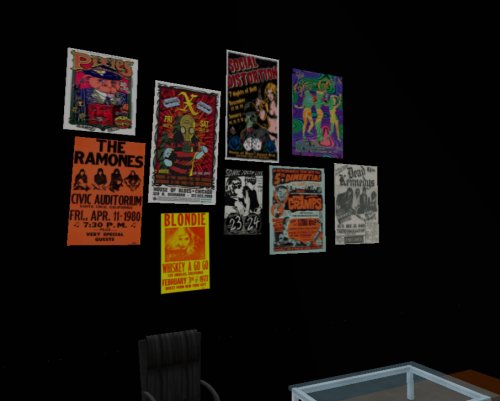
After buying a couple of posters from the Warhead Rock’n’Roll shop, at L$25 each, I figured it would be cheaper to make my own, since uploading image files is only L$10 a go.

After a quick google for pictures of suitable concert posters I set to work creating objects in Second Life for the first time. They turned out fairly well I think, though I guess making simple two-dimensional shapes isn’t that much of an achievement.

interior02

Pretty neat huh? I should go into the virtual poster business.