O Superman

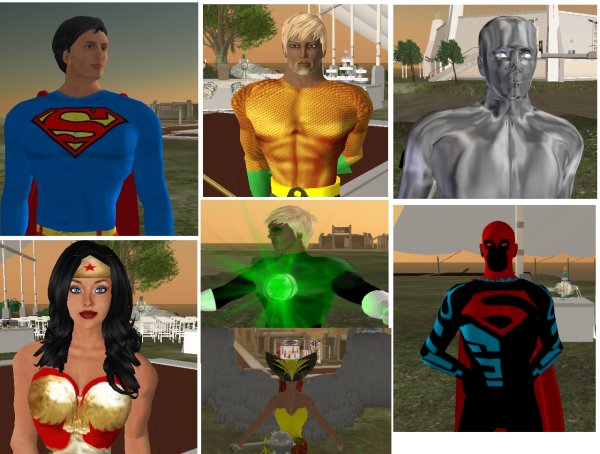
The JLU saga rumbles on, and has jumped from Second Life into the real world, on the way losing much of its lustre.

I may have exaggerated a little when I implied that the wannabe superheroes were some sort of virtual Freikorps, but they do seem to be doing their best to make themselves look like a thoroughly sinister outfit. Their latest stunt is to try to censor the Herald’s exposé of the secret JLU database by threatening the paper’s web host with the DMCA. The Herald, to their credit, are not taking this lying down, and have counter-filed a complaint charging JLU supremo Kalel Venkman with intentionally lodging a false DMCA report, which, I understand, is not a trivial offence.

(A side-effect of this process has been to reveal the real-life identity of Herald editor Pixeleen Mistral, who, rather impressively, turns out to be internet legend Mark McCahill.)

The whole story was quite fun when it was confined to the grid and the SL blogosphere, but I suspect it is about to become rather less amusing for the participants now that everyone is getting lawyered-up. A well-connected academic like McCahill can probably look after himself – I’m sure he’ll be able to hit up Lawrence Lessig for some free legal advice – but Venkman, who, the internet tells me, is really a technical writer from Los Angeles, may be having second thoughts about the potentially expensive escalation of hostilities that he has initiated.

Why has Venkman done this? He had a perfectly good role-playing scenario set up, with heroes and villains, intrigue and espionage, skulduggery and back-stabbing, confidential dossiers and secret deals, topped off with open conflict between the forces of good and evil across hundreds of worlds – all the ingredients for a gripping narrative, with Venkman himself right at the centre. He’s trading that for a dull tale of dreary lawyers exchanging dismal arguments in dusty courtrooms, a story that seems likely to end in unhappiness for Venkman and his lycra-clad cohort.

This seems to me to be a case of incomplete immersion, or perhaps over-augmentation; either way Venkman appears to have lost sight of the boundary between the virtual world and the real. The role of “Venkman” has become so important to his self-image that he is unable to see the Herald‘s story for what it is –  a chance to build on the mythology he has already established, an opportunity he should welcome – and instead regards it as a threat to his real-life identity, one which must be countered with a real-life action, regardless of the fact that such action risks destroying his existence, both virtual and real.

The story reminds me of cases we’ve covered before – the tale of another virtual superhero, Twixt, and the Stroker v. Linden lawsuit. Both of these involved people acting in ways that made no sense when seen in the context of the virtual world alone, but became more comprehensible when one thought about the interaction between virtual and real identities, particularly the unconscious aspects of the latter.

Is it possible to be a complete immersionist, to live one’s virtual life in total isolation from the conscious and unconscious influences of one’s everyday personality? Would such a thing be desirable? Probably not, for what is interesting to me about living a Second Life, and recording my thoughts about it, is the way that it casts light on corners of my consciousness that I may have been only vaguely aware of. While projection of real-life neuroses into the metaverse may be illuminating, I’m much less convinced that allowing in-world dynamics to leak out and influence one’s external behaviour can be anything other than harmful. This may be a lesson that Kalel Venkman, or at least his mortal alter-ego, is about to learn the hard way.

Because when justice is gone, there’s always force.

Second Life, with graphics, on the iPhone?

I’ve had the Touch Life app on my iPhone for a while, though I tend not to use it much, since not being able to move around (apart from teleporting) or see what is around you (apart from a map view) means you don’t get anything like the full SL experience.

However when I read about the Peek360 service from Avatrian, which lets you view SL via a web interface, I figured that there might be a way of making the mobile SL experience a bit more satisfying.

Step 1: Log into Touch Life and teleport to where you want to go. Note the region and the coordinates. Log out.

Step 2: Launch Safari and go to the Peek360 page. Enter the coordinates noted above, and your email address. Note the estimate that is given for when your image will be ready (from 4 to 30 minutes the times I did it).

Step 3: Log back in to Touch Life (if you want to be in the picture), then wait for the period mentioned above. Log out.

Step 4: Check for the email from Peek360, and follow the link to the picture taken by the bot they sent to the coordinates you gave.

The rather disappointing result of this cumbersome process can be seen below:

(In the spirit of this experiment I posted this with the WordPress iPhone app, and I don’t know how to rotate the screenshot.)

Not quite a killer app then. It might work better on a device that allowed multiple processes, and ran flash.

If I was smart enough I could probably set my desktop to log in to SL, then feed screenshots to a web page that I could access with my iPhone, with some sort of remote-access facility to allow me to control the viewer. The frame rate would have to be pretty slow, but it should be playable.

[Update: someone already did this of course, two years ago in fact.]

Zombie Glamour

M4EEQEZXBAZ8

As you can see I’m still trying to re-register SLS with Technorati – the process has dragged on for months, and now they seem to have lost my claim, so I’m having to start over. I wouldn’t bother, but I want to keep our place in the big list of Second Life blogs, and a Technorati rating was a condition of inclusion last year.

Anyhow, it gives me an excuse to link to a site I’ve been wanting to feature for a while; the rather wonderful, and only slightly disturbing, Zombie Pinups.

The Avatars United will never be defeated

I was busy with some real life issues over the last week or so, and hadn’t been paying attention to all the various SL-related blogs and tweets that I usually monitor in a sadly obsessive way, so when I finally got round to looking at them I thought I might have missed a big story. Everyone seemed to be going on about “Avatars United“, and for one terrible moment I feared that someone had stolen a march on my plans to start up a virtual revolutionary movement by launching their own grassroots organisation.

The truth turned out to be a bit less exciting; AU is a two-year old social networking site that had been more or less moribund until Linden Lab unexpectedly bought it over at the end of last month. This prompted a flurry of interest from the SL community and a rush to take advantage of the site’s USP; the ability to collect all your virtual identities in one place and associate them with one another and, if you want, with your real one (though not many people were taking that option up). Amusingly, they don’t seem to have any system to verify that users actually own the avatars they are claiming, which has led to a rash of virtual identity theft.

Why the Lab has bothered with this is not entirely clear, since I thought they were trying to promote SL itself as a social networking service with benefits, and I can’t see the advantage for them in encouraging people to take their chatting off the grid and on to some other site. I imagine that they are more interested in harnessing the development skills of the AU staff to improve the SL experience than running a virtual Facebook.

From a user’s point of view the appeal of AU is even more opaque; the main attraction (for me anyhow) of having multiple online identities is that they are separate, and thus able to reflect different aspects of my personality. (Shelly Turkle wrote about this years ago.) If I need to integrate my avatars for any purpose I already have a perfectly good place to do so; it’s called “inside my head”.

I’m not the only person to have doubts; in what must be one of the shortest hype-cycles ever the AU backlash has already started.

Two Galleries

I recently spent some time wandering around The Leominster Galleries, a new project from Sigmund Leominster, of SL on SL fame. The space exists to showcase Siggy’s personal art collection, with three floors of permanent exhibits and a room for temporary shows, all floating in the air high above the Root Squared sim.

Siggy’s taste seems to be firmly rooted in the 19th century, with the work of William Adolphe Bouguereau particularly well represented:

Bouguereau is an interesting choice; a stalwart of the French Académie des Beaux-Arts, he was acclaimed a genius in his day, but his reputation declined spectacularly in the 20th century, when his work was largely viewed as technically competent, but exemplifying the worst aspects of the ossified Academic style. He was entirely eclipsed by the Impressionists, a movement he had attempted to exclude from the Salon, and which he struggled to understand. More recently reviving the popularity of Bouguereau has become somewhat of a cause célèbre among conservative art critics, who see in his work an affirmation of traditional values tragically displaced (in their view) by modernism.

I don’t know if Siggy is making a political point with his picture selection, or if he just likes the sanitised eroticism that was popular in 19th century bourgeois circles. To be fair, the collection is not entirely composed of tasteful nudes in classical tableaux – there are some tasteful nudes in faux-Arthurian tableaux too, courtesy of the Pre-Raphaelites:

a fair representation of Symbolist works:

and a smattering of Surrealism:

The visit introduced me to several works I hadn’t seen before, since, I must admit, I usually hurry through the 19th century rooms when I visit the big galleries, so it was educational to a degree, but I do wonder what value was added by hosting the exhibition in Second Life, rather than, say, posting it in a blog. I suppose one could invite one’s friends around to make it a more social experience. The exhibits might perhaps be a little more interactive, with links to information about the artists and movements, and some explanation of the curatorial philosophy. The gallery design could be a bit less clinical too, since the modern aesthetic of the plain walls and light wood floor clashes somewhat with the cluttered hanging. A few chairs wouldn’t go amiss either. These are minor criticisms though, and the Leominster Galleries are well worth checking out.

A rather different artistic experience is on offer at The Primtings Museum, where they don’t hang the pictures on the walls, but build installations that allow visitors to place themselves into some iconic images:

(I’m pretty sure that I once sat in a real-life recreation of Van Gogh’s Room at Arles, but this was in Amsterdam, so it might just have been a drug-fuelled hallucination.)

There are dozens of works on display by various virtual artists, including our old friend AM Radio, who reworked David’s The Death of Marat, above. A full catalogue can be found on the Primtings website.

Surrealist paintings provide the inspiration for a large number of pieces, but, ironically, these are perhaps the least successful works in the gallery. The dream-like quality of Surrealism seems to be lost rather than enhanced by being lifted from the canvas and transformed into rather prosaic tangible objects:

I think for these sort of pieces to work they would have to be more immersive than just three dimensional representations of the paintings presented in a box. A sim-scale re-imagining of Un Chien Andalou perhaps, with the opportunity to slice up eyeballs and pull a piano full of dead donkeys around.

My favourite work at Primtings is this replica of Damien Hirst’s The Physical Impossibility of Death in the Mind of Someone Living:

As befits conceptual art this works just as well in Second Life as it does in reality. The best part is that you can take away a free copy of the formaldehyde tank (though not the shark), and suspend yourself, or your loved ones, in it when you get home.

I did wonder a bit about the copyright status of these two galleries. I think Siggy should be all right, since the artists he features are all long dead, but Primtings might be on shakier ground if Hirst ever finds out they have been ripping him off, so you should probably take it in while you still can.

And finally – Johnny would have a fit if I mentioned Un Chien Andalou without linking to this.

Injustice Unlimited

If our report that the Lindens were running a secret surveillance program wasn’t enough to convince you that Second Life is a virtual banana republic, we now hear, via the Herald, that they have also been covertly sponsoring vigilante goon squad the Justice League Unlimited.

So far the self-styled JLU have mainly confined themselves to low-level harrassment of residents they deem to have breached community standards (with no regard for pinko concepts like “due process” of course), as well as maintaining a Nixon-style enemies list, but the Lab no doubt finds it useful to have a plausibly deniable gang of thugs on hand, ready to help disrupt any organised political opposition that might arise.

Comrade Obama

Well, let no one tell you that we’re not influential here at SLS. Just one day after we called on President Obama to move to the left he has finally started showing his true red colours by declaring war on the banking system.

Next week: Obama orders Secretary Clinton to put the Middle East peace process on hold and concentrate on bringing democracy to Second Life

Just what is it that we want to do?

The answer to that is fairly straightforward – no need to formulate complicated transitional demands, or debate maximum and minimum programmes. We only need to think about the things that SL residents (or SL bloggers at any rate) are always moaning about.

A major gripe is the Lindens’ propensity to change fundamental aspects of the resident experience without involving the user base in the decision process, or at best engaging in some token consultation exercise. A second, and not unrelated, complaint is the belief that the Lab privileges some residents and businesses over everyone else, by uneven application of the Terms of Service, or commercial favouritism, aggravated by their reluctance to adequately regulate commercial relations between residents, most contentiously in the realm of intellectual property rights.

The steps needed to resolve these issues broadly correspond to two features usually associated with western liberal democracy; executive accountability and the rule of law. We can therefore formulate two central demands that, one might expect, would be supported by a majority of SL residents.

  1. An elected forum with the power of veto over major changes in Second Life.
  2. A robust judicial system operating independently of Linden Lab.

Obviously some of the finer details, like suffrage, will have to be worked out, but I think the basic concepts are enough to get the SL democracy ball rolling.

And when we’re done? Then we’ll get loaded.

You say you want a revolution

Woody Allan, in his indispensable Brief Yet Helpful Guide To Civil Disobedience gives the following advice to would-be revolutionaries:

In perpetrating a revolution, there are two requirements: someone or something to revolt against and someone to actually show up and do the revolting.

In the case of Second Life it’s fairly clear what needs to be overthrown – the tyrannical rule of the Linden clique – but much less obvious who might be capable of carrying this out.

In the real world much ink has been spilt – indeed much blood has been spilt – in the debate over the revolutionary potential of the various social classes. Any account of this I give here is bound to be hopelessly reductive, but I’ll try to summarise.

The bourgeoisie may initially take the lead in a movement for democratic change, either in the context of a struggle against feudal social relations – the prime example being the French Revolution – or, more relevant to the modern world, in the fight for national self-determination of colonies dominated by foreign imperialism. However history has shown that, once in power, the bourgeoisie will not carry through the revolution to its conclusion, for fear that extending full democratic rights to the masses will undermine the dominance of capital, but will instead come to an accommodation with the old regime that maintains the conditions for capitalist class rule.

A classic Marxist position would hold that the only class with true revolutionary potential is the proletariat. This is uncontroversial in advanced capitalist countries like Britain or Germany, but less clear in places where the proletariat is relatively small in comparison to the peasantry – pre-revolutionary Russia for example, or economically underdeveloped colonies.

This has led to the idea that communists should support the bourgeois revolution, then wait until the development of capitalism has produced a numerically significant working class, before moving on to the next step of proletarian revolution. Counterposed to this stagist position is the concept of Permanent Revolution, summed up by Trotsky thus:

The perspective of permanent revolution may be summarized in the following way: the complete victory of the democratic revolution in Russia is conceivable only in the form of the dictatorship of the proletariat, leaning on the peasantry. The dictatorship of the proletariat, which would inevitably place on the order of the day not only democratic but socialistic tasks as well, would at the same time give a powerful impetus to the international socialist revolution. Only the victory of the proletariat in the West could protect Russia from bourgeois resoration and assure it the possibility of rounding out the establishment of socialism.

The important points here are that the proletarian party must maintain its organisational independence, and be at the head of the revolutionary movement, and that the survival of the socialist revolution in a country where capitalism is relatively underdeveloped is dependent on successful revolutions in more advanced countries.

In the Russian context the latter hope receded after the defeat of the German revolution in 1923. In the wake of this the Russian Communist Party under Stalin came to follow a position of “socialism in one country”, and the Comintern accordingly adopted a more stagist outlook, notably in China. The Communist Party of China was encouraged to cooperate with the nationalist Kuomintang, a policy which ended badly for the CPC with the Shanghai massacre of 1927. Following this setback Mao developed the the view that the peasantry, as opposed to the urban proletariat, was key to the revolutionary struggle, a perspective which has been hugely influential in anti-colonialist movements in the developing world ever since, and which does have a good record in military terms, though perhaps less so in advancing the socialist development of post-revolutionary societies.

Does any of this illuminate the situation in Second Life? Not exactly, since the class identity of SL residents will depend on their real life situation, rather than their status on the grid. By this reckoning I would think that most residents would be proletarians, though I’m sure that not many would consciously see themselves as such. However I think that it is possible to broadly map out virtual class divisions in SL, and I would propose the following taxonomy:

  • Feudal aristocracy –  The Lindens
  • Bourgeoisie – Business-owning premium account residents
  • Proletariat – Non-business-owning premium account residents
  • Peasantry – Basic account residents

The latter three classes would clearly benefit from an increase in SL democracy, but, in line with the real world experience, I think that only the virtual proletariat are likely to see the process through. The entrepreneurial classes are likely to want to limit any reform that may threaten their economic interests, and while the peasants might provide the numbers, they lack the developed class consciousness required to give leadership to a revolutionary movement.

So in practical terms I think we need to agitate widely around democratic demands, work with the bourgeoisie as far as they will go while maintaining an independent proletarian party, and providing leadership to the peasantry. The immediate task is to work out how to start spreading these ideas around the grid. I’ve a few thoughts on that, which I’ll outline next time.

What’s up

M Linden has a “What’s ahead in 2010?” post over at the official SL blog site, and, as one might expect, it’s the usual “bigger, better, faster, more” stuff. What’s interesting is that amongst the questionable self-congratulation (the adult content changes were a big success apparently) and the borderline-delusional optimism (“Second Life [will become] a standard in business, education and government”) there isn’t a single word about introducing more democracy into the user experience.

This seems a strange omission, given that the Lindens are always keen to make out that the Second Life grid is just like a real country, with lots of landmass, millions of residents, and the GDP of Guinea-Bissau. They’re content to impose taxation, in the form of subscription charges, tier payments and the cut they take from L$ transactions, but representation is clearly not on the agenda.

Are we going to let them get away with this? Or are we going to draw up our own revolutionary roadmap? Watch this space.

[When I was composing this post in my head I was thinking that Bigger, Better, Faster, More! was the title of an album by The Sugarcubes, but I had it mixed up with Here Today, Tomorrow Next Week!; BBFM! is by the rather lamer 4 Non Blondes. Yet another sign that my brain is slowing up as the years pass by. Still, the lyrics of 4NB’s big hit are at least tangentially relevant.]