Internet addiction update

In my last post on internet addiction I mentioned a few of the treatment options available; in a new development the Capio Nightingale Hospital in London has started offering a Young Person Technology Addiction programme. This is as far as I know the first specialised therapy programme for IA available in the UK, though I’m sure there are other people like me who are interested in the subject, and have been seeing cases as they come up in our routine work.

The Capio programme offers inpatient and outpatient therapy, and is only available privately, though I guess it might be possible to get it paid for by the NHS via an extra-contractual referral. The therapeutic model they are using seems to be a mix of CBT, IPT and behavioural interventions. I did train in IPT a few years back, but I’ve only ever used it in depression, so I don’t know how effective it might be in IA, though, now I think of it, it does seem likely it would be useful in cases where lack of confidence in interpersonal relationships is an issue. It’ll be interesting to see if they publish any outcome studies.

Big Star

Well this is sad news; Alex Chilton died earlier this week, at the tragically young age of 59, just days before Big Star were due to play a reunion gig at SXSW.

I came to Big Star via Teenage Fanclub, who were heavily influenced by the harmonies of the Memphis-based band. Thirteen, the Fannies 4th album, is named for this classic Big Star track.

I’ve not listened to #1 Record for a while – although it came out in 1972, in my mind it’s associated with the mid-90’s, when I had it on a lot. I’ll get it out and enjoy some good memories – just a shame I’ve been reminded of them in such sad circumstances.

Falling into the chasm

It was reported yesterday that Facebook had overtaken Google to become the most popular website in the US last week. The social networking site gathered 7.07% of total hits (up 185% on last year), marginally ahead of Google’s 7.03%.

Pundits are suggesting that this is an indication of how people are increasingly using the internet in a different way – instead of searching for information, the theory goes, we are now looking more for social connections.

As we’ve noted before, this type of thinking seems to be driving Linden Lab’s corporate strategy, as they try to market Second Life as a social networking application. They clearly have some way to go to compete with Facebook though, both in the raw numbers – FB has a user base of 400 million, and concurrency of up to a million, against SL‘s figures of 18 million and 80,000 respectively – and in terms of cultural penetration. Major newspapers are still publishing articles that assume that the majority of their readers will never have heard of Second Life, while Facebook references can be found even in traditionally conservative media like legacy comics.

Grace McDunnough posted an interesting piece (illuminating comments too) on the Lab’s marketing strategy a couple of days ago. Referencing a recent Harvard Business School case study, which itself draws on Geoffrey Moore‘s influential 1991 book Crossing the Chasm, Grace concludes that the educational market is a bust, the “adult” market is an embarrassment, and that content creators are being slowly sidelined. What does this leave? A 3D chat service, or, as Grace puts it, “playing house with paper dolls”.

This rings sadly true to me, and seems a terrible waste of the platform’s potential, but I guess there’s no arguing with market forces. It seems that the early adopter community (in which I count myself spiritually, if not strictly speaking temporally) is going to find itself increasingly marginalised. We can only hope that the Facebookisation of Second Life turns into a complete fiasco, M. Linden gets his cards, and a more enlightened management goes back to the original, steady (if limited) business model of taking money from people like me, who are willing to pay a few bucks a month to live out the life of the mind in a virtual world.

On Second Life and addiction

I wasn’t going to say anything on the sad story of the Korean couple who allegedly left their baby to starve while they spent time in the virtual world Prius Online, because, you know, it seemed a bit exploitative, but I noticed that a few other blogs had referred to the issue directly or indirectly, and of course I couldn’t resist putting my two cents worth into the comments, (though it turns out that last post wasn’t inspired by the Korean incident after all), so I thought I might as well draw a few thoughts together and post them here.

Actually I’m not going to address the Korean story directly, since all I know about it is what I’ve read in the papers, and in cases like these one really needs to have all the facts before formulating any opinions. Instead I’ll say something more general about the concept of internet addiction – whether it exists at all, and, if so, what can be done to help those suffering from the problem.

My personal opinion is that problematic use of the internet should be regarded as a pathological behaviour, and that it is best thought of as an impulse-control disorder. I first became interested in the topic after reading Caught in The Net, by Kimberly Young, who did a lot of the early work in this area, and who runs the Center for Internet Addiction. Her book is aimed at a lay audience – she does tend to throw around terms like “obsession”, “compulsion” and “addiction” a bit freely – but her conceptualisation of dysfunctional online activity, drawing on the model of pathological gambling, is basically sound.

The existence and nature of internet addiction is still the subject of academic debate though. I thought Jerald Block made a good case a couple of years ago in an editorial in the AJP, Issues for DSM-V: Internet Addiction, but the draft DSM V, out last month, fails to include it. Interestingly the draft also proposes to move pathological gambling out of “Impulse-Control Disorders Not Elsewhere Classified” and into “Addiction and Related Disorders”, a move that has been labelled one of the “The 19 Worst Suggestions For DSM5“.

This argument about classification may seem a bit arcane, but it reflects a division of opinion that was also evident in the discussion of the Korean case; to what extent does labelling a particular behaviour an “addiction” absolve the person concerned of responsibility for their actions?

When it comes to MMORPGs (which for the sake of this argument we’ll take as including Second Life) there is a tendency among pro-game writers to deny that virtual worlds have any addictive properties at all, and to focus instead on the personal characteristics of the “addicts”, and especially their “personal responsibility” or lack thereof, when seeking to explain the problem. This is evident in the posts I linked to above, and more so in the comments, and is understandable when one considers that politicians and the media are quick to stir up moral panics about the supposed corrupting influence of games on society.

It’s true that impulse-control disorders are rooted in individual psychopathology, which in turn develops from the complex interaction of neurobiology, psychodynamics, cognition, social factors and environment. However I think it has to be acknowledged that games, and especially MMORPGS, have features which may promote problematic use in vulnerable people.

What are these elements? The ability to produce feelings of mastery, to increase confidence in social interaction and to explore hidden aspects of personality, which can combine to boost self-esteem. (These are of course the same things that make the worlds attractive in the first place.) Add in the variable reward schedules that are designed into the games to a greater or lesser degree, and you have the potential to set up cycles of dysfunctional behaviour.

This doesn’t mean that games are inherently dangerous, since clearly the vast majority of players manage to use them without coming to any harm. It does suggest though that there is a particular subset of players for whom over-use of games might become a problem, and raises the question of whether game developers like Linden Lab should be responsible for raising awareness of the possible hazards among residents of their worlds. I would argue that there should be some material about recognising the signs of internet addiction included in the orientation process, and perhaps a timer built into the viewer that that pops up after, say, two hours on the grid and suggests that it might be time to take a break. I can’t see this happening though, since steps like these could be construed as an admission by the Lab that they are aware of the potentially harmful nature of their product, which would presumably expose them to some sort of liability.

What of treatment? In general terms, my experience of treating this sort of problem has convinced me of the importance of taking a non-judgemental approach. Although therapy for impulse-control disorder does focus on the choices that the client makes in certain situations, with the aim of helping them regain a feeling of control, over-emphasising “personal responsibility” is usually not helpful. These clients start with low-self esteem, and the condition further erodes their confidence in their ability to take charge of their lives, so reminding them that they could have avoided the mess by making different choices tends not to make them feel any better. Instead it’s more useful to focus on the positives, the areas of their lives that they feel they can manage sucessfully, and try to build on these.

It’s interesting that discussion of addictions, and particularly process addictions (which, as mentioned above, I prefer to conceptualise as impulse-control disorders, though plenty of people would disagree with me), often takes on a rather moralistic tone, with implicit, or sometimes explicit, condemnation of addicts for failing to take “responsibility” for what they do. I tend to think that this position represents a defence against acknowledging the extent to which everyone is a potential “addict”, a projection of intolerable unconscious “irresponsibility”. I think it’s healthier to recognise that we are all fallible humans, and we can all make bad choices, and remember that when we do mess up it’s nicer if people treat us with sympathy and compassion, rather than going on and on about “personal responsibility”.

In internet addiction specifically the treatment with the best evidence base is CBT – Young published a paper on treatment outcomes in 2007. There was also an interesting paper last year from the International Gaming Research Unit at Nottingham Trent University last year looking at various treatment approaches to videogame addiction, including 12-step, CBT and Motivational Interviewing. 12-step programmes for internet addiction are widely available – at On-Line Gamers Anonymous for example – but I’m not aware that these have been rigorously evaluated. I’m not as familiar as I would like to be with the published work coming out of South Korea and China, where they take this problem very seriously, but what I have read suggests that behavioural and family therapy approaches are useful, in younger populations especially. I expect there will be a lot more research into treatment of internet addiction published in the West over the next few years, and the best therapeutic options should become more evident.

A Radical Game

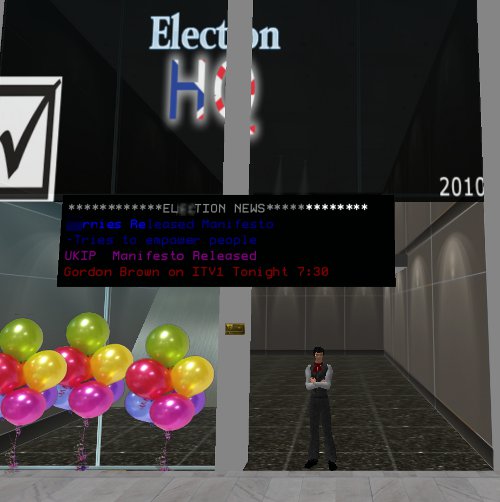
Readers may be wondering what has happened to my grand plans to launch a grid-wide insurrection to bring democracy to Second Life. I haven’t forgotten about it completely, but I have been distracted by some real-life political activity; I realised that if I had time to spend on agitation in an imaginary world, then I had no real excuse for dodging my responsibilities in my local community, where the issues are rather more pressing.

I was also a bit discouraged when I read Annabelle Boyd Jones’s B.A. thesis (OK, when I read the abstract of Annabelle Boyd Jones’s B.A. thesis) The Disconnect Between Journalism and Governance; A Critical Analysis of the Interaction of Journalism and Governance in the Virtual World Second Life, in which she concludes that journalism (and what is SLS if not citizen-journalism?) has had “negligible influence over the structure and direction of governance”. Ms Jones was awarded first class honours, so I guess her work is fairly robust, though I felt her selection of SL sources was a little restrictive, taking in the usual suspects like the Herald and New World Notes, plus the now-defunct AvaStar and Reuters SL, though also Your 2nd Place and Second Thoughts, the latter amusingly characterised as “incendiary”.

On the other hand… My re-engagement with local politics isn’t entirely attributable to guilt-tripping; thinking about democracy and radicalism in the context of Second Life reminded me how stimulating political activity can be, and primed me to get back into it. I ended up re-reading most of Trotsky’s The History of the Russian Revolution, which really catches the excitement of the times, as the old order collapsed and a new world of limitless possibilities opened up. (John Reed‘s Ten Days that Shook the World, and Warren Beatey’s epic film Reds, based on Reed’s life, are equally inspiring.)

It can be argued that Second Life is a similarly fresh political landscape, and the challenges faced by anyone trying to build a progressive movement on the grid would be comparable to those in front of the Bolsheviks as they sought to galvanise the population of Russia around a new ideology in 1917. It would follow that, just as there are lessons for revolutionaries today in the events of October, agitating in SL might teach us something about organising in real life. Role-playing revolutionary games in Second Life could provide the intellectual space where ideas about engaging people with radical politics can be tried out and refined, before being fed back into offline experience.

For example, I was thinking about how I might go about recruiting members to an SL Communist Party, and naturally I fell back on my fairly extensive experience of doing similar things in the real world. Thinking about how to translate this on to the grid forced me to consider what worked and what didn’t, what were the really essential steps and what was just habit, what was outdated and what still applied. All this was still in my mind the other day when I met with some people to talk about what kind of intervention we can mount around the forthcoming UK General Election, and my contribution to that discussion was certainly informed by the thoughts I’d had about Second Life. Time will tell how useful these grid-derived insights are going to be of course, and the process would undoubtedly have been more valuable had I started it about a year ago, so that I could have gone through a few iterations of virtual party building and generated more feedback, but it felt as if I had been able to look at things from a new angle.

Does this mean that I am softening on my immersionist position and coming round to a more augmentalist viewpoint? Not really, because I still think that what happens on the grid has no direct significance outside of the game world, and that no matter how good a virtual simulation might be, the lessons learned only become valuable if they are applied to action in the real world.

The idea that games can be useful in preparing us for more serious affairs is hardly new of course; it’s something we have been doing in one form or another since the dawn of humanity. Wellington said that the Battle of Waterloo was won on the playing-fields of Eton, (though Orwell thought that the opening battles of all subsequent wars had been lost there.) Perhaps the outcome of future conflicts will be decided on the sims of Second Life.

Discordant Thinking

Here’s a classic social psychology experiment: recruit a bunch of college students and split them into two groups. Have them all spend a couple of hours doing some dull, repetitive task, but give the first group $50 each for their trouble, and the second group only $1. Then ask them to report how enjoyable the job was; the high-paid group will tend to rate it lower than those who received only a pittance.

This may seem paradoxical, but is easily explained. The contrast between the subjects’ image of themselves as smart, successful people and the menial task they have been assigned causes them to experience an uncomfortable cognitive dissonance; the first group can resolve this by reasoning that they’re doing it for the money, but the second group have to try to convince themselves that the job itself is intrinsically interesting, and that they’re not stupid for wasting their time with it.

I thought of this when I read the story of the businessman who dramatically cut his document-translation bill by getting SL residents to do it for L$50 (US$0.20) a go, rather than the going rate of US$50. (I learned of this via a tweet from Wallace Linden, who seems to think that it’s a great advert for the platform; “Do business in Second Life – our residents are morons who will work for buttons!”) I can’t imagine that the people who did the work really believe that their time is worth only 0.4% of their real-life equivalents, so they must be thinking that, because it’s happening in SL, it’s actually fun, and not work at all. (Of course they may be ripping the guy off by cutting and pasting his documents through Google translate, but even that would take a couple of minutes, so we’re still talking sub-minimum-wage labour).

It makes me wonder if a similar psychological process is behind my own enjoyment of Second Life. I spend a lot of time wandering around deserted landscapes looking at rather dull virtual architechture, and even more time reading (and commenting upon) the boring tittle-tattle that makes up the SL blogosphere. When I think about it, it does seem a bit pointless (which is probably why I keep it a secret from just about everyone I know.)

On the other hand, virtual worlds are the brightest stars in the technological heavens, aren’t they? They must be, or all us smart people wouldn’t be wasting our valuable time with them…

Monetising SL 2.0

I feel that I should download the SL 2.0 viewer, just so that I can have an opinion about it, and join in the general excitement, but I’m finding it hard to get enthusiastic about what is, after all, just a gateway to the really interesting part of Second Life, that is the content and the community. When I first signed up to SL a couple of years ago I downloaded the alpha build of the Linux client, and I was happy with that until fairly recently, when the Lab started restricting which viewers you could log in with and it stopped working. I switched to the then-current version of Snowglobe, which I have had no major complaints about.

I’ve never been entirely convinced that making the viewer more user-friendly was the key to broadening SL‘s appeal. I guess the Lab did some consumer research that told them that the viewer’s rather steep learning-curve was contributing to SL‘s woeful retention rate, and I’m sure that the new version makes it a bit easier to get through the first hour, but I would have thought that keeping people on board for months and years would depend more on the nature of the virtual world and its residents than the bells and whistles of the client software.

Though maybe I’m overstating the importance of content. The BBC are currently running a series The Virtual Revolution (which you can watch online if you live in the UK), which is taking a look at the impact on society of the growth of the internet in the last 20 years. It’s necessarily broad, and there’s been nothing terribly surprising, but it’s still interesting, particularly the discussion of how Web 2.0 has been monetised. Services like YouTube, Facebook and Twitter may get their user-generated content for free, but most of it is worthless junk. That doesn’t matter though, the theory goes, because as users post, search, rate and comment on all those videos, updates and tweets, they reveal a mass of valuable data about themselves and their social networks, information that can be profitably mined for targeted advertising.

One can’t help but wonder if the Lindens have some similar plan in mind. They have certainly been talking up the social-networking aspects of SL, with their purchase of Avatars United, and Wallace Linden’s suggestion that we should all link our real identities to our avatars. If they could find out all about us and our interests, they could turn that into a revenue stream, provided they could figure out how to serve up the ads in a way that wasn’t too annoying. Perhaps the much-touted URL-on-a-prim functionality of the 2.0 viewer is part of the Lab’s plan to sneak pop-up advertising into the virtual landscape.

The Kid With The Replaceable Head

People who know how I dress would probably refuse to believe this, but I am a regular reader of the fashion pages in the newspaper, especially when there is some big event like London Fashion Week on. I don’t update my own style, such as it is, with any great frequency – an observer with only my wardrobe to go by would conclude that there had been no major developments in male couture since Richard Hell started wearing ripped T-shirts in 1976 – but I do like to keep in touch with the latest trends, so that when I meet someone new I can judge how much of a fashion victim they are.

LFW has of course been overshadowed this year by the death of Alexander McQueen. Fashion is by its nature ephemeral, but there is no doubt that McQueen was one of those designers who deserves to be thought of as a serious artist, and whose influence on popular culture went far beyond the catwalk. The tragic circumstances of his passing, with so much of his career still in front of him, only adds to the feeling that the world has lost a major talent.

Anyway, I mention this because I was reading an article about Swedish designer Ann-Sofie Back’s new collection, which apparently has been inspired by her experience working as a stripper in Second Life. Interestingly, she doesn’t seem to rate SL, or the virtual fashion industry, very highly, describing it thus: “Second Life is quite a shitty, slow game where nothing much happens, but people do make an effort with clothes, hair and make-up. The weird thing is, you have the chance to really create something fantastic – you know, with rabbit ears or you could be green. But most people want to look like Katie Price and Peter Andre, and wear clothes like people on Big Brother. It’s even more conformist than real life.”

I won’t pretend that I know enough about the SL fashion scene to say whether or not Ms Back’s opinion is accurate, though my limited observation has made me think that there is quite a degree of conservatism operating, with most of the items available being a variation on a few themes, so she may well be on to something.

The assertion that SL in general is essentially conventional does seem more counter-intuitive, when one thinks of the myriad of character types one meets around the grid. Sometimes outward rebelliousness masks inner conformity though, and the rules governing a subculture can be as rigid as any in more mainstream society. Someone needs to do some anthropological work among SL‘s Furries or Tinys or Vampires or whatever to see if this is the case.

Considering all this has led me to reflect on the way I have been leading my virtual existence, on the grid and in this blog, and how much I have used SL to break with convention and explore facets of my personality that I normally keep hidden. Sadly, I must admit that I haven’t really taken up the opportunity to reinvent myself to any great extent. My avatar looks pretty much like I do (or did 20 years ago at least), and my activity is a similarly unadventurous echo of the ineffectual political agitation and low-powered cultural and psychological rumination that passes for my day to day intellectual life.

You may think that the fact that, faced with the limitless possiblities for self-expression offered by Second Life, I have chosen to create an alter-ego that is at most a slightly polished version of my real self, is a sign that I have a dreadful lack of imagination, and you may well be right. I however prefer to recall the research in this area which suggests that it is the people with the lowest self-esteem who are most likely to idealise their virtual existence, and to conclude that my rather boring cyber-identity proves that I must be supremely well-actualised in real life, and that my personality has only a little room for improvement.

And talking of Richard Hell

O Superman

The JLU saga rumbles on, and has jumped from Second Life into the real world, on the way losing much of its lustre.

I may have exaggerated a little when I implied that the wannabe superheroes were some sort of virtual Freikorps, but they do seem to be doing their best to make themselves look like a thoroughly sinister outfit. Their latest stunt is to try to censor the Herald’s exposé of the secret JLU database by threatening the paper’s web host with the DMCA. The Herald, to their credit, are not taking this lying down, and have counter-filed a complaint charging JLU supremo Kalel Venkman with intentionally lodging a false DMCA report, which, I understand, is not a trivial offence.

(A side-effect of this process has been to reveal the real-life identity of Herald editor Pixeleen Mistral, who, rather impressively, turns out to be internet legend Mark McCahill.)

The whole story was quite fun when it was confined to the grid and the SL blogosphere, but I suspect it is about to become rather less amusing for the participants now that everyone is getting lawyered-up. A well-connected academic like McCahill can probably look after himself – I’m sure he’ll be able to hit up Lawrence Lessig for some free legal advice – but Venkman, who, the internet tells me, is really a technical writer from Los Angeles, may be having second thoughts about the potentially expensive escalation of hostilities that he has initiated.

Why has Venkman done this? He had a perfectly good role-playing scenario set up, with heroes and villains, intrigue and espionage, skulduggery and back-stabbing, confidential dossiers and secret deals, topped off with open conflict between the forces of good and evil across hundreds of worlds – all the ingredients for a gripping narrative, with Venkman himself right at the centre. He’s trading that for a dull tale of dreary lawyers exchanging dismal arguments in dusty courtrooms, a story that seems likely to end in unhappiness for Venkman and his lycra-clad cohort.

This seems to me to be a case of incomplete immersion, or perhaps over-augmentation; either way Venkman appears to have lost sight of the boundary between the virtual world and the real. The role of “Venkman” has become so important to his self-image that he is unable to see the Herald‘s story for what it is –  a chance to build on the mythology he has already established, an opportunity he should welcome – and instead regards it as a threat to his real-life identity, one which must be countered with a real-life action, regardless of the fact that such action risks destroying his existence, both virtual and real.

The story reminds me of cases we’ve covered before – the tale of another virtual superhero, Twixt, and the Stroker v. Linden lawsuit. Both of these involved people acting in ways that made no sense when seen in the context of the virtual world alone, but became more comprehensible when one thought about the interaction between virtual and real identities, particularly the unconscious aspects of the latter.

Is it possible to be a complete immersionist, to live one’s virtual life in total isolation from the conscious and unconscious influences of one’s everyday personality? Would such a thing be desirable? Probably not, for what is interesting to me about living a Second Life, and recording my thoughts about it, is the way that it casts light on corners of my consciousness that I may have been only vaguely aware of. While projection of real-life neuroses into the metaverse may be illuminating, I’m much less convinced that allowing in-world dynamics to leak out and influence one’s external behaviour can be anything other than harmful. This may be a lesson that Kalel Venkman, or at least his mortal alter-ego, is about to learn the hard way.

Because when justice is gone, there’s always force.

Second Life, with graphics, on the iPhone?

I’ve had the Touch Life app on my iPhone for a while, though I tend not to use it much, since not being able to move around (apart from teleporting) or see what is around you (apart from a map view) means you don’t get anything like the full SL experience.

However when I read about the Peek360 service from Avatrian, which lets you view SL via a web interface, I figured that there might be a way of making the mobile SL experience a bit more satisfying.

Step 1: Log into Touch Life and teleport to where you want to go. Note the region and the coordinates. Log out.

Step 2: Launch Safari and go to the Peek360 page. Enter the coordinates noted above, and your email address. Note the estimate that is given for when your image will be ready (from 4 to 30 minutes the times I did it).

Step 3: Log back in to Touch Life (if you want to be in the picture), then wait for the period mentioned above. Log out.

Step 4: Check for the email from Peek360, and follow the link to the picture taken by the bot they sent to the coordinates you gave.

The rather disappointing result of this cumbersome process can be seen below:

(In the spirit of this experiment I posted this with the WordPress iPhone app, and I don’t know how to rotate the screenshot.)

Not quite a killer app then. It might work better on a device that allowed multiple processes, and ran flash.

If I was smart enough I could probably set my desktop to log in to SL, then feed screenshots to a web page that I could access with my iPhone, with some sort of remote-access facility to allow me to control the viewer. The frame rate would have to be pretty slow, but it should be playable.

[Update: someone already did this of course, two years ago in fact.]