I need to return some videotapes…

Man, these flotation tanks are something else; I went in for a quick dip, and when I got out three weeks had passed…

The weather has turned much colder since I last posted, dispelling any lingering memories of the summer and heralding the onset of another brutal North-European winter. When I was younger I used to quite like autumn and the winter months; walking to work in the crisp cold dawn and spending the long dark nights drinking and socialising by friendly fires. Now, as the leaves fall and the darkness draws in, I can’t help but reflect gloomily on the season just past, and how it is likely that I have more summers behind me than lie ahead.

Recent years have seen me go out a lot less in the winter, a trend exacerbated by my growing addiction to the internet. Brave the icy winds to meet friends in a crowded bar, or enjoy wandering on a (virtual) tropical beach? Drive up into the mountains for a day of skiing, or curl up with my laptop and read about someone else doing it instead? Looking out the window at the grey sky, it seems like an easy choice.

I do make more of an effort to leave the house during the warmer weather, usually going to the park with a book. I did perhaps read a bit less this summer, now I’ve got an iPhone, which lets me get my cyber-fix even when I’m out and about. The city where I live has a “no drinking in public” ordinance though, which means if I am minded to take a small refreshment and/or a discreet smoke while reading, which I often am, I am obliged to remove myself to the quieter corners of the park where the other substance abusers hang out, and where it is rarely advisable to flash expensive electronic gadgets, so the low-tech book still comes in handy for entertainment.

What I’m reading at any given time is largely dependent on what happened to be on the shelves of my local second-hand bookstore the week before, but I do try to rotate through a cycle of contemporary fiction, classic literature and non-fiction, padded out with a lot of pulpy sci-fi.

This summer I finally got round to buying a copy of Lunar Park, which had been on my “to-read” list for ages. Bret Easton Ellis is one of my favourite living authors; when I daydream about writing a novel his is the style I imagine myself emulating. I like the way he can build a sense of dread and paranoia from deceptively banal descriptive prose; never has an appreciation of the work of Phil Collins sounded so terrifying. American Psycho is easily his best work, maintaining a thoroughly unsettling tone from start to finish, thanks to a central character at once monsterous and comic, insecure psychopath Patrick Bateman. Ellis’s other novels are more patchy; Less Than Zero is certainly efficient in evoking a sense of ennui, but as a result it rather lacks narrative momentum, similarly Glamorama‘s characters are so authentically shallow that it is hard to remember who they are let alone care what happens to them.

Lunar Park isn’t as good as Psycho but it is very entertaining, particularly the opening chapters where Ellis constructs a plausibly alternative autobiography, before setting up an intiguing suburban horror story. It flags a bit in the last third, when the subtext overwhelms the narrative to some extent, but the themes of loss and regret are mostly woven into the story in a pleasingly organic fashion, and the ending is unexpectedly poignant.

I’ve picked out a few volumes to get through before the end of the year, and I’ll try to write some brief notes on them, since I think this blog would benefit from some more intellectually challenging content amongst the pop-culture ephemera.

That’s on hold for this week though, while I take a look at Burning Life. Look out for a post on that sometime in the next month or so…

Fly me to the moon

40 years ago today Neil Armstrong became the first man to set foot upon the moon. I was alive at the time, but too young to have any memories of the actual event. I do remember that when I was growing up in the ’70’s, watching TV shows like UFO and Space:1999, reading comics like 2000AD and lots of pulpy sci-fi novels (The Moon is a Harsh Mistress by Robert Heinlein is one that especially sticks in my mind), and of course seeing Star Wars at the cinema, I just took it for granted that by the time I was an adult there would be widely-available space travel, permanent bases on the moon and regular trips to Mars and beyond.

Whole books have been written about my generation’s disappointment when these visions of the 21st Century failed to materialise. What we got was the internet, with virtual worlds to explore instead of alien planets. It is possible to visit a the SL version of Tranquility Base:

moon01

and numerous other lunar-themed sims, like this somewhat gloomy moonbase:

moon02

or this rather cooler one:

moon03

but I can’t help feeling a bit cheated.

The disillusionment isn’t just a generational thing though. It reflects my internal dissatisfaction with the course that my life has taken, as I age and am forced to acknowledge that there are some opportunities that will never come my way. It’s not that I’m unhappy with the decisions that I have taken over the years, just that every path that one chooses means leaving many more untrodden.

And anyway, I’m still hopeful that NASA will get their act together and make space travel available to the masses before I die. I just want to see what spring is like on Jupiter and Mars

Ferrisburg, Vermont

Award-winning Second Life artist AM Radio has a new work, “The Red and the Wild” on display at the Institute for Digital Intermedia Arts.

An empty house and a steam locomotive float eerily on the surface of a shallow sea. A dynamic red mass surges out of, or perhaps into, the upper storey of the building, exploding over the landscape. Cables radiate out from the house, leading to boxes containing mysterious artefacts. In the distance stands a row of water towers, brooding over the horizon.

red-wild01

What does it all mean? In a Freudian analysis, a house would symbolise the human body, the open window suggesting a female form, while the locomotive and the water towers seem clearly phallic. The scarlet substance may be blood, or perhaps a representation of energy of some kind. Is it emanating from the building, or penetrating it? Are we witnessing an escape, or an intrusion?

I may be over-analysing this. Mr Radio, in the interviews he has given about the piece, says it was inspired in part by “Breakfast at Tiffany’s“, where Holly Golightly visualises her anxiety as a “mean red”. He also mentions that the house is based on one that he remembers from childhood. Looking inside the building reveals that the red has its origin in what looks like a crystal radio set. So maybe there is a message about containing anxiety by constructing your own reality/identity, something that Second Life is well suited to.

Or not. The ambiguity of the piece is a large part of its attraction. It’s like a Rorschach ink blot. My sexualised interpretation tells you more about me than it does about the artist or the work.

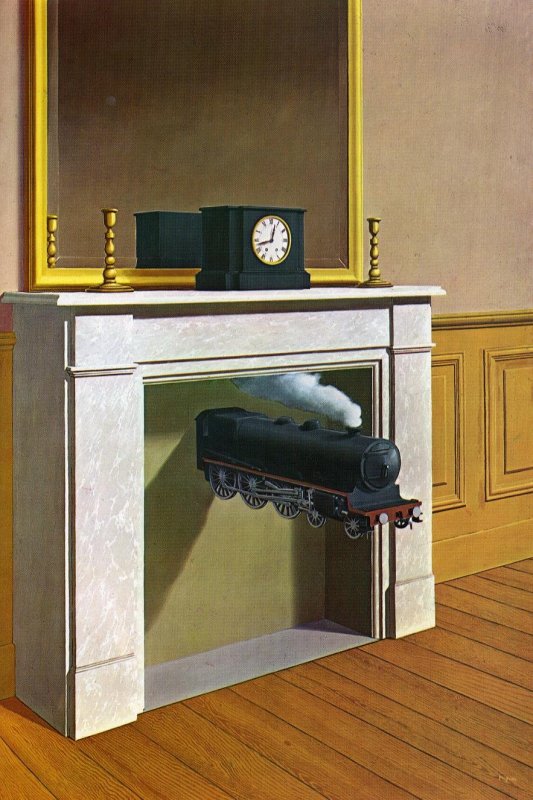
I’ve read a couple of pieces about AM Radio, but I haven’t heard him discuss his influences. I would say that his installations give more than a nod in the direction of surrealism, particularly the work of René Magritte. Doorways, windows, locomotives, are all recurring themes.

(As an aside, I vaguely remember seeing somewhere that someone had created an avatar with an apple for a face, after Magritte’s famous image. If I only imagined that, and no one has actually done it, I want to claim credit for the idea right now).

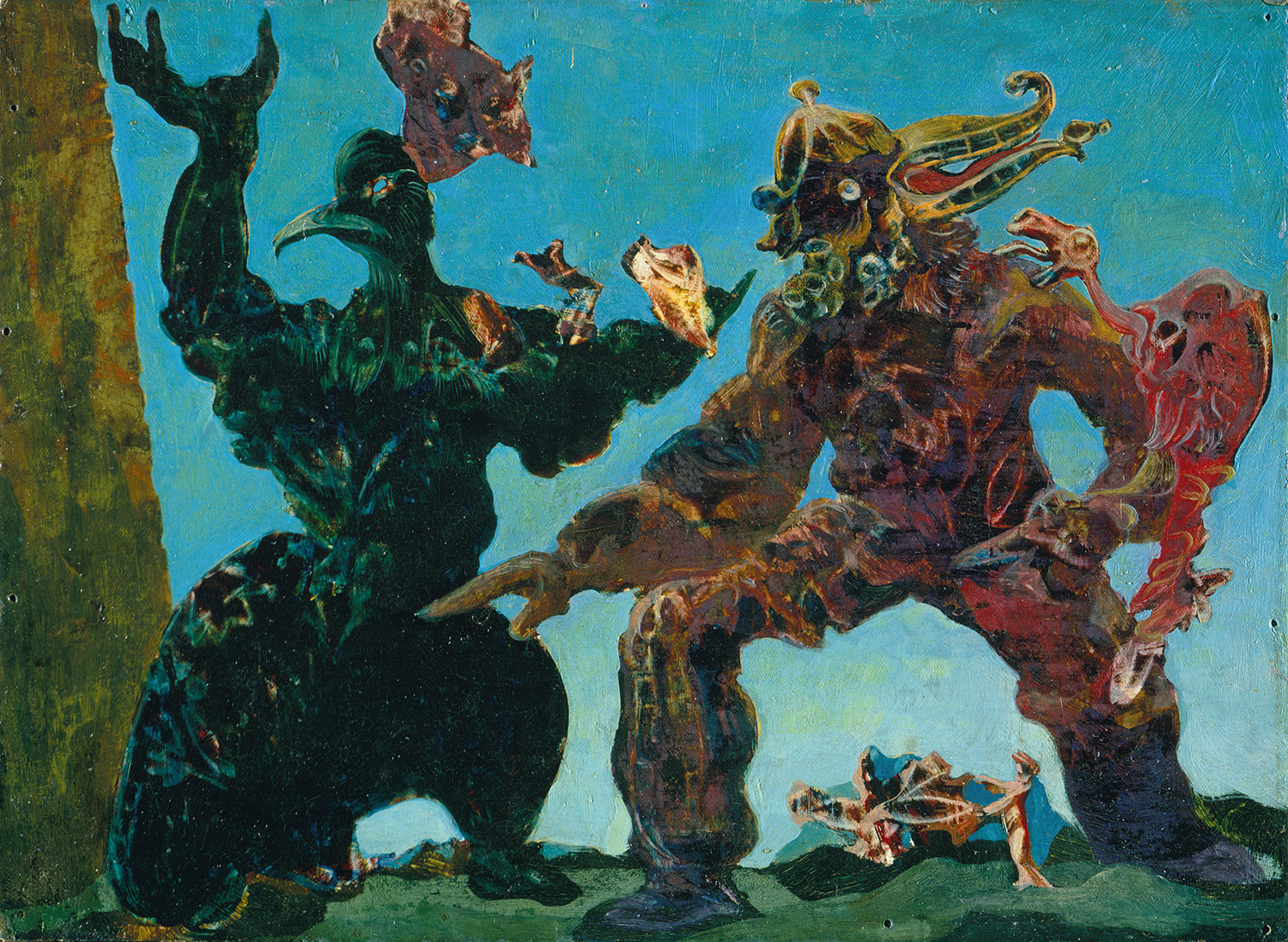
I like AM’s stuff, though I find it mostly intriguing rather than unsettling in the way that the best surrealist works are. I think the Second Life aesthetic is too clean to really invoke that dream/nightmare feeling that you get from someone like Max Ernst.

My favourite is probably the “Lost Highway” segment of “The Space Between these Trees“:

space01

Doors again. The Doors of Perception perhaps. I should drop some mescaline next time I log on, I might get more of a nightmare thing going.

Bötterdämmerung

… would have been a much better title for my last post, come to think of it.

I first saw Blade Runner during its original cinema run back in 1982, around the same time as I was reading all the early William Gibson stuff, and it had a similarly profound effect on my emerging aesthetic consciousness. Functional hi-tech amidst a crumbling cityscape has been my idea of what the future holds ever since, and it’s always seemed quite attractive. What with the depression, and global climate change, and the decline of the Western powers, it’s just about possible to imagine that Los Angeles in 2019 will look pretty much like it does in Ridley Scott’s movie, though maybe without the flying cars, and hopefully without the killer robots on the loose.

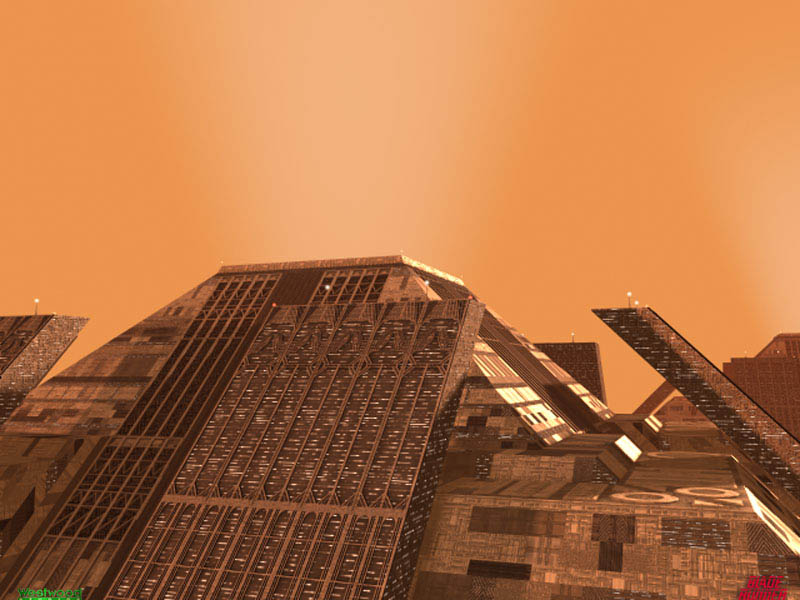
There is a Bladerunner City in SL, but the architecture on display owes more to the ziggurats of the Tyrell Corporation than the run-down streets of future LA which, for me, are the most visually pleasing element of the film. The owners of the sim are evidently interested in transhumanism; the welcome notecard at the entrance gives a brief history of the idea, from Dante to Huxley. I got the impression that they would prefer Roy Batty (surely the least threateningly-named homicidal android ever) to the crumpled Rick Deckard, though of course (spoiler alert) it turns out that Deckard’s human frailty is actually a more perfect realisation of the replicant-maker’s craft than Batty’s superhuman abilities (or not, it depends which version you watch).

I can’t say that I am familiar enough with the various strands of transhumanism to have a firm opinion about it; I do believe that technology changes who we are as humans, but I think that that process does not operate on the level of the individual, but rather is mediated through the changes in social organisation that accompany advances in science. To take the internet as an example, it is only now that we are working out how to use it in a social way, with things like Facebook, and blogs, and even Second Life, that the full civilisation-changing potential of the medium is becoming apparent. Maybe one day we will all be dreaming of electric sheep.

Precocious wisdom

My assertion that only the young and inexperienced can have the confidence to write authoritatively about the mysteries of love seems to be borne out by the news that “How To Talk To Girls”, a book by nine-year-old Alec Greven, has made it on to the New York Times best-sellers list.

I would point to this as further evidence of the infantalisation of our culture, but, as far as I can tell from the reviews, the key tip the book imparts for clicking with the chicks is “Pay attention to them when they are talking about stuff they like”, which is actually pretty sound advice. I wish I had known that when I was nineteen, never mind nine.

Cargo cult consciousness

There was once a time when I was a regular reader of the Second Life Herald, but these days I look at it only rarely. Founded by noted metaverse pioneer Peter Ludlow, aka Urizenus Sklar, the Herald, with its mission statement “to record, observe and study the legal, social and economic implications of life in the virtual world” promises some serious commentary on Second Life culture, a window into what is going on in the minds of the grid’s most interesting residents.

In reality the Herald is a strange brew; part superficial yet impenetrable gossip, part breathless exposé . I have never been able to decide if one is meant to take it seriously, or if it is in fact some sort of elaborate joke, a parody of our shallow, celebrity-obsessed culture and insatiably sensationalist media.

The overall impression, for me anyhow, is rather exclusive; to extend William Gibson’s high-school simile, it’s like the class newspaper edited by the popular kids; the geeks, dweebs and other losers can look but only dream about joining in. Just like any non-virtual celebrity-gossip publication in fact, but with one crucial difference; while real-life celebs, at least on the A-list, are objectively attractive, and their lifestyles glamorous, their Second Life counterparts are generally not much more aesthetically pleasing than the average avatar, and the accounts of their activities are seldom other than dull. The element that gives an edge to our culture’s worship of its secular idols – aspirational envy – is missing, and in its absence there is nothing to hold the reader’s attention.

For me the Herald is a good example of cargo cult culture; the idea that, by reproducing the form of a real-life phenomenon in the virtual universe, one can appropriate its significance. This theme seems to underlie a lot of what goes on in Second Life, and its essential fallacy is why life on the grid so often seems unfulfilling.

I think that it is mistake to see the potential of the metaverse as lying in the ability to mould a more perfect version of the real world. What is created by such an effort is but a shadow of reality; instead of emerging into the sunlight we retreat further into the cave. The real promise is contained in the possibility of experiencing something that augments our perception of reality rather than trying to reproduce elements of it. I don’t know if that is going on somewhere on the grid, and I’m not sure that I would be able to recognise it if it was, let alone articulate its meaning.

The problem is that everyone who comes to SL, myself included, brings with them the baggage of conscious and unconscious expectation. I am self-aware enough to know that in visiting the grid, and especially in writing about it in this blog, I am chasing after something that is missing in my real life. Put like that it sounds a bit dysfunctional, but I think that for most people a little wish-fulfillment is a healthy thing, and reflecting on experience in Second Life can provide useful insight into what is going on in one’s life outside the metaverse. Perhaps if Freud were living now he would ditch the interpretation of dreams in favour of avatar analysis as a royal road to the unconscious. It is of course possible to overdo this, and use one’s virtual life as a way of hiding from, rather than illuminating, the problems of real life. This desire to evade harsh reality is certainly one of the factors underlying internet addiction, or indeed any sort of addiction, but even for the non-addicted majority of SL residents, in whose number I count myself, there is a downside to the escapism – by using SL as a way of relieving my frustration with the limitations of my current existence I am locking myself into a real-world paradigm, and thus missing out on the what the grid really has to offer. If I was perfectly happy with my life I could perhaps approach SL with an open mind and experience its full potential, but then if I was perfectly happy with my life I wouldn’t be wasting hours sitting in front of a computer screen.

It’s the Second Life paradox; the people who will visit regularly do so because they are, more or less consciously, trying to fill some gap in their lives; as a consequence of this they are the least likely to be able to make the most of the opportunities SL affords. Meanwhile the people whose lives are fully realised, the very ones who would be best suited to exploring the possibilities of this new virtual world, will never feel the need to come anywhere near it.

The Sprawl

As I mentioned a while ago, back in the early 80’s I had a subscription to OMNI magazine, and it was there that I read the early work of William Gibson, including “Burning Chrome“, in which Gibson introduced the term “cyberspace“. I haven’t read that story for over 20 years, but I can still remember how excited I was by the idea of plugging your brain into a computer and being instantly transported to a virtual world in which pure information was experienced as unmediated sensual perception.

I have subsequently gone off actually sticking wires into my skull, but I still like the concept of an immersive artificial experience. Part of my disappointment with Second Life has been its failure to live up to Gibson’s vision of cyberspace as “a consensual hallucination … lines of light ranged in the nonspace of the mind”.

There’s an interesting interview with Gibson on his website, in which he talks about his experience of visiting Second Life, which he compares to “a cross between being in some suburban shopping mall … and the worst day you ever spent in high school”, which chimes with my experience – there’s hardly anyone else around, and the people you do meet won’t talk to you.

It’s well worth reading the whole interview; Gibson touches on a number of interesting points, including the way that the ubiquity of internet access means that everything that is published these days is effectively hyperlinked, and how this alters the relationship between author, reader and text.

Though I guess that authors have always seen their work appropriated as inspiration for other artists.

Hot Chicks with lawyers

In my high-minded discussion of the ethics of blogging I overlooked one obvious hazard of casually appropriating the private details of other people’s lives; getting sued.

That truth has found Jay Louis though, now that he’s on the receiving end of a lawsuit in connection with the book of his blog “Hot Chicks with Douchebags“. It’s interesting that he wasn’t sued over the website itself, presumably because potential plaintiffs need a defendant with some serious money, like publisher Simon & Schuster, before they can persuade a lawyer to take on the case.

I can’t see the suit succeeding, since even someone like me, whose knowledge of the US legal system is entirely based on watching “LA Law” and “Ally McBeal“, knows that the First Amendment protects the right to shower ridicule on your fellow citizens. I guess the claimants – who allege that their appearance in the book has left them needing medical treatment and psychological therapy – are hoping that S&S will settle out of court to avoid the bad publicity. (Or perhaps not; I had it in my mind that Simon and Schuster were a classy operation, but they do publish literary gems like the “Douchebag” book and “Hooking up with Tila Tequila“, so I may be mistaken).

I don’t think anyone could seriously claim that their real-life reputation was damaged by their Second Life activities appearing online, and, even if they did, I believe that Linden Labs have been doing their best to establish that Second Life disputes fall under the jurisdiction of the US courts, so I’ll be able to assert my Constitutional rights. I’m sure that James Madison would approve.