Cinco de Mayo

I first became aware of the significance of this date for the Latino community in the US nearly 20 years ago now, when I found myself in San Antonio, and came across an impromptu fiesta at a traditional icehouse on one of the dusty streets in the insalubrious part of town where I was staying. Twenty-four hours, many new friends, numerous beers and a lot of good weed later I was a convert. Good times.

Big Star

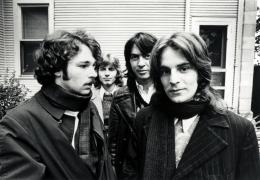
Well this is sad news; Alex Chilton died earlier this week, at the tragically young age of 59, just days before Big Star were due to play a reunion gig at SXSW.

I came to Big Star via Teenage Fanclub, who were heavily influenced by the harmonies of the Memphis-based band. Thirteen, the Fannies 4th album, is named for this classic Big Star track.

I’ve not listened to #1 Record for a while – although it came out in 1972, in my mind it’s associated with the mid-90’s, when I had it on a lot. I’ll get it out and enjoy some good memories – just a shame I’ve been reminded of them in such sad circumstances.

Fly me to the moon

40 years ago today Neil Armstrong became the first man to set foot upon the moon. I was alive at the time, but too young to have any memories of the actual event. I do remember that when I was growing up in the ’70’s, watching TV shows like UFO and Space:1999, reading comics like 2000AD and lots of pulpy sci-fi novels (The Moon is a Harsh Mistress by Robert Heinlein is one that especially sticks in my mind), and of course seeing Star Wars at the cinema, I just took it for granted that by the time I was an adult there would be widely-available space travel, permanent bases on the moon and regular trips to Mars and beyond.

Whole books have been written about my generation’s disappointment when these visions of the 21st Century failed to materialise. What we got was the internet, with virtual worlds to explore instead of alien planets. It is possible to visit a the SL version of Tranquility Base:

moon01

and numerous other lunar-themed sims, like this somewhat gloomy moonbase:

moon02

or this rather cooler one:

moon03

but I can’t help feeling a bit cheated.

The disillusionment isn’t just a generational thing though. It reflects my internal dissatisfaction with the course that my life has taken, as I age and am forced to acknowledge that there are some opportunities that will never come my way. It’s not that I’m unhappy with the decisions that I have taken over the years, just that every path that one chooses means leaving many more untrodden.

And anyway, I’m still hopeful that NASA will get their act together and make space travel available to the masses before I die. I just want to see what spring is like on Jupiter and Mars

Nothing to do with your Vorsprung durch Technik

As I mentioned before, I’m not really in the festival-going demographic any more, so when Glastonbury rolled around this weekend I settled down in my comfy chair to watch it on the TV.

It’s getting on for a decade since I last attended the festival in person, and, fun though it was, I can’t say that I miss the authentic outdoor experience all that much. It’s not that I have any bad memories of Glasto – every time I went the weather was pretty good, and I was never ripped off or anything – but latterly it began to feel like a lot of hard work, trudging around huge fields packed with alarmingly young-looking people, all for the sake of a distant glimpse of an indifferent performance by a band I was only half-interested in to start with.

I can count the festival performances that I remember with real excitement on one hand – Nirvana at Reading, the Pixies at T in the Park and the Flaming Lips at Glastonbury. There were plenty of other festivals that were fun at the time, but stick in my mind for reasons other than the music, like the people I was with, or the drugs we were taking.

So having my friends round to get stoned in the comfort of my own house is how I get the festival vibe these days. The BBC coverage of Glasto was pretty good, and when it got dull we could always put on a record. Watching Blur play their greatest hits on Sunday night was pleasantly nostalgic, a trip back to the great summer of ’95. I was never hugely into Britpop, to be honest. I did buy all the albums – Blur, Oasis, Pulp, Suede and the rest, even Sleeper, god help me – but I was more of an American alt-rock fan at the time. (I was deeply in love with Tanya Donelly for a greater part of the ’90’s). Parklife has aged pretty well though, and we all got up to dance around when Phil Daniels came on to do the title track. Know what I mean?

Like tears in rain

After my last two posts I had to dig out my copy of Blade Runner to see if it was as good as I remembered. Now I’m getting older the themes of identity and mortality are probably a bit more relevant than they were in the past, which may go some way towards explaining why the film seems to be more profound every time I watch it.

During the climatic rooftop scene, where the android Batty is mourning the ephemeral nature of his memories, I found myself thinking that, if he wanted to preserve his experience for posterity, what he needed was a blog, or, even better, a Twitter account:

roybatty I’m watching attack ships on fire off the shoulder of Orion. 2 minutes ago

I’d be the first to admit that my blogging is at least partially motivated by a desire to leave some permanent trace of my existence. It’s the equivalant of stone-age man leaving hand prints on a cave wall; perhaps future archeologists will be as puzzled by the significance of my random jottings as we are by the daubings that were the social media of our Neolithic forebears:

Grod @Zoug I can has mammothburger? 12000 years ago

Bötterdämmerung

… would have been a much better title for my last post, come to think of it.

I first saw Blade Runner during its original cinema run back in 1982, around the same time as I was reading all the early William Gibson stuff, and it had a similarly profound effect on my emerging aesthetic consciousness. Functional hi-tech amidst a crumbling cityscape has been my idea of what the future holds ever since, and it’s always seemed quite attractive. What with the depression, and global climate change, and the decline of the Western powers, it’s just about possible to imagine that Los Angeles in 2019 will look pretty much like it does in Ridley Scott’s movie, though maybe without the flying cars, and hopefully without the killer robots on the loose.

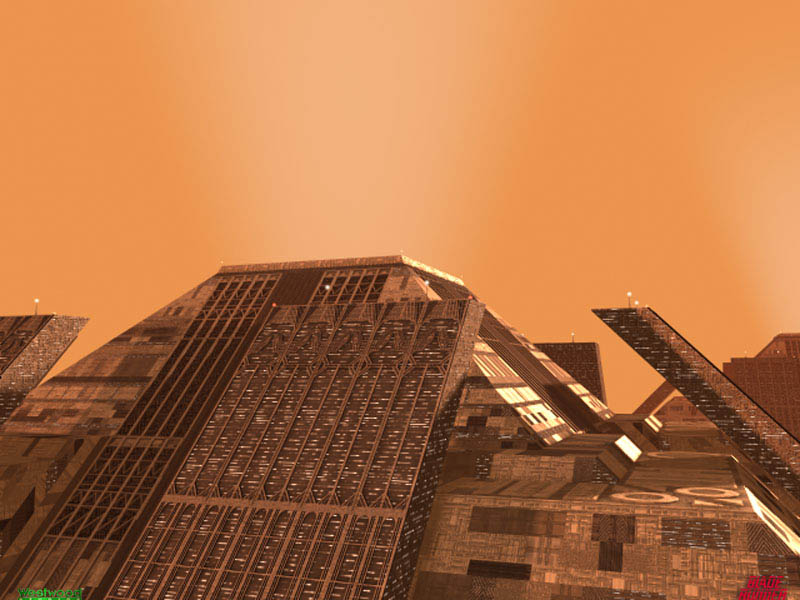
There is a Bladerunner City in SL, but the architecture on display owes more to the ziggurats of the Tyrell Corporation than the run-down streets of future LA which, for me, are the most visually pleasing element of the film. The owners of the sim are evidently interested in transhumanism; the welcome notecard at the entrance gives a brief history of the idea, from Dante to Huxley. I got the impression that they would prefer Roy Batty (surely the least threateningly-named homicidal android ever) to the crumpled Rick Deckard, though of course (spoiler alert) it turns out that Deckard’s human frailty is actually a more perfect realisation of the replicant-maker’s craft than Batty’s superhuman abilities (or not, it depends which version you watch).

I can’t say that I am familiar enough with the various strands of transhumanism to have a firm opinion about it; I do believe that technology changes who we are as humans, but I think that that process does not operate on the level of the individual, but rather is mediated through the changes in social organisation that accompany advances in science. To take the internet as an example, it is only now that we are working out how to use it in a social way, with things like Facebook, and blogs, and even Second Life, that the full civilisation-changing potential of the medium is becoming apparent. Maybe one day we will all be dreaming of electric sheep.

Bad reputation

Reports revealed this week that the UK government is maintaining an island in Second Life, at a cost of £12000 a year, for the purpose of allowing private companies to showcase new technology.

I would show you some pictures of the sim, but of course we mere taxpayers are not permitted to visit; only government officials and the firms taking part can gain access. The story has created a minor scandal, with opposition politicians seizing the opportunity to accuse the ruling party of “living in a fantasy world”, while the scheme’s defenders have claimed that holding meetings and events on the grid will greatly increase government efficiency.

My first reaction to this story was to think that £12000 a year was not a great deal of money, as government expenditure goes – it’s the equivalent of one very junior civil servant. Compared to the amount that, say, defence contractors gouge, it doesn’t seem to be the basis for a particularly lucrative business, even if the project is expanded when the pilot phase ends in 2011.

It also makes me wonder why government departments, or corporations, or educational establishments need to be connected to the main grid at all. Why don’t they run mini-grids on their own servers? That would be sufficient for meetings, presentations and teaching, without the risk of participants wandering out of the building and coming across something scary; it would also maximise control over access and security, and would presumably run faster and be more reliable. Most importantly perhaps, it would create some distance between the client’s business and the potentially toxic Second Life brand.

For the one thing that the man in the street knows, or thinks he knows, about SL is that it is a haven for sexual perversity of the worst kind, and while Linden Labs may insist that they have solved the problem by quarantining questionable content in its own continent, all they are doing is drawing more attention to the fact that the problem exists in the first place.

The potential customers that L-Labs are courting with their new U-rated strategy are probably not particularly worried that they personally will be exposed to anything untoward; they will be more concerned that association with Second Life will be a hostage to fortune. Political opponents, disgruntled shareholders or disaffected employees will be able to search Google images for something suitably salacious to take to the media; the result will probably be transient embarrassment rather than lasting damage, but why take a chance?

Real-life locations can reinvent themselves of course; I remember Times Square being pretty sleazy when I visited New York years ago, but I hear it is now thoroughly Disneyfied. I guess time will tell if Second Life will be able to undergo a similar process of rehabilitation.

I’m sure Joan would agree with me that Times Square was better the old way.

Intelligence Failure

I can still remember the story on the front page of the only copy of the Seattle Post-Intelligencer that I ever bought – it was a report on the assassination of Rajiv Ghandi, which means I must have purchased the paper on the 22nd of May 1991, when I was travelling up the Pacific coast on my way to the Cascade Mountains.

If if I ever make it back to Seattle (which I hope I do one day, because it is probably the nicest city I have ever visited) I won’t be able to buy the paper again, because, as of today, the S P-I has become an online-only operation, after 146 years in business.

The print newspaper model – where investigative reporting was subsidised by advertising sales – has collapsed, as ad revenue has migrated to the web. What will fill the news-gathering vacuum left behind? The idea that an army of bloggers will ever replace the likes of Woodward and Bernstein is patently ridiculous.

Information may seem to be more freely available then ever, thanks to the ubiquity of the internet (in the developed world at least), but the real knowledge, the stuff the Man doesn’t want us to know, will be buried even deeper in the mass of celebrity trivia and idle speculation that passes for news in the blogosphere. We are doomed to a new age of ignorance. Only musicians can save us now.

R.I.P. Lux Interior

I hadn’t played anything by The Cramps for a while before I thought about them on New Year’s Eve, so this last month I have had “Off the Bone”, “Smell of Female” and the rest on fairly constant rotation on my stereo; I was listening to this track when I read the tragic news that Lux Interior had passed away.

I wouldn’t say that I knew Lux, though I did shake his hand once, and I must have seen The Cramps play live a dozen times. They were one of the key bands that provided a musical backdrop to my student years, and, as I’ve said before, the passing of one more of the stalwarts of that scene is another reminder of how long ago it all was.

The Sprawl

As I mentioned a while ago, back in the early 80’s I had a subscription to OMNI magazine, and it was there that I read the early work of William Gibson, including “Burning Chrome“, in which Gibson introduced the term “cyberspace“. I haven’t read that story for over 20 years, but I can still remember how excited I was by the idea of plugging your brain into a computer and being instantly transported to a virtual world in which pure information was experienced as unmediated sensual perception.

I have subsequently gone off actually sticking wires into my skull, but I still like the concept of an immersive artificial experience. Part of my disappointment with Second Life has been its failure to live up to Gibson’s vision of cyberspace as “a consensual hallucination … lines of light ranged in the nonspace of the mind”.

There’s an interesting interview with Gibson on his website, in which he talks about his experience of visiting Second Life, which he compares to “a cross between being in some suburban shopping mall … and the worst day you ever spent in high school”, which chimes with my experience – there’s hardly anyone else around, and the people you do meet won’t talk to you.

It’s well worth reading the whole interview; Gibson touches on a number of interesting points, including the way that the ubiquity of internet access means that everything that is published these days is effectively hyperlinked, and how this alters the relationship between author, reader and text.

Though I guess that authors have always seen their work appropriated as inspiration for other artists.