Plunging Necklines

Nosferatu-fever seems to be everywhere these days, what with True Blood, and Twilight, and of course Bloodlines, so I thought I would try to try to secure my very own Interview with the Vampire.

I got myself a nice Mina Harker-style dress, dyed my hair jet-black and headed off in search of some blood-suckers:

vampire02

[Dress, boots and accessories from Crimson Shadow, graveyard at Vampire City.]

Typing “vampire” into the in-world search threw up a few leads. The first couple of places I visited turned out to be undead-themed combat sims (as far as I could tell, since the welcome notes I got were in Portuguese), and I also came across several gothic clothing stores, but I eventually got lucky and landed up at the home base of one of the larger Bloodlines clans.

Half a dozen or so tall, dark, caped figures were gathered in the courtyard of a Medieval-style castle. They seemed to be waiting for something to happen, so I went over to take a look. I wasn’t sure about vampire etiquette, so I didn’t say anything at first, but after five minutes of silent inactivity I decided to break the ice.

“Are they going to like, fight, or something?” I asked the man standing next to me, gesturing towards the two heavily-armed figures at the centre of the group, who appeared to be squaring-up to one another. “I don’t know,” he replied, turning to face me. He reminded me of Christopher Lambert in Highlander 3, his trench-coat accessorised with a samauri sword. We got chatting, and he told me he had been in the clan for just a few days, having previously been a Gorean slave-master. “I got bored with all the submissiveness” he said, making me wonder what his expectations of that role had been, “so I decided to get back to my vampire roots.” “You prefer the assertive vampire girls then?” I asked, trying to sound flirtatious, but he wanted to tell me about how far he’d progressed in the vampire fighting ranks, and we ended up talking about our experiences playing D&D, which killed the moment a bit.

I had been led to believe that these Bloodlines fanatics would leap at a girl’s throat at the drop of a hat, so I was a little offended that the crowd seemed more interested in the non-existent fight than me. The awkward silence was broken by the arrival of a junior member of the clan, accompanied by a girl in a decidedly non-gothic spotty dress, who was evidently a new recruit.

One of the combatants, who turned out to be the head of the clan, broke off from the staring contest, or whatever it was, to greet the newcomers. After some small talk it was decided that we should all head off to the Turning Chamber for the Initiation Ceremony. I asked the new girl if she minded me tagging along, and she was cool with that, so I followed the others into the castle.

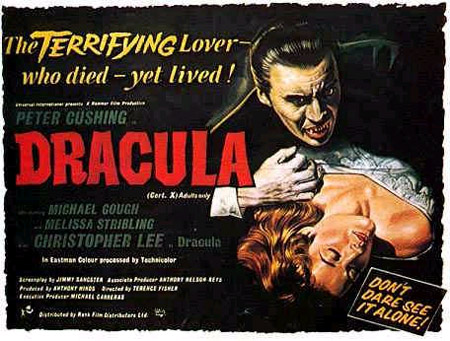
Now I don’t know what springs to your mind when you hear the words “Vampire Initiation Ceremony”, but I think of vintage Dracula flicks, where louche ghouls overwhelm swooning maidens in scenes of barely repressed sensuality, or, if I’m feeling particularly excitable, Catherine Deneuve and Susan Sarandon in The Hunger. At the very least I was expecting some sort of occult ritual, with a soundtrack of sinister Latin chanting.

You may imagine my disappointment then, when I discovered that the Turning Chamber resembled nothing more than a brightly-lit pub basement. The barrels that lined the walls were full of blood rather than beer, but the ambiance was definitely more functional than spooky. The focus of the room was not some unholy altar dripping with virginal blood, but a vending machine dispensing various Bloodlines products. After instructing the convert to buy several items (which cost about L$1000) the clan chief departed, leaving the actual biting to his minions. They didn’t seem to know what they were doing, and it took an age of searching in inventories and unpacking boxes, during which the poor girl had to log out and log in again twice, before her lifeblood finally began to drain away, very slowly. I asked Christopher Lambert how long this was going to take. “I don’t know, this is my first one” he said.

I chatted with the new vampire girl while we waited. What had attracted her to the blood-sucking lifestyle? The fashion sense and the romance it seemed. She was hoping it would get a bit better.

Christopher eventually got round to asking me if I would like to join the clan too, but I politely declined. If I ever give up my virtual soul I want it to be more meaningful than a cold transaction in a characterless cellar. The rich symbolism of the vampire myth deserves more respect.

(I know it’s unfair to dismiss Second Life Vampire culture based on a brief visit to one sim, so I’m open to suggestions of places I should visit for a more satisfying experience. Post them to mail@secondlifeshrink.com, and I’ll review them in a future post, if they’re any good).

Paranoid

Shortly after publishing my last post I tried to log on to Second Life, to meet up with Olivia, but I kept getting knocked back, with a message saying there was some unspecified “problem” with my log-in. Then Olivia emailed me to say that she wasn’t able to sign in either.

Suddenly it all became clear to me. The Lindens had been so badly stung by my criticism of their “adult content” proposals (and all my other subversive posts) that they had kicked both of us off the grid in retaliation. They were obviously logging all the traffic on this IP address. They probably had my phone bugged as well, and, come to think of it, the postman who delivered the mail this morning wasn’t the regular guy either – he must be working for them too…

I enjoyed my status as Linden Enemy #1, The Blogger They Could Not Silence, for five minutes, before reluctantly checking out the grid status page, and confirming that it was a universal glitch that was keeping everyone out.

Oh well, I can dream. At least it gives me an excuse to link to some vintage Black Sabb.

Brave New World

As readers will no doubt be aware by now, in an almost unbelievable development Linden Labs have announced the creation of a new “adult-themed” continent, to which all mainland businesses dealing in such merchandise will be required to relocate in the very near future. As it is worded the proposal seems to indicate that all adult-orientated activity will be confined to the new landmass, though various Lindens, contributing to the debate on the SL forums, have sought to reassure residents that the regulations will be interpreted in a way that will not affect what individuals do in the privacy of their own homes.

To say that reaction to this announcement has been negative would be somewhat of an understatement. I gave up reading the comments on the forum after 15 pages, but the feeling among residents was unmistakable – almost universally this is regarded as a terrible idea. Objections range from opposition in principle to the limitation of free expression, through doubts about the workability of the scheme (particularly the age verification element), to concerns from retailers worried that they will be forced to exchange their established prime locations for undesirable plots on the new continent. Just about everyone expects in-world trade to take a hammering, mainland land prices to collapse and a mass exodus of disaffected residents.

Linden Labs seem to be taking a massive risk with this move. At the moment they have a solid if limited business model – collecting subscriptions from a core of residents for whom the freedom to do what they want in SL is the main attraction. They may or may not actually engage in “adult” activity, but they like the idea that they could if they so desired – it’s a transgressive edge that is missing from their real lives. The Lindens are betting that the income they will lose as a result of alienating part of their current user base will be more than compensated for by new money from corporate and educational customers who are currently, so the theory goes, scared off by the reports of Second Life’s rampant perversity. I guess they have done some sort of research to back this up, but even so it’s a brave enterprise that will forego a proven revenue stream in pursuit of what may turn out to be an non-existent market.

Et in Arcadia ego

Back when I first started writing about Second Life I identified what I thought was the main factor limiting the potential for growth in the virtual economy, which was that residents could exist indefinitely without having to spend anything at all. Avatars never needed to eat or drink, clothes never wore out, and buying or renting a place to stay was entirely optional. Only two things were really driving commerce – discretionary purchase of fashion items and adult-themed entertainment – and this wasn’t broad enough to support more than a handful of businesses. The former suffered due to over-supply, poor quality and a limited customer base, and the latter had to compete with a large population of amateurs willing to give the product away for free.

I should perhaps have realised that this was a potentially valuable insight. Mars Braken, of Liquid Designs, the company behind SL vampire phenomenon “Bloodlines” was evidently thinking along the same lines, but unlike me he has figured out a way of turning the idea into cash.

Beneath all the pseudo-gothic jargon of the blood-sucking RPG lies a simple concept – players have a limited and decaying supply of a substance (“Sacred Blood” in this case, though it could be “hit points”, or “lifeforce”, or whatever) which they must constantly replenish, for if it falls to zero they will be expelled from the game. It’s possible to obtain free blood by soliciting donations from other residents, but this is slow and inefficient, thus creating a market in traded blood, over the supply of which Liquid Designs hold a monopoly (for the time being anyhow – no doubt we will soon be reading stories about how Chinese peasants are scraping a living collecting virtual blood to sell to western vampires).

The game has become popular enough to generate six-figure US$ revenues for Liquid Designs, according to New World Notes. It has also unleashed a plague of inconsiderate leeches, who are annoying the hell out of the normal population with their indiscriminate exsanguination.

There is probably an analogy to be drawn here with the operation of modern capitalism. Corporations play upon our insecurities to convince us that our social status depends on purchase of their products, and we fill their coffers trying to satisfy a need that we never even knew we had. I’ll just note the irony in the fact that “Bloodlines” players, in seeking to emulate creatures that never die, are voluntarily relenquishing the prelapsarian immortality that their avatars naturally possess.

A suitable case for Tweetment?

If the thought of Facebook ripping off all your stuff wasn’t scary enough, it now turns out that social media use is, allegedly, bad for your health.

According to Dr Aric Sigman (a “business and performance psychologist”) a whole host of physical ills, from the common cold to coronary disease, stroke, cancer and dementia, can be linked to use of social networking sites. He implies that the causative factor is lack of face-to-face interaction, caused by people spending too much time online.

I have read the full paper, published in Biologist, journal of the Institute of Biology, (there is a good summary of it in the Guardian), though it’s more of a magazine article than a scientific paper as such, containing as it does no original research, and no indication that Dr Sigman has carried out a systematic review of work published on the topic. I have to say that I find his conclusions somewhat hard to swallow (or at least the conclusions he highlights in his press release – the actual paper is rather more circumspect in what it says about social networking services).

First off, even if one accepts that there has been an increase in “social disconnectedness” in the last twenty years, there are any number of factors that could explain this, and attributing it all to social networking services, which are a fairly recent development, sounds more like a way of generating headlines than serious science. My experience, admittedly anecdotal, of services like Facebook makes me think that the people who use them most are actually among the more gregarious in society, and that those who have problems with real-life social interaction tend to find it difficult to cultivate online friendships too. There has perhaps been a change in the definition of “friendship”, but I think it is wrong to assume that this change is necessarily a devaluation – Dr Sigman seems to give no value to the definite positive effects of virtual interaction for people who would otherwise have little or no contact with other humans, due to physical disability, mental health problems, geographical isolation, or just lack of confidence.

Secondly, while there may well be an association between measures of social isolation and adverse physical and psychological health outcomes, the direction of causality is less clear, and the mediating factors proposed in Dr Sigman’s paper seem speculative to say the least, so it is absurdly reductive to claim that there is a direct connection between use of social media and ill-health.

Then there’s the ad hominem stuff. Dr Sigman is a repeat offender when it comes to scare stories about modern life – he has previously warned of the dangers of too much television, violent films and computer use generally. Unsurprisingly he is regularly quoted approvingly in the conservative press. He has a website of course, and a book to promote (Remotely Controlled: How Television is Damaging Our Lives), and he is available as a “Business Speaker” at £4-7K a time.

Lastly, (and I’ll admit that this is pure medical snobbery) I’m always a bit suspicious of anyone who lists “Fellow of the Royal Society of Medicine” first among their qualifications, especially when they are not medically qualified. You may think it is just for top doctors, but the title is, as the RSM website says, available to anybody “holding medical, dental, veterinary or higher scientific qualifications; or in senior positions in healthcare and related fields” who is willing to pay the annual fee. I get junk mail once or twice a year inviting me to become a Fellow of the RSM – that’s how exclusive and prestigious it is.

So, on balance, I think that people can go on Tweeting and Poking without worrying too much about premature death.

Precocious wisdom

My assertion that only the young and inexperienced can have the confidence to write authoritatively about the mysteries of love seems to be borne out by the news that “How To Talk To Girls”, a book by nine-year-old Alec Greven, has made it on to the New York Times best-sellers list.

I would point to this as further evidence of the infantalisation of our culture, but, as far as I can tell from the reviews, the key tip the book imparts for clicking with the chicks is “Pay attention to them when they are talking about stuff they like”, which is actually pretty sound advice. I wish I had known that when I was nineteen, never mind nine.

Cargo cult consciousness

There was once a time when I was a regular reader of the Second Life Herald, but these days I look at it only rarely. Founded by noted metaverse pioneer Peter Ludlow, aka Urizenus Sklar, the Herald, with its mission statement “to record, observe and study the legal, social and economic implications of life in the virtual world” promises some serious commentary on Second Life culture, a window into what is going on in the minds of the grid’s most interesting residents.

In reality the Herald is a strange brew; part superficial yet impenetrable gossip, part breathless exposé . I have never been able to decide if one is meant to take it seriously, or if it is in fact some sort of elaborate joke, a parody of our shallow, celebrity-obsessed culture and insatiably sensationalist media.

The overall impression, for me anyhow, is rather exclusive; to extend William Gibson’s high-school simile, it’s like the class newspaper edited by the popular kids; the geeks, dweebs and other losers can look but only dream about joining in. Just like any non-virtual celebrity-gossip publication in fact, but with one crucial difference; while real-life celebs, at least on the A-list, are objectively attractive, and their lifestyles glamorous, their Second Life counterparts are generally not much more aesthetically pleasing than the average avatar, and the accounts of their activities are seldom other than dull. The element that gives an edge to our culture’s worship of its secular idols – aspirational envy – is missing, and in its absence there is nothing to hold the reader’s attention.

For me the Herald is a good example of cargo cult culture; the idea that, by reproducing the form of a real-life phenomenon in the virtual universe, one can appropriate its significance. This theme seems to underlie a lot of what goes on in Second Life, and its essential fallacy is why life on the grid so often seems unfulfilling.

I think that it is mistake to see the potential of the metaverse as lying in the ability to mould a more perfect version of the real world. What is created by such an effort is but a shadow of reality; instead of emerging into the sunlight we retreat further into the cave. The real promise is contained in the possibility of experiencing something that augments our perception of reality rather than trying to reproduce elements of it. I don’t know if that is going on somewhere on the grid, and I’m not sure that I would be able to recognise it if it was, let alone articulate its meaning.

The problem is that everyone who comes to SL, myself included, brings with them the baggage of conscious and unconscious expectation. I am self-aware enough to know that in visiting the grid, and especially in writing about it in this blog, I am chasing after something that is missing in my real life. Put like that it sounds a bit dysfunctional, but I think that for most people a little wish-fulfillment is a healthy thing, and reflecting on experience in Second Life can provide useful insight into what is going on in one’s life outside the metaverse. Perhaps if Freud were living now he would ditch the interpretation of dreams in favour of avatar analysis as a royal road to the unconscious. It is of course possible to overdo this, and use one’s virtual life as a way of hiding from, rather than illuminating, the problems of real life. This desire to evade harsh reality is certainly one of the factors underlying internet addiction, or indeed any sort of addiction, but even for the non-addicted majority of SL residents, in whose number I count myself, there is a downside to the escapism – by using SL as a way of relieving my frustration with the limitations of my current existence I am locking myself into a real-world paradigm, and thus missing out on the what the grid really has to offer. If I was perfectly happy with my life I could perhaps approach SL with an open mind and experience its full potential, but then if I was perfectly happy with my life I wouldn’t be wasting hours sitting in front of a computer screen.

It’s the Second Life paradox; the people who will visit regularly do so because they are, more or less consciously, trying to fill some gap in their lives; as a consequence of this they are the least likely to be able to make the most of the opportunities SL affords. Meanwhile the people whose lives are fully realised, the very ones who would be best suited to exploring the possibilities of this new virtual world, will never feel the need to come anywhere near it.

Nietzsche work if you can get it

Browsing through the blogosphere tonight I came across this post on philosophical inquiry in Second Life, which at once interested and infuriated me.

I was mildly intrigued by Professor Luciano Floridi’s proposal to spend two years on the grid looking at the question of “The Construction of Personal Identities Online”. I’m not sure that this research is quite as groundbreaking as the professor thinks, since it’s been pretty well covered in the sociological and psychological literature over the past 15 years; even I can waffle semi-authoritatively on the topic for an hour or so. (Floridi rather ambitiously claims to be the first philosopher to seriously consider Second Life, an assertion that has provoked an amusing spat with the rather better-known Peter Ludlow, another pretender to that title, in the comments section of the post). Still, a highly trained thinker like Floridi is bound to come up with some new perspectives on the metaverse, and I’ll follow his project with interest.

I was initially rather peeved when I read that Floridi had been given a grant of £165 000 to realise his plans, thinking that I would have done it for half that, but £165K is about what I would earn in two years doing my current job, and I guess he’ll have to pay for a couple of research assistants, and probably some other expenses too, so isn’t actually that great a deal. Still, I’m a bit jealous. I knew I should have paid more attention when my research tutor was telling me how to write grant applications.

The best laid schemes

I dined tonight on haggis, tatties and neeps, in honour of our national poet, Robert Burns. January 25th, Burns Night, is always well observed here in Scotland, and all around the world, but this year is particularly special, being the 250th anniversary of his birth.

I’m very partial to haggis at any time of the year; when I was a student there was seldom a week that went by in which I did not consume deep-fried haggis with chips at least once. As the years have passed I have come more to resemble Burns’ description of those who love this particular delicacy:

But mark the Rustic, haggis-fed,
The trembling earth resounds his tread.

so I partake of it less, and usually opt for the boiled version rather than the battered one.

Burns has to some extent been buried in the tartan-hued mythology that passes for our national identity, but the character of the man, and the power of his work, transcend any shortbread-tin cliché. The words of “A Man’s A Man For A’ That”, his ode to equality and internationalism, have justly made Burns a hero to movements for social justice the world over:

Then let us pray that come it may,
(As come it will for a’ that,)
That Sense and Worth, o’er a’ the earth,
Shall bear the gree, an’ a’ that.
For a’ that, an’ a’ that,
It’s coming yet for a’ that,
That Man to Man, the world o’er,
Shall brothers be for a’ that.

On a personal level, I marvel at the way Burns can conjure a profound insight into the human condition from the seemingly mundane events of day-to-day existence. I often find myself reflecting on the truth of this stanza from “To A Mouse”:

But, Mousie, thou art no thy lane,
In proving foresight may be vain;
The best-laid schemes o’ mice an ‘men
Gang aft agley,
An’lea’e us nought but grief an’ pain,
For promis’d joy!

Or this one, from “To A Louse”:

O wad some Power the giftie gie us
To see oursels as ithers see us!
It wad frae mony a blunder free us,
An’ foolish notion:
What airs in dress an’ gait wad lea’e us,
An’ ev’n devotion!

More than anything though I love Burns’ comic sensibility, his ability to prick the affectations of the pompous and self-righteous, and to lighten the heart of the honest sinner with the sympathetic recognition of human frailty. My favourite amongst Burns’ poems is a toss-up between “Tam O’Shanter” and “Holy Willie’s Prayer” , for I share both Tam’s weakness for earthly pleasures:

O Tam! had’st thou but been sae wise,
As taen thy ain wife Kate’s advice!
She tauld thee weel thou was a skellum,
A blethering, blustering, drunken blellum;
That frae November till October,
Ae market-day thou was na sober;
That ilka melder wi’ the Miller,
Thou sat as lang as thou had siller;
That ev’ry naig was ca’d a shoe on
The Smith and thee gat roarin’ fou on;
That at the Lord’s house, ev’n on Sunday,
Thou drank wi’ Kirkton Jean till Monday,
She prophesied that late or soon,
Thou wad be found, deep drown’d in Doon,
Or catch’d wi’ warlocks in the mirk,
By Alloway’s auld, haunted kirk.

and Willie’s tendency to think well of himself:

I bless and praise Thy matchless might,
When thousands Thou hast left in night,
That I am here afore Thy sight,
For gifts an’ grace
A burning and a shining light
To a’ this place.

and remembering Burns’ verses keeps me on the straight and narrow.

The pith o’ sense an’ pride o’ worth
Are higher rank than a’ that

Poetic Truths

I was feeling that I had slightly overdone the negativity in my last post, so I decided to check out the reports on Gwen Bell‘s “Chicks who Click 09” conference, which took place last week. I figured that a gender-based discussion of virtual interaction was bound to be quite interesting, and I was sure that I could find something positive to say about it.

The list of speakers wasn’t too promising however; mostly marketing people and motivational gurus rather than serious academics. Then there was the fact that one whole day out of a two day meeting was devoted to skiing and networking, which suggested that the organisers were perhaps aiming for a less intellectually rigorous ambience.

The formal proceedings of the meeting haven’t been published yet, so all I have to go on is the tweets exchanged by the participants. The medium doesn’t really lend itself to deep and meaningful discussion, but even so the conversations were pretty vacuous.

Some of the comments were almost archetypal in their pseudo-profundity, like “We’re moving from an era of fear-based branding to one of hope, thanks to @barackobama.” It’s like there’s a formula they teach you in Inspirational Writing 101; [Fatuous Generalisation]+[Imaginary Transition]*[Zeitgeisty Buzzword]=[Comment that sounds Meaningful so long as you don’t think about it for more than two seconds].

There was one contribution that I thought made some sort of sense, though perhaps not in the way its author intended. “Twitter is your canary in the coal mine” wrote zenawiest, and I couldn’t agree more. When the “Social Media” industry curls up and dies I’ll know that it’s time to sell my Google shares.

Well, I did start this post with the best of intentions, but I’ve ended up serving another dish of cheerless cynicism, with a side helping of intellectual snobbery and a schadenfreude garnish. I should maybe take up Twittering, it might help me lighten up a bit.

[Update: Read a more balanced review of the event from someone who was actually there.]

Here’s today’s tune. I had thought that the lyrics would be a suitably obscure reference to the content of the post, but of course several bloggers got there before me. All their blogs seem to be defunct, one, poignantly, after just one post; I think that this one is the best.