Is that a blog in your pocket?

Farhad Manjoo at Slate posted an interesting article a couple of weeks ago about the economics of social networking sites. Apparently Facebook spends US$1.5 million on electricity and bandwidth every month, and US$2 million a week on new hardware, all to store and display user-derived content that is proving hard to monetise. YouTube has similar problems; both sites are burning through capital like it is going out of fashion.

Does this mean Web 2.0 is going to be the next dot.com bubble? Probably not, but the multi-billion dollar valuation of social media firms is likely to be revised sharply downwards before too long.

Are the prospects for professional bloggers any brighter? If you believe Mark Penn at the Wall Street Journal, there are now more people in the US earning a living from blogging than there are lawyers. I was initially excited by this news, before I remembered that Penn was the genius behind Hillary Clinton’s “Big State” strategy in the Democratic primaries. Lane Hudson at the Huffington Post takes Penn’s blogging figures apart very efficiently; it remains depressingly true that the vast majority of bloggers will fail to emulate Mae West – they may keep e-diaries, but their e-diaries will never keep them.

Like tears in rain

After my last two posts I had to dig out my copy of Blade Runner to see if it was as good as I remembered. Now I’m getting older the themes of identity and mortality are probably a bit more relevant than they were in the past, which may go some way towards explaining why the film seems to be more profound every time I watch it.

During the climatic rooftop scene, where the android Batty is mourning the ephemeral nature of his memories, I found myself thinking that, if he wanted to preserve his experience for posterity, what he needed was a blog, or, even better, a Twitter account:

roybatty I’m watching attack ships on fire off the shoulder of Orion. 2 minutes ago

I’d be the first to admit that my blogging is at least partially motivated by a desire to leave some permanent trace of my existence. It’s the equivalant of stone-age man leaving hand prints on a cave wall; perhaps future archeologists will be as puzzled by the significance of my random jottings as we are by the daubings that were the social media of our Neolithic forebears:

Grod @Zoug I can has mammothburger? 12000 years ago

Bötterdämmerung

… would have been a much better title for my last post, come to think of it.

I first saw Blade Runner during its original cinema run back in 1982, around the same time as I was reading all the early William Gibson stuff, and it had a similarly profound effect on my emerging aesthetic consciousness. Functional hi-tech amidst a crumbling cityscape has been my idea of what the future holds ever since, and it’s always seemed quite attractive. What with the depression, and global climate change, and the decline of the Western powers, it’s just about possible to imagine that Los Angeles in 2019 will look pretty much like it does in Ridley Scott’s movie, though maybe without the flying cars, and hopefully without the killer robots on the loose.

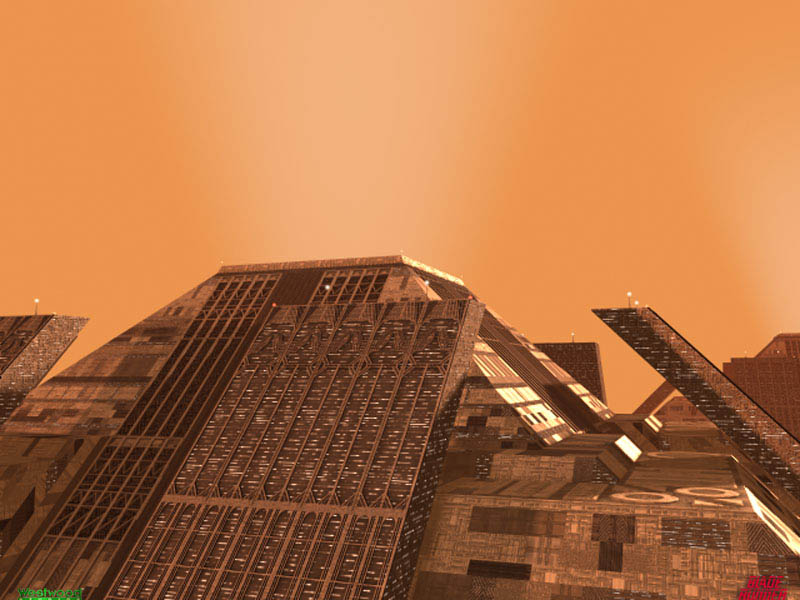
There is a Bladerunner City in SL, but the architecture on display owes more to the ziggurats of the Tyrell Corporation than the run-down streets of future LA which, for me, are the most visually pleasing element of the film. The owners of the sim are evidently interested in transhumanism; the welcome notecard at the entrance gives a brief history of the idea, from Dante to Huxley. I got the impression that they would prefer Roy Batty (surely the least threateningly-named homicidal android ever) to the crumpled Rick Deckard, though of course (spoiler alert) it turns out that Deckard’s human frailty is actually a more perfect realisation of the replicant-maker’s craft than Batty’s superhuman abilities (or not, it depends which version you watch).

I can’t say that I am familiar enough with the various strands of transhumanism to have a firm opinion about it; I do believe that technology changes who we are as humans, but I think that that process does not operate on the level of the individual, but rather is mediated through the changes in social organisation that accompany advances in science. To take the internet as an example, it is only now that we are working out how to use it in a social way, with things like Facebook, and blogs, and even Second Life, that the full civilisation-changing potential of the medium is becoming apparent. Maybe one day we will all be dreaming of electric sheep.

Big Bird is watching you

Two nuggets of Twitter news caught my eye this week. First off, contact management firm Salesforce.com have added Twitter to their “Service Cloud”. For a fee, they will monitor all the Tweets in the feed, looking out for a specified keyword, then pass the details of Twitterers who have used that word on to the client, in real-time. The idea is that a company can be alerted when someone tweets an interest in their product, allowing a sales person to intervene in the conversation with useful advice.

It doesn’t take a great deal of imagination to think of this being used in a sinister way. I’m sure the FBI already look out for certain keywords, and the technology could easily be set to pick up tweets on any subject your boss, or your spouse, or the government doesn’t approve of.

Think I’m being paranoid? Read this story about how an indiscreet tweet got some poor cubicle-dweller in trouble before she’d even started the job. Then ask yourself if you really want everyone in the world to know what you’re doing right now.

A suitable case for Tweetment?

If the thought of Facebook ripping off all your stuff wasn’t scary enough, it now turns out that social media use is, allegedly, bad for your health.

According to Dr Aric Sigman (a “business and performance psychologist”) a whole host of physical ills, from the common cold to coronary disease, stroke, cancer and dementia, can be linked to use of social networking sites. He implies that the causative factor is lack of face-to-face interaction, caused by people spending too much time online.

I have read the full paper, published in Biologist, journal of the Institute of Biology, (there is a good summary of it in the Guardian), though it’s more of a magazine article than a scientific paper as such, containing as it does no original research, and no indication that Dr Sigman has carried out a systematic review of work published on the topic. I have to say that I find his conclusions somewhat hard to swallow (or at least the conclusions he highlights in his press release – the actual paper is rather more circumspect in what it says about social networking services).

First off, even if one accepts that there has been an increase in “social disconnectedness” in the last twenty years, there are any number of factors that could explain this, and attributing it all to social networking services, which are a fairly recent development, sounds more like a way of generating headlines than serious science. My experience, admittedly anecdotal, of services like Facebook makes me think that the people who use them most are actually among the more gregarious in society, and that those who have problems with real-life social interaction tend to find it difficult to cultivate online friendships too. There has perhaps been a change in the definition of “friendship”, but I think it is wrong to assume that this change is necessarily a devaluation – Dr Sigman seems to give no value to the definite positive effects of virtual interaction for people who would otherwise have little or no contact with other humans, due to physical disability, mental health problems, geographical isolation, or just lack of confidence.

Secondly, while there may well be an association between measures of social isolation and adverse physical and psychological health outcomes, the direction of causality is less clear, and the mediating factors proposed in Dr Sigman’s paper seem speculative to say the least, so it is absurdly reductive to claim that there is a direct connection between use of social media and ill-health.

Then there’s the ad hominem stuff. Dr Sigman is a repeat offender when it comes to scare stories about modern life – he has previously warned of the dangers of too much television, violent films and computer use generally. Unsurprisingly he is regularly quoted approvingly in the conservative press. He has a website of course, and a book to promote (Remotely Controlled: How Television is Damaging Our Lives), and he is available as a “Business Speaker” at £4-7K a time.

Lastly, (and I’ll admit that this is pure medical snobbery) I’m always a bit suspicious of anyone who lists “Fellow of the Royal Society of Medicine” first among their qualifications, especially when they are not medically qualified. You may think it is just for top doctors, but the title is, as the RSM website says, available to anybody “holding medical, dental, veterinary or higher scientific qualifications; or in senior positions in healthcare and related fields” who is willing to pay the annual fee. I get junk mail once or twice a year inviting me to become a Fellow of the RSM – that’s how exclusive and prestigious it is.

So, on balance, I think that people can go on Tweeting and Poking without worrying too much about premature death.

Creative licence

Facebook, in response to general outrage, has been forced to abandon proposed new terms of service, which would, if you believe the detractors, have allowed the corporation to claim ownership of all material uploaded by users of the service, even those who had deleted their accounts This raises several interesting issues, including how social media blurs the distinction between personal and public space, and the extent to which users of services like Facebook and Twitter can expect to retain control over content they create.

I have always felt that it is prudent to regard the internet as being completely public, and to assume that anything that you put into the system will persist forever, indelibly marked with your digital fingerprints, and accessible to anyone who knows how to look for it. Accordingly I do my best to be discreet, but despite this I often, in retrospect, feel that I have been lulled by the apparent anonymity of the medium into revealing more about myself than I might have intended. There is a certain amount of narcissism involved in such worries; while it is technically possible to, say, link all the Google searches I have done to my IP address, I seriously doubt that anyone is going to bother. Similarly, it seems unlikely that Mark Zuckerberg was really planning to purloin millions of badly-exposed pictures of Facebook users grinning drunkenly during their works’ night out, for some nefarious purpose that only he can imagine; all he wants are your shopping preferences, so that he can sell advertising and convince the venture capitalists that he does have some sort of monetisation strategy. Still, the idea that once you join Facebook you can never leave makes it sound even more creepily cult-like than it did before.

On the face of it Second Life residents don’t have to worry about being creatively expropriated by the Lindens; the terms of service clearly state that copyright in content resides with the originator. As I’ve touched on before though, “creativity” in the metaverse isn’t limited to the production of discrete items. The very act of interacting with others on the grid is in itself a performance, one which can be observed and appropriated. Who, if anyone, “owns” this? You may not have to worry that the Lindens will claim control of your entire virtual life, like Facebook is trying to do, but perhaps you should be concerned that all the imaginative energy that you put into living your second life will end up providing free inspiration for some lurking writer.

Bandwagonesque

Since everyone else is doing it, we decided to get a Twitter feed too. Why not sign up to be our friend? Then you too can bask in the reflected glory of our exciting lives.

Talking of fanclubs…

Twitter on

Proving once again that when I say “All I know is that I know nothing” I’m right on the money, a report out today reveals that, far from being on its last legs, Twitter use (in the UK at least) is ten times what it was this time last year.

Popular isn’t the same as profitable of course; if you believe Wikipedia (and who doesn’t?) Twitter has yet to accrue a cent in revenue. Twitter monetisation strategies are ten a penny in the blogosphere; it’ll be interesting to see what they come up with, especially in the current economic climate.

David Johansen still looks remarkably good, all things considered.

Poetic Truths

I was feeling that I had slightly overdone the negativity in my last post, so I decided to check out the reports on Gwen Bell‘s “Chicks who Click 09” conference, which took place last week. I figured that a gender-based discussion of virtual interaction was bound to be quite interesting, and I was sure that I could find something positive to say about it.

The list of speakers wasn’t too promising however; mostly marketing people and motivational gurus rather than serious academics. Then there was the fact that one whole day out of a two day meeting was devoted to skiing and networking, which suggested that the organisers were perhaps aiming for a less intellectually rigorous ambience.

The formal proceedings of the meeting haven’t been published yet, so all I have to go on is the tweets exchanged by the participants. The medium doesn’t really lend itself to deep and meaningful discussion, but even so the conversations were pretty vacuous.

Some of the comments were almost archetypal in their pseudo-profundity, like “We’re moving from an era of fear-based branding to one of hope, thanks to @barackobama.” It’s like there’s a formula they teach you in Inspirational Writing 101; [Fatuous Generalisation]+[Imaginary Transition]*[Zeitgeisty Buzzword]=[Comment that sounds Meaningful so long as you don’t think about it for more than two seconds].

There was one contribution that I thought made some sort of sense, though perhaps not in the way its author intended. “Twitter is your canary in the coal mine” wrote zenawiest, and I couldn’t agree more. When the “Social Media” industry curls up and dies I’ll know that it’s time to sell my Google shares.

Well, I did start this post with the best of intentions, but I’ve ended up serving another dish of cheerless cynicism, with a side helping of intellectual snobbery and a schadenfreude garnish. I should maybe take up Twittering, it might help me lighten up a bit.

[Update: Read a more balanced review of the event from someone who was actually there.]

Here’s today’s tune. I had thought that the lyrics would be a suitably obscure reference to the content of the post, but of course several bloggers got there before me. All their blogs seem to be defunct, one, poignantly, after just one post; I think that this one is the best.

Modern Romance

Now and again I come across something on the internet that reminds me how disconnected I am from the world of the young. (Actually for “now and again” read “every 20 minutes or so”).

Occasionally though I read a piece that doesn’t just make me feel old and out of the loop, but cynical and misanthropic as well, and not in a good way. The latest example of this is Gwen Bell’s blog, and specifically this post: “A Guide to Falling in Love + Growing a Modern Romance Online“.

Gwen feels qualified to write about this because she met her boyfriend Joel, who is now her fiancé, via Twitter. The story is rather sweet in its own way, especially the bit where her beloved proposes by making an elaborate sign and hanging it up in their favourite coffee shop. They are due to wed later this year; you can follow the build up to the nuptials on their joint website, as well as on Gwen’s Twitter feed.

So why does this happy tale awaken my inner curmudgeon? “A bad-tempered, difficult, cantankerous person” sums up my personality pretty well at the best of times I guess, but the sort of unselfconscious narcissism that drives people to use a service like Twitter, or to write “A Guide to Falling in Love + Growing a Modern Romance Online” based on their own personal experience of doing so once, is something of a bête noire for me.

(I know that I am the author of a blog which deals mainly with my random thoughts, so we’re deep within “pot, kettle, black” territory here, but, come on, Twitter? Like even your closest friends are so interested in what you are doing right at this minute that they need a constant update on your mundane daily activity? RandomTweets.com, a site dedicated to finding anything on Twitter “humorous, weird, inspiring, newsworthy or just plain cool”, hasn’t been updated since July 15th, presumably the day the webmaster went insane after reading “I’m shopping!!!” once too often).

Gwen’s “Guide” contains so much that feels completely alien to my concept of “Romance” that it’s hard to pick out examples. You really have read the whole thing to appreciate it. This is my favourite bit though (with Gwen’s emphasis):

Joel and I have shared a calendar for about 6 months now. We each had our own Gcalendars (free) associated with our Gmail accounts, and then we set up a joint calendar for shared events. Once a week we go over the details of the week together. We roll over events that we missed.
Most important, we associate a time and date to things so that we get a reminder sent to our phones before it’s time for it to start. Believe it or not, this seemingly small point is a crucial ingredient to the success of our relationship.

This is how the kids live these days? A boy can be so overwhelmed by information that he will forget he has a date with his inamorata unless a computer phones him up to remind him?

If I’m honest though, I have to admit that I’m the one with the problem here, not Gwen. She has the confidence of youth, and I have what Socrates called True Wisdom, that which “comes to each of us when we realize how little we understand about life, ourselves, and the world around us”. I could never write a “Guide to Love”, not because I haven’t been around that particular block more than a few times, but because the experience I have had has convinced me that, when it comes to affairs of the human heart, we all have to make our own way. So good luck to Gwen and Joel, may they have many happy years together, and avoid True Wisdom for as long as they can.

[Socrates also said “Enjoy yourself — it’s later than you think”, so from now on I’m going to try to lighten up some of my more dour posts by ending with a link to the song that inspired the post title. Though, come to think of it, this one is a bit of a downer.]