Liberal Distraction

The economy had been rather sidelined in the election campaign over the last week or so, as the media obsessed over the prospect of a hung parliament and speculated about the possible makeup of potential coalitions. A cynical observer (like me) might conclude that the attention given to Nick Clegg and the unlikely rise of the Liberal Democrats has been designed to distract us from the fact that all the main parties have essentially the same prescription for reducing the deficit, one that involves sharp cuts in public spending.

The intensity of the coming pain was hinted at in a report released today by the Institute for Fiscal Studies, which predicts a return to the sort of austerity not seen since the 70’s, or, in the case of the Tories’ plans, since the war, and notes that all the leading parties have been less than forthcoming on where the axe is going to fall.

The whole thing is rather dispiriting, though I guess it’s just about possible to imagine something good coming out of it all eventually. If the opinion polls are accurate and the election result is inconclusive, then one or other of Labour or the Tories will have to court the Lib Dems, who are likely to demand electoral reform as the price of their support, and a fairer voting system will give left parties more of a chance.

The austerity measures, when they come, are bound to generate some sort of public reaction, as we’re seeing in Greece. If we can do some work now to establish the framework of a left-led anti-cuts campaign, we could be in a position to make an advance when the next election comes, which might be sooner rather than later if past experience with hung parliaments in the UK is anything to go by.

So Nick Clegg might end up being an agent of real change after all, in ways he never intended.
Virtual Epiphany

I spent the best part of the weekend reading about the Woodbury saga on various blogs, until late on Sunday night, half-way through a particularly dense screed, I had a sudden Moment of Clarity. “Why,” I asked myself, “am I wasting my time with this nonsense?”

The really sad thing is that I have a good idea what the answer to that question is, as a result of one of the other Second Life-related projects that I am squandering my limited intellectual capital on, the psychological profiling of the typical SL resident. (I have a rough draft of this ready, but it may be some time before I get round to working it up into anything coherent enough to post, assuming I don’t get distracted in the meantime.)

Anyway, to shake this SL fever I’m going to take a break from obsessing about virtual events for a while, and pay a bit more attention to real life, specifically the election. The country may be standing on the verge of the biggest political realignment in a generation, which I guess will probably be of more lasting interest than the ephemera of Second Life.

Прощай Woodbury

On the very day that it emerged that Linden Lab was facing a lawsuit accusing them, among other things, of failing to respect the property rights of Second Life residents, it was also reported that the Lindens had been flexing their absolutist muscles by summarily terminating several sims connected with Woodbury University, as well as banning numerous individuals allegedly associated with the group.

I’m not going to get into the debate about the guilt or otherwise of the WU; it’s easy to find stories of their alleged crimes, as well as more positive accounts of their activities. The bigger point is that a virtual world that purports to respect the values of bourgeois society should have a rather more transparent system for the administration of justice, instead of the secretive Star Chamber that hands out punishment at the moment.

Whatever the truth in the accusations of griefing, I’m sorry to see the Woodbury sims go. I’m not usually a big fan of Soviet-chic, especially when it is entirely devoid of political content (for the WU are not communists, or even particularly left-leaning, whatever Prok says), but I liked their big Hall of People’s Deputies or whatever it was, and the submarine, and the big bear. The grid will be a slightly duller place without them.

Revolutionary Litigation

Tateru Nino at Massively is reporting that the Lindens are facing yet another lawsuit, this one accusing the Lab of fraudulently representing the nature of property relations in Second Life by suggesting that ownership of virtual land and objects rested with users, when in fact everything on the grid, in the final analysis, belongs to the Lindens (as is made clear in the newly-revised Terms of Service). The plantiffs allege that they have been expropriated without due process, contrary to the provisions of Californian Law, and have hired a lawyer with experience of virtual-world litigation to argue their case.

This case is, in effect, an attempt to impose capitalist social relations on the feudal landscape of Second Life. We have of course been advocating this for a while, though what we had in mind was an indigenous revolution rather than inviting a foreign power (in this case the State of California) to invade and reform the system by force.

Happy 4/20!

We haven’t had a marijuana-themed post for a while, mainly because my life is far too burdened with responsibility to allow me to smoke much these days, and when I do blogging is the last thing on my mind, but I couldn’t let International Stoner Day go by without some mention of the noble weed.

None of the main parties contesting the UK election are unequivocally in favour of legalising cannabis, but the Liberal Democrats, currently riding high in the polls, have historically been open to the idea of decriminalisation at least. Their manifesto does promise that their drugs policy in government would follow scientific advice, which is increasingly coming out against prohibition.

It would be nice to think that the Nick Clegg is a secret toker who would make legalisation of pot a red-line issue in the coalition negotiations that would occur in the event of a hung parliament, but sadly this seems unlikely.

There are more promising developments across the Atlantic in California, where a ballot initiative proposing the legalisation of marijuana is due to be voted on in November. One of the driving forces behind the measure is the Golden State’s ballooning budget deficit; supporters claim that regulating and taxing pot sales could raise up to $1.4 billion annually. If the bill passes and the money starts rolling in it may be hard for a cash-strapped government over here to resist the temptation to grab a piece of the action.

The final piece of the puzzle may, paradoxically, be the emerging evidence that links cannabis with serious mental health problems. This was the rationale given by the Home Secretary when harsher penalties for cannabis possession were reintroduced in 2008, against the advice of the government’s own advisers. However the counter-argument, that the risks associated with cannabis make it imperative that it is properly regulated, and treated as a matter of public health rather than criminal justice, will hopefully gain ground, especially if our Californian cousins lead the way.

These things move slowly though, and I doubt that we’ll be able to light up legally by next April 20th, whoever wins the election. I can only hope that it doesn’t take too long, and my dreams of spending my retirement tending my own little patch of green can come true.

Chronicle of a TOS Change Foretold

I’ve hitherto refrained from commenting on the new Second Life Terms of Service, because, well, life is too short, and anyway all the salient points are covered in the official announcement, and the accompanying discussion.

However I do feel compelled to say that one of the “new” clauses that people seem to be focussing on – the one that stipulates that “buying” virtual land doesn’t mean that one “owns” anything, merely that one has been granted a (limited) licence to use the service in a particular way – shouldn’t be news to readers of SLS, as we pointed out that this was the case as long ago as 2007.

Liberal Renaissance

It has been a beautifully clear day today; no sign in the blue skies of any of this volcanic ash that is blanketing the country. It’s slightly unnerving to think that a big chunk of our transport infrastructure can be paralysed by invisible dust high above our heads. Maybe this will give a boost to the idea that we should give up going out of the house, and do all out travelling in virtual worlds instead.

Back on the ground, the media is digesting the performances of the main party leaders in last night’s televised election debate; there seems to be a consensus that, while nobody landed a knockout blow, Gordon Brown did as well as was expected (that is, not very), David Cameron’s vague promises of change were unconvincing, and Nick Clegg stole the show with his honest straight talking.

The positive reaction to Clegg is interesting; he and the Liberal Democrats have made much of the fact that they are willing to spell out in detail exactly how much pain we are going to have to endure to get the economy back on track, while the other parties promise to cut the deficit but don’t want to scare us by revealing what that might entail. The Lib Dems are banking on the hope that the respect they win from the electorate by treating voters as responsible adults who can face reality, and not children who have to be shielded from the truth, will outweigh the aversion caused by the cuts they are proposing. The initial poll results might seem to back this up, but I wonder if people really are ready to be that stoic, and if over the course of the campaign there might be a swing back towards the “Trust us, we’ll sort things out, you don’t have to worry” message coming from Labour and the Tories.

I found the event more illuminating than I was expecting. There is a tendency on the left to characterise the main parties as differing only in the degree of their support for capital, and it is true that on one level the debate was three rich white men arguing over how hard they have to hit the workers to make sure there is enough money left in the state coffers to keep the bankers happy. However the bulk of the electorate don’t look at things this way, and for them it would have been clear that their day-to-day lives over the next few years are going to be significantly different if the vote goes one way rather than another.

My personal assessment is that Brown did enough to plant seeds of doubt about how grim things could get under the Tories to start people thinking that perhaps five more years of Labour, or a Lib-Lab coalition, might not be so bad after all. There are still three weeks of campaigning, and two more TV debates, to go of course, so everything is still to play for, but the election isn’t going to be the Tory landslide that looked inevitable even a few months ago.

Like Pompeii (or Herculaneum)

The skies have been unusually quiet today, as the ash plume from the volcano below the Eyjafjallajokull glacier in Iceland has spread over northern Europe, closing UK airspace to commercial aviation.

This evening the sky has turned a deep red. Those of a superstitious nature might take this as a positive omen for the left in the coming elections, but it may take more than intervention from Loki to swing things towards Labour. Perhaps the picture will be a little clearer after the leaders’ TV debate tonight.

My first thought for musical accompaniment to this post was something by Ash, but that seemed a bit obvious, so here’s something appropriate by the B-52’s.

Virtual world voters shunned

Back in 2008, during the US Presidential Election primaries, all the Democratic hopefuls had a Second Life presence of one sort or another; Hillary Clinton and John Edwards had virtual campaign headquarters, and there were several “Obama for President” resident groups. The GOP were slower to embrace SL, though eventually a couple of Sarah Palin avatars made an appearance.

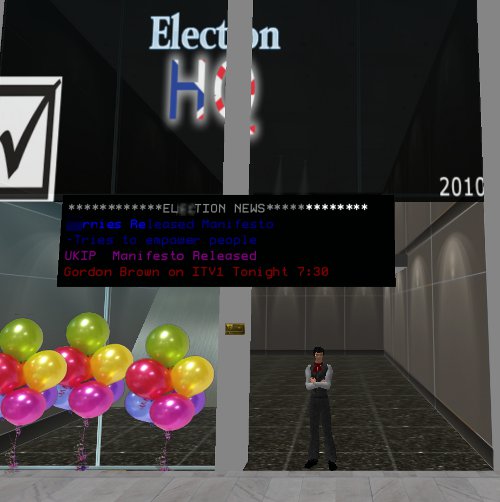
I had expected to see the current UK elections stir some interest on the grid, but all I could find was this rather disappointing “Election HQ“, which consists of nothing more than a few balloons and a malfunctioning noticeboard outside an empty store:

There is a “Conservative Party Supporters” group, with a grand total of 3 members, led by one “ToryBoy Horatio”. Potential members are greeted with a jolly “Well hello fellow Etonians and the rest of you rabble”, which makes me think that this might just possibly be a parody rather than a serious vote-gathering enterprise.

It’s said that about 7.5% of SL residents live in the UK, which, out of active users, would amount to around 75,000 potential voters, a not inconsiderable constituency. The fact that none of the major parties has felt it necessary to establish a Second Life presence may say something about the how the platform’s profile has declined in the last two years.

Or perhaps they are are just wary of meeting the same fate as John Edward’s virtual campaign (as described in Peter Ludlow’s brief history of griefing in the metaverse).

Taxing issues

My prediction that the election campaign would be “exciting” was perhaps a little optimistic, but the focus has been on the economy, as I was expecting. The debate so far has centred around the issue of National Insurance levels, though this clearly is just a proxy for  the real divide between the main parties, which is on the level of short-term cuts in public sector spending that are needed to stabilise the economy. My sense is that Labour are doing better than expected in the early exchanges, since they seem to have more credible numbers, whereas the Tories are rather unbelievably claiming that the £6 billion they need to cover the cost of not raising NI can be found through “efficiency savings” that won’t have any detrimental effect on services.

There have been comparisons drawn with Ireland, where the government have severely reined in public spending, thus reducing their deficit in absolute terms, but with the result that the economy has shrunk even faster, meaning that the deficit is now actually bigger as a proportion of GDP. This would seem to suggest that the Labour strategy of (relatively) gentle cuts in UK government spending is the right one, or the least wrong one at any rate.

However Labour’s reputation for general economic competence has obviously been undermined by the fact that they led us into the recession in the first place, and the voters’ desire for change may be enough to carry the Tories into power. There have been some signs that Labour may try to play up the class element of the debate, which I would have thought would be the way to go – “No Cuts, Tax the Rich” would be a good slogan – but they have just promised not to increase income tax, while leaving the door open for a hike in the regressive VAT, so I don’t hold out much hope of a sharp shift to the left.

It will be interesting to see the effect that the televised leaders’ debate this week has on the polls. I like to think that the UK electorate is completely focussed on the issues, and is too smart to be distracted by presidential-style personality contests, but I expect I will be proved wrong about that.

Finally, the most amusing story of the campaign so far is that of Stuart MacLennan, the (now ex-) Labour candidate for Moray in north-east Scotland, who was forced to resign after the papers reported that he had made various offensive comments about political opponents and his prospective constituents on Twitter. I would have thought that the first thing to do when standing for public office would be to delete your Twitter feed, since the last thing you want the voters to know is what is really on your mind.