From Off the Streets of Cleveland

I’m just back from holiday, and I was going to leave it a while before I started blogging again, but I have been moved to action by the sad news of the passing of a true hero of the counter-culture, Harvey Pekar, of American Splendor fame.

I’m not usually one for vicarious grief, but I have been feeling genuinely cut-up since I heard that Harvey was dead. His work was personal and honest, sometimes painfully so, never glossing over his own character flaws, and it was hard to read it without getting to feel that you really knew the guy. Long before anyone had even dreamed of blogs, Harvey was there, documenting the daily grind of a lowly wage-slave, creating poetry from the rhythms of his blue-collar existence.

If you’re not familiar with American Splendor then visit your local comic-book store and pick up an anthology – the best one to start with is probably American Splendor: The Life and Times of Harvey Pekar which collects up the best of the early issues; also worth reading is Our Cancer Year, which chronicles Harvey’s experience of lymphoma – it is quite grim in parts, but ultimately positive. More recent comics can be found online at The Pekar Project. The 2003 biopic American Splendor was justly lauded by the critics, and Harvey also features in a segment of the 1988 documentary Comic Book Confidential (which was where I first came across his work). He appeared several times on the Letterman show in the late 80’s, until he fell out with the host after criticising NBC’s owners General Electric on air. He also recorded a series of opinion pieces for radio station WKSU, which can be listened to at their website.

Harvey’s work was based on the idea that the lives and experiences of ordinary people, living through good times and bad with their family, friends and community, were worth recording, and would tell the story of our times more accurately than more conventional histories. As he said, “Ordinary life is pretty complex stuff”, and few have captured it better than he did in the pages of American Splendor.

Explosive talent

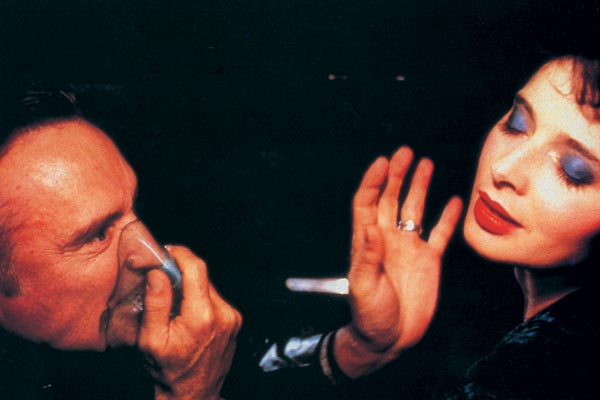
I can’t mention Blue Velvet without noting that Dennis Hopper, who fully inhabited the role of Frank Booth in that movie, passed away this week.

Hopper was a complex character, and was evidently not much fun to be around in the 70’s, but it’s difficult not to have some respect for the guy who directed Easy Rider, and was hard enough to round off a lecture to film students by blowing himself up.

That gum you like is going to come back in style

I don’t look at the TV much these days, and I very rarely find myself following an episodic drama series. The last time I even partially got into a show was when I caught most of the first season of The Wire, which I quite liked, but the effort of committing myself to regular appointments with the box was too much, and I never made it past the first episode of season two.

I was thinking about this the other day when I read an article at the AV Club which considered the cultural impact of David Lynch’s cult 90’s series Twin Peaks. It reminded me not just of how slavishly I had followed that programme, but of the way that even left-field shows like Lynch‘s unsettling masterpiece could attract mass audiences at that time.

Compared with today it was both easier and harder for a show to be a big hit back then; easier because there was less competition for the audience’s attention – the UK had only four terrestrial channels to choose from, satellite and cable were niche products, and there was no internet – and harder because there was no way to see things other than by sitting down in front of the TV at a set time – no DVD box-sets, no Tivo, and no internet TV. We did have VHS recorders I guess, though the elderly model I had at the time was much too unreliable to trust with an unmissable event like that week’s Twin Peaks.

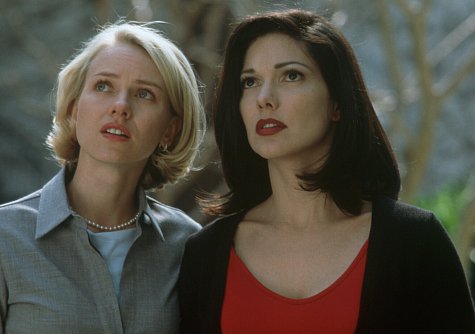
I had been a big David Lynch fan since I saw Eraserhead late one night on TV, and I’ve liked everything he’s done since (even Dune), especially Blue Velvet and Mulholland Drive (the latter is in the running for my favourite film of all time), so it was always likely I was going to be a Twin Peaks devotee, but what confirmed my addiction was the community that grew up around the show on campus. I was already hanging out with most of what became the Twin Peaks crowd, but we certainly bonded that little bit more over long evenings of coffee and cherry pie (actually, “coffee” and “cherry pie”) discussing our various theories of what the story was about. I’d like to say that we still get together every year to reminisce, but, with a couple of exceptions, I haven’t talked to any of those people in the best part of twenty years. Probably best to leave the memories undisturbed.

Anyway, the point that I’m meandering towards is that often what sticks with you about a cultural experience is not so much the event itself, but more the social connections that surrounded it. What’s changed since my Twin Peaks days is that, thanks to the wonder of the interwebs, it’s no longer necessary to be geographically co-located with your fellow fanatics to feel part of a community.

Certainly my experience over the last three years has been that, while it was the virtual eye-candy that initially pulled me into Second Life, what’s kept me around is the narrative that unfolds in the relationships between residents, played out partly in-world, but mostly in the SL blogosphere.

I don’t want to overstate the profundity of the SL storyline – it’s more potboiler than classic literature – but it’s diverting, harmless, and, best of all, it creates a pleasing illusion of interactivity. I can tell myself that I am involved in writing this tale, in my own small way, and that makes me just committed enough to stick with it through the many, many dull patches.

There’s an interesting paper by Wanenchak in the latest edition of Game Studies entitled Tags, Threads, and Frames: Toward a Synthesis of Interaction Ritual and Livejournal Roleplaying. It’s well worth reading in its entirety, but the part pertinent to this discussion is the brief review of Goffman‘s frame analysis as it applies to a collaborative online narrative:

… frames allow players to engage with the gameworld in such a way that their narrative construction and interactions become sensible to themselves and to each other.

What I find most fascinating about the Second Life narrative (and what I think gives it a claim to being a unique cultural phenomenon) is the fact that the frames that people are using are often unclear, shifting and overlapping. To put it in different terms, although they are operating in the same “gameworld”, which includes not just the SL grid but also the associated blogs, tweets and what have you, people are engaged with often wildly differing levels of immersion.

The effect of this is, more often than not, to render the meta-story unintelligible, but occasionally it all comes together to produce an instant of dream-like clarity that makes the whole project seem worthwhile. I would give some examples of this, but I suspect that, like real dreams, the beauty of these moments is highly subjective, and that any description I attempted would sound hopelessly prosaic.

Which brings us back to David Lynch. What I think he does better than any other director is capture the fractured reality of dreams and nightmares, in a way that is at once unsettling and beguiling. Sometimes – just sometimes – being part of the world of Second Life is like living in Twin Peaks.

Two Galleries

I recently spent some time wandering around The Leominster Galleries, a new project from Sigmund Leominster, of SL on SL fame. The space exists to showcase Siggy’s personal art collection, with three floors of permanent exhibits and a room for temporary shows, all floating in the air high above the Root Squared sim.

Siggy’s taste seems to be firmly rooted in the 19th century, with the work of William Adolphe Bouguereau particularly well represented:

Bouguereau is an interesting choice; a stalwart of the French Académie des Beaux-Arts, he was acclaimed a genius in his day, but his reputation declined spectacularly in the 20th century, when his work was largely viewed as technically competent, but exemplifying the worst aspects of the ossified Academic style. He was entirely eclipsed by the Impressionists, a movement he had attempted to exclude from the Salon, and which he struggled to understand. More recently reviving the popularity of Bouguereau has become somewhat of a cause célèbre among conservative art critics, who see in his work an affirmation of traditional values tragically displaced (in their view) by modernism.

I don’t know if Siggy is making a political point with his picture selection, or if he just likes the sanitised eroticism that was popular in 19th century bourgeois circles. To be fair, the collection is not entirely composed of tasteful nudes in classical tableaux – there are some tasteful nudes in faux-Arthurian tableaux too, courtesy of the Pre-Raphaelites:

a fair representation of Symbolist works:

and a smattering of Surrealism:

The visit introduced me to several works I hadn’t seen before, since, I must admit, I usually hurry through the 19th century rooms when I visit the big galleries, so it was educational to a degree, but I do wonder what value was added by hosting the exhibition in Second Life, rather than, say, posting it in a blog. I suppose one could invite one’s friends around to make it a more social experience. The exhibits might perhaps be a little more interactive, with links to information about the artists and movements, and some explanation of the curatorial philosophy. The gallery design could be a bit less clinical too, since the modern aesthetic of the plain walls and light wood floor clashes somewhat with the cluttered hanging. A few chairs wouldn’t go amiss either. These are minor criticisms though, and the Leominster Galleries are well worth checking out.

A rather different artistic experience is on offer at The Primtings Museum, where they don’t hang the pictures on the walls, but build installations that allow visitors to place themselves into some iconic images:

(I’m pretty sure that I once sat in a real-life recreation of Van Gogh’s Room at Arles, but this was in Amsterdam, so it might just have been a drug-fuelled hallucination.)

There are dozens of works on display by various virtual artists, including our old friend AM Radio, who reworked David’s The Death of Marat, above. A full catalogue can be found on the Primtings website.

Surrealist paintings provide the inspiration for a large number of pieces, but, ironically, these are perhaps the least successful works in the gallery. The dream-like quality of Surrealism seems to be lost rather than enhanced by being lifted from the canvas and transformed into rather prosaic tangible objects:

I think for these sort of pieces to work they would have to be more immersive than just three dimensional representations of the paintings presented in a box. A sim-scale re-imagining of Un Chien Andalou perhaps, with the opportunity to slice up eyeballs and pull a piano full of dead donkeys around.

My favourite work at Primtings is this replica of Damien Hirst’s The Physical Impossibility of Death in the Mind of Someone Living:

As befits conceptual art this works just as well in Second Life as it does in reality. The best part is that you can take away a free copy of the formaldehyde tank (though not the shark), and suspend yourself, or your loved ones, in it when you get home.

I did wonder a bit about the copyright status of these two galleries. I think Siggy should be all right, since the artists he features are all long dead, but Primtings might be on shakier ground if Hirst ever finds out they have been ripping him off, so you should probably take it in while you still can.

And finally – Johnny would have a fit if I mentioned Un Chien Andalou without linking to this.

Virtual Bakumatsu

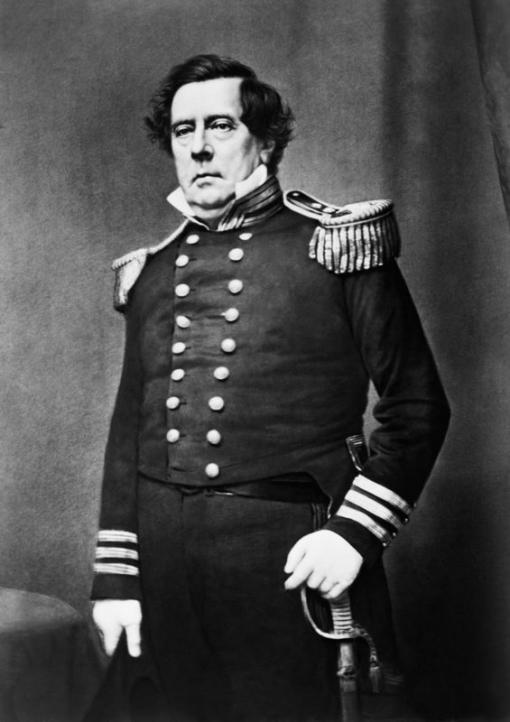
On the 8th of July 1853 US Navy Commodore Matthew C. Perry anchored at Uraga Harbour near Edo (modern-day Tokyo) and presented officials with a letter from President Millard Fillmore, which demanded that Japan, which had been largely closed to foreigners for two centuries, open its borders to US trade. To show that he was serious Perry bombarded the harbour with explosive shells, and when he returned a few months later he found the locals willing to sign up to the Convention of Kanagawa, which established, among other things, minimal import taxes for foreign goods.

In the years that followed Japan was obliged to conclude similar treaties with other Western powers, and the influx of cheap imports plunged the country into economic chaos. The feudal order of the 250 year old Tokugawa Shogunate collapsed under the pressure, its demise speeded by military intervention by the US, France and Britain. It was followed by the Meiji Restoration, which laid the foundations for the modern industrialised Japanese state, though the remnants of feudalism were not entirely swept away until the defeat of the Satsuma Rebellion in 1877 (an event portrayed, with considerable artistic licence, in the film The Last Samurai).

I mention this because I can see parallels between the hierarchical society of sakoku-era Japan and the regime we know in Second Life. What commerce there is with the outside world is strictly regulated by the ruling caste, who either directly control the marketplaces, or take a hefty cut of transactions. In-world manufacturing is dominated by small-scale craft producers, and success in this field is dependent on acquiring mastery of relatively low-tech but somewhat esoteric skills. Borders are closed, there is no democracy, and the population lives and dies at the whim of their masters.

Like feudal Japan Second Life is threatened by a tsunami that may sweep away the present economic certainties. This peril does not come in the shape of a warship, but in the seemingly harmless form of mesh imports.

The plan to allow import of content created using professional 3D design tools like Maya or Blender was first announced back in August, and recent reports have suggested that it will become reality soon. The Second Life design market is currently protected by the fact that there is little incentive for professional digital designers to learn how to build with prims, since there is no application for the skill outside of SL. Once they are able to create virtual objects using the knowledge they already have it’s more likely that they (or the companies that they work for) will see SL as a way of making some easy cash. Existing SL designers will find themselves exposed to competition from a well-established industry, whose advanced products will make their painstakingly sculpted prim creations look hopelessly primitive, and their businesses will be unable to survive.

Will this opening of the market to outside competition be a bad thing for the average non-entrepreneurial resident? The quality of virtual items will rise, and they will probably be cheaper too, since production will be more efficient. The grid as a whole will survive, as the Lindens are sure to impose a healthy tax on mesh uploads to keep their revenue stream flowing. There may be less circulation of L$ within the world, as the dominant businesses are less likely to be resident-owned concerns, and would be extracting their profits rather than spending them on the grid, but this would just mean more real money would have to be transferred in to allow residents to buy stuff, which would also boost the Lab’s bottom line.

What might change is the nature of the SL experience. The idea that all residents have the tools at hand to create their own reality will fade, to be replaced by a culture where our avatars exist only to consume the products that are manufactured for us. Second Life, which seemed to offer an antidote to the alienation of capitalist society, will have become just one more expression of it. I guess this is progress though, and we can no more resist it than the Samurai could halt the march of modernity and expel the barbarians. We can only hope that this is just the first step in a process of proletarianisation of the SL population that will one day create the conditions for more progressive social change.

Ladies and Gentlemen We Are Floating in Space

I logged on to the grid for the first time in ages last week, only to find that my entire inventory had been rendered inaccessible for some reason. This included all my shapes and skins, with the result that my avatar took on an elemental form:

blob01

I thought this looked pretty cool, like William Hurt when he has spent too much time tripping in the flotation tank in Altered States.

Two things had changed since my last visit; the adult content filtering regulations had gone into effect, and I had finally got around to upgrading my viewer from the Linux alpha build that I’d been using for the last couple of years. I figured that one or other, or perhaps both, of these had nixed my content – not, I hasten to add, because it was particularly risqué, but because it was all old stuff, and I thought it was maybe unverified or something. This turned out to be an unnecessarily paranoid interpretation of events, since when I looked today everything was back to normal, there having been some sort of “Asset Server Issue”, according to the grid status report.

Anyway, I was glad to be reminded of Altered States, one of my all-time favourite stoner movies. John Lilly, on whose experiences the film is loosely based, is a hero of sorts to me – his work on altered states of consciousness during sensory isolation (he invented the flotation tank for this purpose) is very interesting, his later fascination with talking to dolphins perhaps less so.

Thus inspired I hit Xstreet to see if I could pick up a flotation tank for my apartment, but the closest I could find was this sci-fi style healing tank (L$200 from A’den Technologies):

flotation01

There wasn’t any sensory deprivation, but it was restful to bob up and down, listening to some suitable mood music.

The killer awoke before dawn

I’ve been caught up with work and social engagements recently, and so completely missed the latest big Second Life story; Stroker Serpentine’s lawsuit against Linden Lab over the thorny issue of IP rights, and the Lindens’ efforts, or lack thereof, to protect them.

The details of the case, and its merits, have been well covered in the Alphaville Herald and New World Notes, and there’s no shortage of comment around the SL blogosphere (like here, here and here). In such circumstances any opinion I care to offer is bound to be superfluous, as well as being thoroughly uninformative, seeing as how I have no knowledge whatsoever of contract and copyright law as it is applied in the state of California. But what kind of blogger would I be if I let ignorance of the topic or fear of repetition stand in the way of weighing in with my two cents worth?

Everyone agrees that content theft is an issue; Stroker’s case revolves around the question of whether the Lindens are mere providers of the framework in which the criminality occurs, and thus not responsible for it, or if the fact that the Lab profits from copyright infringement by collecting dues from the malefactors makes it part of the evil enterprise. The precedent that is being quoted is the case of Louis Vuitton Malletier, S.A., v. Akanoc Solutions, Inc., et al., where the luxury goods maker was awarded $32 million damages against a firm that hosted websites selling counterfeit Vuitton items. The Taser case seems relevant too, as well as the Lab’s previous actions in banning in-world gambling and banking, which presumably stemmed from a realisation that the US Department of Justice was likely to regard hosting illegal activity as an offence in itself.

The Lindens’ defence will probably rest on the “safe harbor” provision of the DMCA, but they may be on shaky ground there, since any claim to be at one remove from the murky business of SL commerce would be rather undermined by their ownership of XStreet, and their record of assisting aggrieved creatives with DMCA filings is allegedly very poor. There is some speculation that the Second Life Terms of Service, specifically the sections prohibiting residents from suing the Lindens, might be the Lab’s get-out-of-jail card, but it seems unlikely that any court would enforce a contract containing such obviously unfair terms.

All these legal questions are mildly diverting, but what is much more interesting is the underlying psychology. It reminds me of a gritty crime movie, the part where the heist has gone wrong and the thieves have started to fall out. One can only imagine that Stroker’s sex-bed business must have hit the skids before he would pursue the nuclear option of suing the Lindens. I’ve no doubt that having his designs ripped off has at least partially contributed to this, but I suspect that the inherent limitations of the virtual economy (which we’ve previously discussed here and here) have had a more significant impact.

It feels as if there is more to this than mere financial considerations though. What Stroker and other designers want is not just money, but respect, due acknowledgement of their creative talents. Unfortunately, outside of a small subsection of the SL population, being a virtual clothes/hair/whatever producer just doesn’t count for very much, in terms of cash or kudos. This may or may not be unfair (I tend to think it is some way off being the worst injustice in the world), but it’s a fact, and no amount of complaining on the internet or suing Linden Lab is going to change it.

Looking at it more analytically, there also seems to be an Oedipal theme to this lawsuit. By all accounts Stroker was a Joe-the-plumber type before Second Life gave him the chance to reinvent himself as a virtual pornography mogul; it seems ungrateful, to say the least, that he should set in train a process that could theoretically ruin the company that made his good fortune possible. The Lab may have begat Stroker, but he has good reason to think that he is not Philip’s favourite son; the sex business of which Stroker is the most prominent public face is often cited as the biggest threat to the Lindens’ future prosperity. Stroker would not have to be particularly paranoid to see the regulation of adult content on the grid as an attempt to castrate him (figuratively and literally; ridding SL of penises seems to be one of the prime objectives of the new rules). Perhaps the case represents Stroker’s unconscious desire to kill his virtual father before he himself is annihilated by paternal rage.

What would be the most desirable, or least undesirable, outcome of the case? Should Stroker prevail it would surely be a Pyrrhic victory. The suit is a class action, so every frustrated shopkeeper who ever had a texture pilfered would be able to jump on the bandwagon, exposing the Lindens to potentially unlimited liability. Even if this doomsday scenario didn’t come to pass, an adverse judgement would force the Lab to radically change the Second Life retailing landscape, probably by introducing some sort of merchant registration and approval system, shutting out the small scale entrepreneurs who are, everyone says, the lifeblood of SL creativity.

And what if Stroker loses? There has been the usual Atlas Shrugged-style posturing from various bloggers, with talk of how an exodus of talent will leave the rest of us wailing and gnashing our teeth, bereft of prim hair and erotic animations. In reality, of course, little would change, since any designers who did flounce out would be quickly replaced by others with equal skill and a rather more realistic estimation of the value society places on virtual creativity. It would be for the best in the long run, since Second Life can only benefit from a population that is more interested in enriching the collective experience than amassing personal wealth.

So I’m hoping that the case goes to court, and that Stroker loses. I doubt that this will happen though; the Lindens’ corporate lawyers will want to avoid the uncertainty of going to trial, and will push for a settlement, which I suspect is what Stroker has had in mind from the start. Even if they don’t admit liability the Lab will have to introduce more regulation to avoid facing similar actions in the future, and the nature of Second Life will change forever.

Whatever happens, it feels like a chapter, if not the whole book, is drawing to a close.

It’s the end of our elaborate plans…

Fly me to the moon

40 years ago today Neil Armstrong became the first man to set foot upon the moon. I was alive at the time, but too young to have any memories of the actual event. I do remember that when I was growing up in the ’70’s, watching TV shows like UFO and Space:1999, reading comics like 2000AD and lots of pulpy sci-fi novels (The Moon is a Harsh Mistress by Robert Heinlein is one that especially sticks in my mind), and of course seeing Star Wars at the cinema, I just took it for granted that by the time I was an adult there would be widely-available space travel, permanent bases on the moon and regular trips to Mars and beyond.

Whole books have been written about my generation’s disappointment when these visions of the 21st Century failed to materialise. What we got was the internet, with virtual worlds to explore instead of alien planets. It is possible to visit a the SL version of Tranquility Base:

moon01

and numerous other lunar-themed sims, like this somewhat gloomy moonbase:

moon02

or this rather cooler one:

moon03

but I can’t help feeling a bit cheated.

The disillusionment isn’t just a generational thing though. It reflects my internal dissatisfaction with the course that my life has taken, as I age and am forced to acknowledge that there are some opportunities that will never come my way. It’s not that I’m unhappy with the decisions that I have taken over the years, just that every path that one chooses means leaving many more untrodden.

And anyway, I’m still hopeful that NASA will get their act together and make space travel available to the masses before I die. I just want to see what spring is like on Jupiter and Mars

Like tears in rain

After my last two posts I had to dig out my copy of Blade Runner to see if it was as good as I remembered. Now I’m getting older the themes of identity and mortality are probably a bit more relevant than they were in the past, which may go some way towards explaining why the film seems to be more profound every time I watch it.

During the climatic rooftop scene, where the android Batty is mourning the ephemeral nature of his memories, I found myself thinking that, if he wanted to preserve his experience for posterity, what he needed was a blog, or, even better, a Twitter account:

roybatty I’m watching attack ships on fire off the shoulder of Orion. 2 minutes ago

I’d be the first to admit that my blogging is at least partially motivated by a desire to leave some permanent trace of my existence. It’s the equivalant of stone-age man leaving hand prints on a cave wall; perhaps future archeologists will be as puzzled by the significance of my random jottings as we are by the daubings that were the social media of our Neolithic forebears:

Grod @Zoug I can has mammothburger? 12000 years ago

Bötterdämmerung

… would have been a much better title for my last post, come to think of it.

I first saw Blade Runner during its original cinema run back in 1982, around the same time as I was reading all the early William Gibson stuff, and it had a similarly profound effect on my emerging aesthetic consciousness. Functional hi-tech amidst a crumbling cityscape has been my idea of what the future holds ever since, and it’s always seemed quite attractive. What with the depression, and global climate change, and the decline of the Western powers, it’s just about possible to imagine that Los Angeles in 2019 will look pretty much like it does in Ridley Scott’s movie, though maybe without the flying cars, and hopefully without the killer robots on the loose.

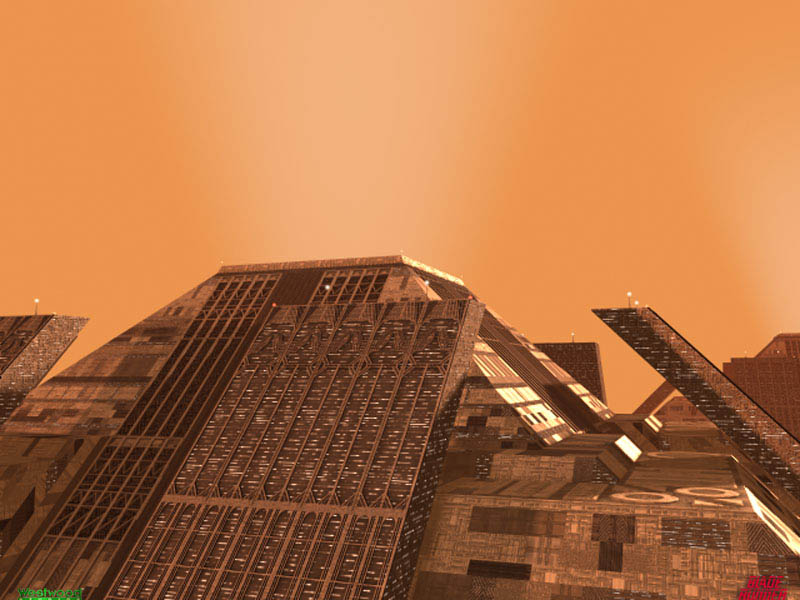
There is a Bladerunner City in SL, but the architecture on display owes more to the ziggurats of the Tyrell Corporation than the run-down streets of future LA which, for me, are the most visually pleasing element of the film. The owners of the sim are evidently interested in transhumanism; the welcome notecard at the entrance gives a brief history of the idea, from Dante to Huxley. I got the impression that they would prefer Roy Batty (surely the least threateningly-named homicidal android ever) to the crumpled Rick Deckard, though of course (spoiler alert) it turns out that Deckard’s human frailty is actually a more perfect realisation of the replicant-maker’s craft than Batty’s superhuman abilities (or not, it depends which version you watch).

I can’t say that I am familiar enough with the various strands of transhumanism to have a firm opinion about it; I do believe that technology changes who we are as humans, but I think that that process does not operate on the level of the individual, but rather is mediated through the changes in social organisation that accompany advances in science. To take the internet as an example, it is only now that we are working out how to use it in a social way, with things like Facebook, and blogs, and even Second Life, that the full civilisation-changing potential of the medium is becoming apparent. Maybe one day we will all be dreaming of electric sheep.