On Second Life and addiction

I wasn’t going to say anything on the sad story of the Korean couple who allegedly left their baby to starve while they spent time in the virtual world Prius Online, because, you know, it seemed a bit exploitative, but I noticed that a few other blogs had referred to the issue directly or indirectly, and of course I couldn’t resist putting my two cents worth into the comments, (though it turns out that last post wasn’t inspired by the Korean incident after all), so I thought I might as well draw a few thoughts together and post them here.

Actually I’m not going to address the Korean story directly, since all I know about it is what I’ve read in the papers, and in cases like these one really needs to have all the facts before formulating any opinions. Instead I’ll say something more general about the concept of internet addiction – whether it exists at all, and, if so, what can be done to help those suffering from the problem.

My personal opinion is that problematic use of the internet should be regarded as a pathological behaviour, and that it is best thought of as an impulse-control disorder. I first became interested in the topic after reading Caught in The Net, by Kimberly Young, who did a lot of the early work in this area, and who runs the Center for Internet Addiction. Her book is aimed at a lay audience – she does tend to throw around terms like “obsession”, “compulsion” and “addiction” a bit freely – but her conceptualisation of dysfunctional online activity, drawing on the model of pathological gambling, is basically sound.

The existence and nature of internet addiction is still the subject of academic debate though. I thought Jerald Block made a good case a couple of years ago in an editorial in the AJP, Issues for DSM-V: Internet Addiction, but the draft DSM V, out last month, fails to include it. Interestingly the draft also proposes to move pathological gambling out of “Impulse-Control Disorders Not Elsewhere Classified” and into “Addiction and Related Disorders”, a move that has been labelled one of the “The 19 Worst Suggestions For DSM5“.

This argument about classification may seem a bit arcane, but it reflects a division of opinion that was also evident in the discussion of the Korean case; to what extent does labelling a particular behaviour an “addiction” absolve the person concerned of responsibility for their actions?

When it comes to MMORPGs (which for the sake of this argument we’ll take as including Second Life) there is a tendency among pro-game writers to deny that virtual worlds have any addictive properties at all, and to focus instead on the personal characteristics of the “addicts”, and especially their “personal responsibility” or lack thereof, when seeking to explain the problem. This is evident in the posts I linked to above, and more so in the comments, and is understandable when one considers that politicians and the media are quick to stir up moral panics about the supposed corrupting influence of games on society.

It’s true that impulse-control disorders are rooted in individual psychopathology, which in turn develops from the complex interaction of neurobiology, psychodynamics, cognition, social factors and environment. However I think it has to be acknowledged that games, and especially MMORPGS, have features which may promote problematic use in vulnerable people.

What are these elements? The ability to produce feelings of mastery, to increase confidence in social interaction and to explore hidden aspects of personality, which can combine to boost self-esteem. (These are of course the same things that make the worlds attractive in the first place.) Add in the variable reward schedules that are designed into the games to a greater or lesser degree, and you have the potential to set up cycles of dysfunctional behaviour.

This doesn’t mean that games are inherently dangerous, since clearly the vast majority of players manage to use them without coming to any harm. It does suggest though that there is a particular subset of players for whom over-use of games might become a problem, and raises the question of whether game developers like Linden Lab should be responsible for raising awareness of the possible hazards among residents of their worlds. I would argue that there should be some material about recognising the signs of internet addiction included in the orientation process, and perhaps a timer built into the viewer that that pops up after, say, two hours on the grid and suggests that it might be time to take a break. I can’t see this happening though, since steps like these could be construed as an admission by the Lab that they are aware of the potentially harmful nature of their product, which would presumably expose them to some sort of liability.

What of treatment? In general terms, my experience of treating this sort of problem has convinced me of the importance of taking a non-judgemental approach. Although therapy for impulse-control disorder does focus on the choices that the client makes in certain situations, with the aim of helping them regain a feeling of control, over-emphasising “personal responsibility” is usually not helpful. These clients start with low-self esteem, and the condition further erodes their confidence in their ability to take charge of their lives, so reminding them that they could have avoided the mess by making different choices tends not to make them feel any better. Instead it’s more useful to focus on the positives, the areas of their lives that they feel they can manage sucessfully, and try to build on these.

It’s interesting that discussion of addictions, and particularly process addictions (which, as mentioned above, I prefer to conceptualise as impulse-control disorders, though plenty of people would disagree with me), often takes on a rather moralistic tone, with implicit, or sometimes explicit, condemnation of addicts for failing to take “responsibility” for what they do. I tend to think that this position represents a defence against acknowledging the extent to which everyone is a potential “addict”, a projection of intolerable unconscious “irresponsibility”. I think it’s healthier to recognise that we are all fallible humans, and we can all make bad choices, and remember that when we do mess up it’s nicer if people treat us with sympathy and compassion, rather than going on and on about “personal responsibility”.

In internet addiction specifically the treatment with the best evidence base is CBT – Young published a paper on treatment outcomes in 2007. There was also an interesting paper last year from the International Gaming Research Unit at Nottingham Trent University last year looking at various treatment approaches to videogame addiction, including 12-step, CBT and Motivational Interviewing. 12-step programmes for internet addiction are widely available – at On-Line Gamers Anonymous for example – but I’m not aware that these have been rigorously evaluated. I’m not as familiar as I would like to be with the published work coming out of South Korea and China, where they take this problem very seriously, but what I have read suggests that behavioural and family therapy approaches are useful, in younger populations especially. I expect there will be a lot more research into treatment of internet addiction published in the West over the next few years, and the best therapeutic options should become more evident.

Monetising SL 2.0

I feel that I should download the SL 2.0 viewer, just so that I can have an opinion about it, and join in the general excitement, but I’m finding it hard to get enthusiastic about what is, after all, just a gateway to the really interesting part of Second Life, that is the content and the community. When I first signed up to SL a couple of years ago I downloaded the alpha build of the Linux client, and I was happy with that until fairly recently, when the Lab started restricting which viewers you could log in with and it stopped working. I switched to the then-current version of Snowglobe, which I have had no major complaints about.

I’ve never been entirely convinced that making the viewer more user-friendly was the key to broadening SL‘s appeal. I guess the Lab did some consumer research that told them that the viewer’s rather steep learning-curve was contributing to SL‘s woeful retention rate, and I’m sure that the new version makes it a bit easier to get through the first hour, but I would have thought that keeping people on board for months and years would depend more on the nature of the virtual world and its residents than the bells and whistles of the client software.

Though maybe I’m overstating the importance of content. The BBC are currently running a series The Virtual Revolution (which you can watch online if you live in the UK), which is taking a look at the impact on society of the growth of the internet in the last 20 years. It’s necessarily broad, and there’s been nothing terribly surprising, but it’s still interesting, particularly the discussion of how Web 2.0 has been monetised. Services like YouTube, Facebook and Twitter may get their user-generated content for free, but most of it is worthless junk. That doesn’t matter though, the theory goes, because as users post, search, rate and comment on all those videos, updates and tweets, they reveal a mass of valuable data about themselves and their social networks, information that can be profitably mined for targeted advertising.

One can’t help but wonder if the Lindens have some similar plan in mind. They have certainly been talking up the social-networking aspects of SL, with their purchase of Avatars United, and Wallace Linden’s suggestion that we should all link our real identities to our avatars. If they could find out all about us and our interests, they could turn that into a revenue stream, provided they could figure out how to serve up the ads in a way that wasn’t too annoying. Perhaps the much-touted URL-on-a-prim functionality of the 2.0 viewer is part of the Lab’s plan to sneak pop-up advertising into the virtual landscape.

Love Forever Changes

Philip Rosedale, late of the SL parish, has a new startup, the snappily named LoveMachine. Its exact purpose is still obscure, but there is talk that they will “have a huge amount of fun, make a bunch of money, and try to save the world”.

Philip has helpfully listed the first few corporate tasks, which include “Locate some great bars in SF that could be good to park new company in for a while”. I’m off to polish my CV for when they advertise for an in-house psychiatrist.

[Hat-tip: Opensource Obscure]

Deadly therapy

In a tragic footnote to last month’s story about the use of electroshock therapy to treat internet addiction in China, the authorities in that country are investigating the death of fifteen-year-old Deng Senshan, who was allegedly beaten to death by staff at a clinic in southern Guangxi province shortly after arriving for treatment for cyberaddiction.

Excessive use of the internet is regarded as a serious public health problem in China, with some reports estimating that nearly 40% of net users show signs of addiction, leading to a proliferation of centres dedicated to treating the problem. The more reputable clinics use modern psychological treatments, but other establishments are military-style camps offering a regime of harsh discipline, of questionable therapeutic value. Whatever one thinks the best course of treatment is, the fact that parents can be so desperate that they are willing to send their children to a place that promises “necessary approaches including punishment to educate the teenager” gives some idea of the level of distress that the condition can generate.

(Don’t) Gimme Gimme Shock Treatment

Asia is far ahead of the West in the recognition and treatment of internet addiction. While we agonise over whether the condition exists at all, the authorities in the East are already taking action; the South Korean government has made tackling cyberaddiction a national health priority, and the splendidly-named Chinese Teenager Mental Growth Base of the General Hospital of the Beijing Military Area Command of the PLA has issued guidelines on “Preventing Network Addiction at Home” (to be read in conjunction with “Basic Principles for A Harmonious Family”).

Unfortunately I have been unable to track down a translated version of the Chinese guidelines, so I don’t know what they recommend, but apparently the treatment options don’t include electroshock therapy, since the Chinese Ministry of Health has just ordered a clinic in Shandong province to stop using the method to discourage teenagers from spending too much time on the net. As a report in the Wall Street Journal notes, the efficacy of the treatment was called into question by the fact that disgruntled ex-patients had chosen to register their dissatisfaction with the clinic by setting up an online protest group.

I do believe that internet addiction exists, though I think it is more useful to conceptualise it as an impulse control disorder than an addiction as such. In my, fairly limited, experience of managing the condition CBT is the treatment of choice, along with pharmacological therapy for any co-morbid mood or anxiety disorder.

I’m not sure that everyone would agree with that though…

Bötterdämmerung

… would have been a much better title for my last post, come to think of it.

I first saw Blade Runner during its original cinema run back in 1982, around the same time as I was reading all the early William Gibson stuff, and it had a similarly profound effect on my emerging aesthetic consciousness. Functional hi-tech amidst a crumbling cityscape has been my idea of what the future holds ever since, and it’s always seemed quite attractive. What with the depression, and global climate change, and the decline of the Western powers, it’s just about possible to imagine that Los Angeles in 2019 will look pretty much like it does in Ridley Scott’s movie, though maybe without the flying cars, and hopefully without the killer robots on the loose.

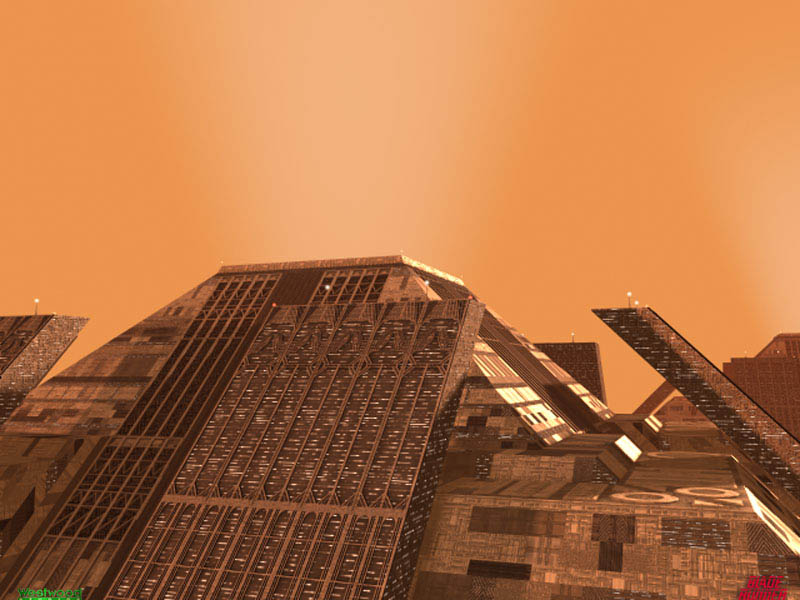
There is a Bladerunner City in SL, but the architecture on display owes more to the ziggurats of the Tyrell Corporation than the run-down streets of future LA which, for me, are the most visually pleasing element of the film. The owners of the sim are evidently interested in transhumanism; the welcome notecard at the entrance gives a brief history of the idea, from Dante to Huxley. I got the impression that they would prefer Roy Batty (surely the least threateningly-named homicidal android ever) to the crumpled Rick Deckard, though of course (spoiler alert) it turns out that Deckard’s human frailty is actually a more perfect realisation of the replicant-maker’s craft than Batty’s superhuman abilities (or not, it depends which version you watch).

I can’t say that I am familiar enough with the various strands of transhumanism to have a firm opinion about it; I do believe that technology changes who we are as humans, but I think that that process does not operate on the level of the individual, but rather is mediated through the changes in social organisation that accompany advances in science. To take the internet as an example, it is only now that we are working out how to use it in a social way, with things like Facebook, and blogs, and even Second Life, that the full civilisation-changing potential of the medium is becoming apparent. Maybe one day we will all be dreaming of electric sheep.

Command-X, Command-C, Command-V

On a more positive note, Cut and Paste has come to the iPhone! So now I can post all those interesting links in my blog without having to resort to writing them down on a piece of paper! Maybe this new media world isn’t so bad after all.

MMORPG mental health professional

In a bid to expand my knowledge of the metaverse beyond Second Life I’ve been reading a bit about EVE Online, which claims to be “the world’s largest game universe”, and sounds rather more action-packed than SL, if this BBC report is to be believed.

I was tempted to try out their 14-day free trial, especially when I saw that there was a linux client available (though it’s apparently going to be discontinued soon). I’m worried that I would end up hooked enough to start paying the €19.95 monthly fee though, not to mention the extra time I would waste online (the average weekly playtime is 17 hours apparently), which would be hard to justify. There do seem to be some interesting in-game dynamics – deception and subterfuge are an integral part of the experience – but I would struggle to convince myself that I was conducting some sort of serious psychological research rather than just playing a game.

When I was first thinking about setting up this blog I considered getting an account at Entropia, which at the time was getting more publicity than Second Life. Four things convinced me that SL was the way to go: Entropia seems more restricted in what there is to do, the creative possibilities provided by SL‘s building and scripting functions were interesting (though I have actually made very little use of them), SL supports linux, and finally, and most importantly, Entropia Shrink doesn’t really trip off the tongue.

A suitable case for Tweetment?

If the thought of Facebook ripping off all your stuff wasn’t scary enough, it now turns out that social media use is, allegedly, bad for your health.

According to Dr Aric Sigman (a “business and performance psychologist”) a whole host of physical ills, from the common cold to coronary disease, stroke, cancer and dementia, can be linked to use of social networking sites. He implies that the causative factor is lack of face-to-face interaction, caused by people spending too much time online.

I have read the full paper, published in Biologist, journal of the Institute of Biology, (there is a good summary of it in the Guardian), though it’s more of a magazine article than a scientific paper as such, containing as it does no original research, and no indication that Dr Sigman has carried out a systematic review of work published on the topic. I have to say that I find his conclusions somewhat hard to swallow (or at least the conclusions he highlights in his press release – the actual paper is rather more circumspect in what it says about social networking services).

First off, even if one accepts that there has been an increase in “social disconnectedness” in the last twenty years, there are any number of factors that could explain this, and attributing it all to social networking services, which are a fairly recent development, sounds more like a way of generating headlines than serious science. My experience, admittedly anecdotal, of services like Facebook makes me think that the people who use them most are actually among the more gregarious in society, and that those who have problems with real-life social interaction tend to find it difficult to cultivate online friendships too. There has perhaps been a change in the definition of “friendship”, but I think it is wrong to assume that this change is necessarily a devaluation – Dr Sigman seems to give no value to the definite positive effects of virtual interaction for people who would otherwise have little or no contact with other humans, due to physical disability, mental health problems, geographical isolation, or just lack of confidence.

Secondly, while there may well be an association between measures of social isolation and adverse physical and psychological health outcomes, the direction of causality is less clear, and the mediating factors proposed in Dr Sigman’s paper seem speculative to say the least, so it is absurdly reductive to claim that there is a direct connection between use of social media and ill-health.

Then there’s the ad hominem stuff. Dr Sigman is a repeat offender when it comes to scare stories about modern life – he has previously warned of the dangers of too much television, violent films and computer use generally. Unsurprisingly he is regularly quoted approvingly in the conservative press. He has a website of course, and a book to promote (Remotely Controlled: How Television is Damaging Our Lives), and he is available as a “Business Speaker” at £4-7K a time.

Lastly, (and I’ll admit that this is pure medical snobbery) I’m always a bit suspicious of anyone who lists “Fellow of the Royal Society of Medicine” first among their qualifications, especially when they are not medically qualified. You may think it is just for top doctors, but the title is, as the RSM website says, available to anybody “holding medical, dental, veterinary or higher scientific qualifications; or in senior positions in healthcare and related fields” who is willing to pay the annual fee. I get junk mail once or twice a year inviting me to become a Fellow of the RSM – that’s how exclusive and prestigious it is.

So, on balance, I think that people can go on Tweeting and Poking without worrying too much about premature death.

Creative licence

Facebook, in response to general outrage, has been forced to abandon proposed new terms of service, which would, if you believe the detractors, have allowed the corporation to claim ownership of all material uploaded by users of the service, even those who had deleted their accounts This raises several interesting issues, including how social media blurs the distinction between personal and public space, and the extent to which users of services like Facebook and Twitter can expect to retain control over content they create.

I have always felt that it is prudent to regard the internet as being completely public, and to assume that anything that you put into the system will persist forever, indelibly marked with your digital fingerprints, and accessible to anyone who knows how to look for it. Accordingly I do my best to be discreet, but despite this I often, in retrospect, feel that I have been lulled by the apparent anonymity of the medium into revealing more about myself than I might have intended. There is a certain amount of narcissism involved in such worries; while it is technically possible to, say, link all the Google searches I have done to my IP address, I seriously doubt that anyone is going to bother. Similarly, it seems unlikely that Mark Zuckerberg was really planning to purloin millions of badly-exposed pictures of Facebook users grinning drunkenly during their works’ night out, for some nefarious purpose that only he can imagine; all he wants are your shopping preferences, so that he can sell advertising and convince the venture capitalists that he does have some sort of monetisation strategy. Still, the idea that once you join Facebook you can never leave makes it sound even more creepily cult-like than it did before.

On the face of it Second Life residents don’t have to worry about being creatively expropriated by the Lindens; the terms of service clearly state that copyright in content resides with the originator. As I’ve touched on before though, “creativity” in the metaverse isn’t limited to the production of discrete items. The very act of interacting with others on the grid is in itself a performance, one which can be observed and appropriated. Who, if anyone, “owns” this? You may not have to worry that the Lindens will claim control of your entire virtual life, like Facebook is trying to do, but perhaps you should be concerned that all the imaginative energy that you put into living your second life will end up providing free inspiration for some lurking writer.