Courting the virtual constituency

I had set aside a bit of time this afternoon to look around the grid and see if any of the Republican Presidential candidates had bothered to establish a presence in Second Life, like Hillary Clinton did last time. However after an hour or so spent logging in, then immediately being kicked off the server, my patience with the polished consumer product that is SL ran out and I decided to go off and do something less frustrating.

I’ll be surprised if any of the candidates have an official build anyway. Four years ago relative mainstreamers like Romney or Huntsman might have felt that a virtual world campaign HQ would be just the thing to show they were hip to where the kids were at, but the days when Second Life was synonymous with tech-savvy are long gone. I imagine that the evangelical wing of the GOP, if they have heard of SL at all, will have read about it in one of those tracts telling them that the internet is a tool of Satan, and will see it as another of the many things that consenting adults do in the privacy of their own homes that should be illegal.

The exception to this is Ron Paul; his wacky brand of right-populism seems pretty much in tune with the prevailing ideology of Second Life, which, in my experience at least, tends to a mish-mash of libertarianism and objectivism, so he might feel it’s worth trying to engage with the SL electorate. I doubt he’ll be doing any virtual campaigning in person, but I’m sure there will be one or two “Ron Paul for President” resident groups, and maybe even a customised avatar, like the Sarah Palin that came out in 2008.

Back in the real world, the Iowa Caucuses turned out as predicted; Romney failed to enthuse more than 25% of the base, and the social conservatives coalesced around Santorum, for now at least. On to New Hampshire tomorrow, where the pundits are suggesting that Romney will wrap it up as Santorum’s lack of money and organisation begins to tell. There are alternative scenarios – Huntsman might siphon moderate votes away from Romney, or Paul might pull off a surprise – but my feeling is that conventional wisdom will be proved right.

2011: The year in review

2011 was a year of two halves here at SLS; we were posting regularly up until about June, but never really got started again after the summer break. Embarrassingly, we only managed eight posts in the last quarter, and two of those were apologies for inactivity. Unsurprisingly our traffic has fallen off a cliff in the last few months, and is now sitting around half of what is was this time last year.

Anyway, here are our top ten posts by traffic for the last twelve months:

  1. The Social Network
  2. Second Life demographics – a brief review
  3. On Second Life and addiction
  4. What’s up
  5. Ladies and Gentlemen We Are Floating in Space
  6. Virtual alchemy
  7. 2010: The year in review
  8. Second Life, with graphics, on the iPhone?
  9. Zombie Epidemiology
  10. Plunging Necklines

Only one of these, The Social Network, is from this year, but at least it is the top post, and one of our better ones too. I’d love to think its high ranking was due to the quality of the writing, but actually it’s because Google kindly chose to link it with the search term “Sean Parker Facebook” for a while over the summer. The addiction and demographics posts from last year continue to do well, probably because no one else can be bothered to write anything on those topics. There is always a steady interest in Second Life zombies, and Olivia’s 2009 Nosferatu-themed post Plunging Necklines made a welcome return to the chart, possibly on the back of the Lab’s promotion of SL as a platform for vampire role-play.

Of the other posts we managed to crank out this year my favourites were, in chronological order:

If I had pick one post of the year it would be The Solution, which I think encapsulates everything we try to do here at SLS; spare prose, literary and political allusion, self-conscious pretension, and all in the service of an utterly inconsequential point.

But what of the world beyond this blog? What of the Arab Spring, the war in Libya, the tsunami in Japan, the News International phone-hacking scandal, the death of Bin Laden, the UK riots, the Eurozone crisis, and everything else that has been going on this year? We did manage to comment on most of these events, but brief blog posts aren’t really the best medium for considering weighty issues, so it was all rather superficial. We might try to follow a couple of topics in more depth next year – perhaps the economy, and the US elections.

Back in January I promised that we would publish more book, film and music reviews, but this hasn’t really worked out. Part of the problem is that I’ve been trying to spread my output over too many projects; I have been doing a bit of critical writing, but I’ve published it in other places. (I could re-post some of my pieces here I guess, but I’m a bit paranoid that someone might Google a passage and link this blog with my other online identities.) The main thing though is that I’ve not been terribly well engaged with contemporary culture; I’ve been on a diet of classic literature and films from the 70s, and the world isn’t necessarily crying out for my belated impressions of The Mill on the Floss or McCabe and Mrs. Miller. At least I kept up with the music scene enough to be all excited ahead of the release of what turned out to be my favourite album of the year, the eponymous debut by Wild Flag, and I also liked Civilian by Wye Oak, Angles by The Strokes and Only in Dreams by The Dum Dum Girls; the latter record’s melancholy tone mirroring the slightly depressing arc of my personal life recently. Overall though I will have to try a bit harder on the cultural front next year.

Finally, what about our core task, the mission to, in the words of our very first post, “wander around the likes of Second Life and report back on what I find, enlightening readers with erudite comments on the interaction that occurs there”? We have been rather remiss in this too. I know why; just about everything interesting there is to say about the psychology of Second Life we have already said in previous years, and I haven’t had the energy to try to put a new gloss on it. The promise that virtual worlds would open up a new understanding of the human psyche has, sadly, turned out to be hollow. There was for a while some interest in watching the dynamics of the conflict between the corporate goals of Linden Lab and the aspirations of the more committed residents, but even that has turned dull since the boringly efficient Rodvik Humble took over at the top. It seems unlikely that this will change in the immediate future, but I will keep an eye on the academic literature in case anyone has any novel ideas.

What does this mean for the year ahead? Perhaps I should accept that this project has run its course, and let it bow out gracefully, but we have been going for nearly five years, an epoch in blog terms, so it would seem a shame to give up now just because things have been a little quiet of late. Politics, culture, psychology; I should be able to make something interesting out of that if I apply myself a little more.

So I guess I’ll be seeing you next year…

Subdivisions

Regular readers will recall that I am a big fan of the work of Sherry Turkle (though, shamefully, I haven’t read, or even purchased, her latest book Alone Together yet; I might download a copy if someone gives me a Kindle for Christmas.) I’ve been particularly influenced by her 1997 paper Multiple subjectivity and virtual community at the end of the Freudian century, in which she advances the idea that online interaction allows one to dis-integrate the various strands of one’s personality, in a way that allows one to gain greater insight into one’s internal mental landscape, and, in theory at least, escape the restrictions of a unitary conception of the self.

This was in my mind the other day, when my Second Life Premium membership came up for renewal. I duly handed over the $80 or so, which is small beer in comparison with what I spend on other types of entertainment, but enough to set me thinking about how many different online identities I have, and how much they cost me each year.

The answers to those questions depend on what one considers as a separate identity; my virtual presence divides into four main groupings which have no overlap at all, but within these there are multiple blogs, web-pages, Twitter, Facebook and forum accounts, and, of course, virtual world avatars. Most of these are free, but I must pay out about $200 annually in hosting and subscription fees, not to mention all the valuable time I spend maintaining the whole show.

Is this worth it? Have I become more self-aware by disaggregating my personality traits? Do each of my four core online identities represent a pure strand of my self, uncontaminated by the other three, and better for it?

Not really. I certainly appreciate the freedom to express myself in certain contexts without having to worry too much about how people who know me through different channels would react, and this has sharpened my understanding of how I function internally, highlighting some strengths, but also a lot of flaws. In each guise I do, in some ways, feel more like my “real” self, but also that there are important parts of “me” missing.

The main thing I have learned, if that’s not too grand a phrase, is that I actually like my messy, complicated, contradictory, every-day, real-life self a lot better than any of my supposedly idealised avatars. Maybe it’s because I started off from a good place; if my self-esteem was lower I might be more inclined to identify with my virtual representations. Perhaps it’s harder to reinvent oneself online than it might appear, and I’m actually just reproducing myself over and over, and delusionally believing that each time I’m somehow different. Or it could be that I am at heart a conformist, and I’m subconsciously inhibiting myself from embracing the full liberating potential of virtual life.

Whatever. It seems unlikely that, at this point in my life, I’m going to be changing much, so I guess that you, my dear readers, the parallel audiences for my other projects, and those fortunate enough to know me in real life, will have to go on putting up with the same old nonsense.

The Physical Impossibility of Running an Art Gallery in Second Life

Readers may recall that about 18 months ago we ran a review of the virtual installations at the Primtings Museum. If you want to see the gallery’s lovingly-sculpted recreations of famous artworks you had better hurry; Artistic Director Ina Centaur has announced that the space is to disappear some time in the next few days, along with the associated sims of the SL Globe Theatre.

I went over there this evening, to walk up the staircase one last time:

and to contemplate mortality:

(On a brighter note, the other art space we covered in that review, The Leominster Galleries, is still going strong.)

Enmeshed

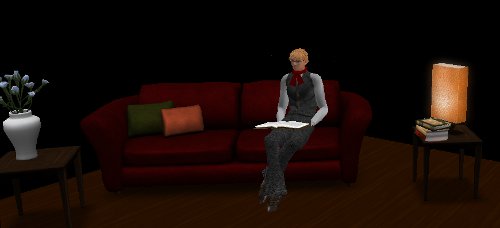
So, I’ve been working on a couple of other projects, and haven’t had much time for virtual world stuff recently, but I was looking for an excuse to slack off the other night, so I decided to go on to the grid to collect this month’s free premium gift. Here I am, sitting on my fine new sofa, trying to look intellectual:

Moving the furniture around was fun for about five minutes, but to be honest I’ve never found the dolls-house aspect of Second Life particularly interesting, so my attention soon wandered.

I had downloaded the 3.0 viewer, so I thought I would check out some of the new mesh objects that are now available, to see if they really would be the revolutionary force that I had predicted a couple of years ago.

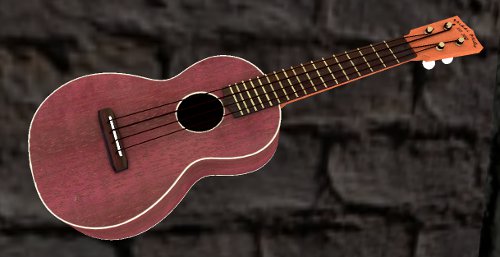
Here’s a ukulele I found at the Mikki Miles Mesh Department, along with various other musical instruments:

and they have some interesting-looking creations at MeshAvatars:

It certainly looks much nicer than the usual prim-based stuff, though I’m far from a connoisseur in these matters. It seemed quite expensive by SL standards, which made me wonder how much trouble it actually was to upload these things, since prefabricated examples can be found pretty easily on the web, and the mesh creation tools aren’t that hard to master (I’m told).

The answer to that turned out to be “more trouble than I can be bothered with”, what with having to register with the Lab as a mesh uploader, take a test in intellectual property rights, and wade through the technical details of the actual process, not to mention paying the upload fees. I’m sure there are plenty of people out there with more patience for this than me though, so I still think that there will eventually be an influx of cheap mesh items that will put the old prim merchants out of business. I suspect the relative obscurity of SL might be their best hope of a reprieve.

Off the wagon

So, that’s me back from my digital sabbatical, though, to be honest, it wasn’t really one of those straight-edge digital sabbaticals that one reads about, since I took my cellphone (though I did manage to cut down my usual rate of calling and texting), and I only gave up the mobile internet because I was in a region remote enough to have no wi-fi hotspots, and prohibitively expensive data roaming charges.

Still, I’ve come back with a renewed appreciation of life off the grid. I was a bit restless for the first couple of days, but after that I hardly missed it at all, and passed my time at a leisurely pace, reading books, listening to music, thinking, writing a little, and even doing some exercise.

I had just about convinced myself that I wasn’t really addicted to the internet after all, but, I’m sad to say, I hadn’t been home more than a few hours before I succumbed to the temptation to quickly check my blog stats, then while I was online I thought I might as well see what people were saying on Facebook… and it was all downhill from there. Last night I spent three hours watching Beavis and Butt-head clips on YouTube. Rapid reinstatement indeed.

Strangely enough I haven’t had any notion to visit Second Life yet. Perhaps the pleasures of SL are too rarefied to give me the quick fix I’m looking for; it’s a fine malt compared with the bathtub gin of social media.

See My Friends

Alarming news in the Telegraph this week; apparently the average 20-something has over 1000 “friends” on social networking sites. It makes the 67 friends of my real-life Facebook account look pretty pathetic, but I’m positively gregarious compared with Johnny, my Second Life avatar, who can muster a mere 20 virtual chums (though some of them are fairly impressive, like Peter Ludlow and Bettina Tizzy). I suppose he could add in his Twitter followers, which would yield a slightly more respectable total of 94. Despite this seeming lack of interest, Johnny is “influential to a tightly formed network that is growing larger“, according to internet reputation assessors Klout, but I would take that with several pinches of virtual salt.

At least Johnny’s account seems to have survived Facebook’s latest purge of avatar profiles; being under the radar does have some advantages I guess. The site’s continuing hostility to pseudonymous accounts is mystifying, since they seem essentially harmless, and boost the membership total, which is a key metric in the social networking industry. Maybe avatar profiles use more electricity or something.

It does make one doubt the wisdom of the Linden Lab strategy of encouraging residents to use Facebook though, since anyone who spent time creating a profile and carefully building up a circle of friends, only to see their work disappear in a flash, will, I imagine, be feeling pretty pissed off with the whole concept. Most long-term residents live in a perpetual fog of dissatisfaction anyway, so I don’t suppose it makes much difference.

I wonder how long it will be until Johnny heads across the river…

Spaced Out

Talking of Yuri Gagarin’s historic space-flight prompted me to revisit a favourite spot in Second Life, the International Spaceflight Museum. They have nicely-rendered models of various rocket-ships from around the world, including the latest Indian and Chinese models:

The big rocket second from the right is a Soviet N1, designed to take cosmonauts to the moon; unfortunately all the test flights exploded shortly after take-off, and the programme was abandoned. Next to it is an American Ares V, which was set to be the launcher for the Moonbase and Mars expeditions, but that programme was cancelled last year.

More successful Soviet craft are featured too, from the Vostok and Voskhod boosters of Gagarin’s day, to the Soyuz workhorses, and the current Proton rocket which, now the Space Shuttle has retired, is the only way to get big things up into orbit:

The Museum also has an earth-orbit exhibit, featuring the International Space Station. I felt a little exposed in my normal clothes, so I quickly scored a nice retro-style space-suit (from Aurican’s Pyramid Store), before venturing into the vacuum:

Now I had the suit it seemed a shame not to do some more space exploration. Back at my little mountainside home I quickly build a mini launch pad, and picked up a cool little space-coupé (a PS-1 Dart by PlasmaStorm Industries at Port Clarke):

My original plan was to zoom around my neighbourhood (which, incidentally, seems to have gone completely to the dogs since last time I looked, abandoned land everywhere, but that’s a topic for another day), but after a few jarring collisions, presumably with the sim borders, I gave up on that and headed into deep space.

First stop was Tranquility Base on the Moon:

Then on to see the big starships at Talmont Space Port:

Finally, some chill-out time at Inspire Space Park, where one can meditate while tumbling through the celestial sphere:

and relax in front of a nice warm fire:

Recreating outer space is perhaps the perfect use for Second Life, since the relatively featureless terrain means it all renders nice and quickly, and the characteristic lack of other people adds to the verisimilitude. I would quite like to get into some space-based role-play, but I don’t really have the time to devote to that right now. Another project to add to my list for later in the year.

Won’t you please be my friend?

In an effort to win back the confidence of the government, I have redoubled my efforts in the social media sphere by setting up a Facebook page unashamedly in the identity of my avatar. This clearly breaches the rules of the social networking site, but I have heard that they are turning a blind eye to SL-related profiles, so hopefully I won’t be deleted.

I currently have a grand total of zero friends, and I’m not exactly sure how I should go about remedying this problem. I guess the Lab would like me to invite all my non-virtual acquaintances over, so that I could introduce them to the joys of the grid, but, in common with most other residents I’m sure, I have a real-life reputation that I don’t want associated with Johnny Staccato, thank you very much. (It’s called Second Life for a reason.)

So I’m reduced to trawling the internet, forlornly appealing for attention. Perhaps not the best way of dispelling the notion that Second Life residents are needy, socially-challenged losers.

I think the problem is that Facebook and Second Life are functional in diametrically opposite ways; the former is useful for integrating our diverse social networks, but the latter is attractive because it allows us to dis-integrate the different strands of our personality. That the Lindens don’t seem to understand this (if they did they wouldn’t be pushing a Facebook strategy, and would have been much quicker to ban alt-linking products like Redzone) is just one more reason to be pessimistic about the future of Second Life.

The Solution

In other news, Hamlet Au at New World Notes has discovered what is wrong with Second Life; it’s the residents. His answer to this problem? We should all get lost, and let the Lindens recruit a better class of customer by befriending people on Facebook.

It puts me in mind of Bertolt Brecht’s famous poem The Solution:

After the uprising of the 17th June
The Secretary of the Writer’s Union
Had leaflets distributed in the Stalinallee
Stating that the people
Had forfeited the confidence of the government
And could win it back only
By redoubled efforts. Would it not be easier
In that case for the government
To dissolve the people
And elect another?

A few months ago I joked that New World Notes was the virtual equivalent of Soviet Weekly – perhaps I was closer to the truth than I knew.