Virtual world voters shunned

Back in 2008, during the US Presidential Election primaries, all the Democratic hopefuls had a Second Life presence of one sort or another; Hillary Clinton and John Edwards had virtual campaign headquarters, and there were several “Obama for President” resident groups. The GOP were slower to embrace SL, though eventually a couple of Sarah Palin avatars made an appearance.

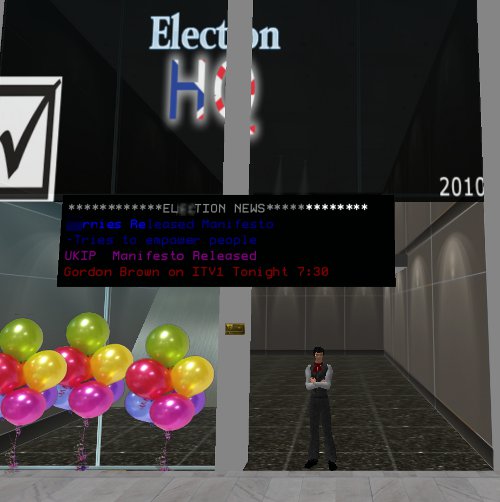
I had expected to see the current UK elections stir some interest on the grid, but all I could find was this rather disappointing “Election HQ“, which consists of nothing more than a few balloons and a malfunctioning noticeboard outside an empty store:

There is a “Conservative Party Supporters” group, with a grand total of 3 members, led by one “ToryBoy Horatio”. Potential members are greeted with a jolly “Well hello fellow Etonians and the rest of you rabble”, which makes me think that this might just possibly be a parody rather than a serious vote-gathering enterprise.

It’s said that about 7.5% of SL residents live in the UK, which, out of active users, would amount to around 75,000 potential voters, a not inconsiderable constituency. The fact that none of the major parties has felt it necessary to establish a Second Life presence may say something about the how the platform’s profile has declined in the last two years.

Or perhaps they are are just wary of meeting the same fate as John Edward’s virtual campaign (as described in Peter Ludlow’s brief history of griefing in the metaverse).

Taxing issues

My prediction that the election campaign would be “exciting” was perhaps a little optimistic, but the focus has been on the economy, as I was expecting. The debate so far has centred around the issue of National Insurance levels, though this clearly is just a proxy for  the real divide between the main parties, which is on the level of short-term cuts in public sector spending that are needed to stabilise the economy. My sense is that Labour are doing better than expected in the early exchanges, since they seem to have more credible numbers, whereas the Tories are rather unbelievably claiming that the £6 billion they need to cover the cost of not raising NI can be found through “efficiency savings” that won’t have any detrimental effect on services.

There have been comparisons drawn with Ireland, where the government have severely reined in public spending, thus reducing their deficit in absolute terms, but with the result that the economy has shrunk even faster, meaning that the deficit is now actually bigger as a proportion of GDP. This would seem to suggest that the Labour strategy of (relatively) gentle cuts in UK government spending is the right one, or the least wrong one at any rate.

However Labour’s reputation for general economic competence has obviously been undermined by the fact that they led us into the recession in the first place, and the voters’ desire for change may be enough to carry the Tories into power. There have been some signs that Labour may try to play up the class element of the debate, which I would have thought would be the way to go – “No Cuts, Tax the Rich” would be a good slogan – but they have just promised not to increase income tax, while leaving the door open for a hike in the regressive VAT, so I don’t hold out much hope of a sharp shift to the left.

It will be interesting to see the effect that the televised leaders’ debate this week has on the polls. I like to think that the UK electorate is completely focussed on the issues, and is too smart to be distracted by presidential-style personality contests, but I expect I will be proved wrong about that.

Finally, the most amusing story of the campaign so far is that of Stuart MacLennan, the (now ex-) Labour candidate for Moray in north-east Scotland, who was forced to resign after the papers reported that he had made various offensive comments about political opponents and his prospective constituents on Twitter. I would have thought that the first thing to do when standing for public office would be to delete your Twitter feed, since the last thing you want the voters to know is what is really on your mind.

Electoral outlook

As widely predicted Gordon Brown has set May 6th as the date for the UK General Election. The campaign promises to be the most exciting since Labour came to power in 1997, since there are significant policy differences between the main parties, and it is far from clear who is going to win.

I expect that the main issue will be the economy, specifically the speed and severity with which public spending needs to be cut to bring the deficit under control, though all the mainstream parties are agreed that cuts must be made. As a public sector worker I have a keen interest in this of course, but even those not directly employed by the government will feel the negative effect of reduced services.

While our sorry excuse for a democracy does entitle me to cast a ballot, I, like a large part of the population, live in a constituency that is not going to be closely contested, so my vote doesn’t really count for anything. As with the US elections a couple of years ago I will be reduced to blogging ineffectually from the sidelines.

I, and my like-minded comrades, may be unable to greatly influence the outcome of the wider election, but we should be able to use the increased interest in politics generated by the poll to do some community organising, with a view to getting ready to oppose whatever cuts may be on the way. The problem is that the electoral process, while theoretically an expression of the population’s ability to control the executive, is in practice a demonstration of the illusionary nature of that power, and this tends to have a demotivating effect.

Still, these are interesting times. The financial crisis has caused a lot of people to question the nature of our economic system, in a way that hasn’t really happened since the end of the Cold War, which opens a door for progressive politics. The left may not make a huge impression in this election, but we can plant some seeds for the future.

A Radical Game

Readers may be wondering what has happened to my grand plans to launch a grid-wide insurrection to bring democracy to Second Life. I haven’t forgotten about it completely, but I have been distracted by some real-life political activity; I realised that if I had time to spend on agitation in an imaginary world, then I had no real excuse for dodging my responsibilities in my local community, where the issues are rather more pressing.

I was also a bit discouraged when I read Annabelle Boyd Jones’s B.A. thesis (OK, when I read the abstract of Annabelle Boyd Jones’s B.A. thesis) The Disconnect Between Journalism and Governance; A Critical Analysis of the Interaction of Journalism and Governance in the Virtual World Second Life, in which she concludes that journalism (and what is SLS if not citizen-journalism?) has had “negligible influence over the structure and direction of governance”. Ms Jones was awarded first class honours, so I guess her work is fairly robust, though I felt her selection of SL sources was a little restrictive, taking in the usual suspects like the Herald and New World Notes, plus the now-defunct AvaStar and Reuters SL, though also Your 2nd Place and Second Thoughts, the latter amusingly characterised as “incendiary”.

On the other hand… My re-engagement with local politics isn’t entirely attributable to guilt-tripping; thinking about democracy and radicalism in the context of Second Life reminded me how stimulating political activity can be, and primed me to get back into it. I ended up re-reading most of Trotsky’s The History of the Russian Revolution, which really catches the excitement of the times, as the old order collapsed and a new world of limitless possibilities opened up. (John Reed‘s Ten Days that Shook the World, and Warren Beatey’s epic film Reds, based on Reed’s life, are equally inspiring.)

It can be argued that Second Life is a similarly fresh political landscape, and the challenges faced by anyone trying to build a progressive movement on the grid would be comparable to those in front of the Bolsheviks as they sought to galvanise the population of Russia around a new ideology in 1917. It would follow that, just as there are lessons for revolutionaries today in the events of October, agitating in SL might teach us something about organising in real life. Role-playing revolutionary games in Second Life could provide the intellectual space where ideas about engaging people with radical politics can be tried out and refined, before being fed back into offline experience.

For example, I was thinking about how I might go about recruiting members to an SL Communist Party, and naturally I fell back on my fairly extensive experience of doing similar things in the real world. Thinking about how to translate this on to the grid forced me to consider what worked and what didn’t, what were the really essential steps and what was just habit, what was outdated and what still applied. All this was still in my mind the other day when I met with some people to talk about what kind of intervention we can mount around the forthcoming UK General Election, and my contribution to that discussion was certainly informed by the thoughts I’d had about Second Life. Time will tell how useful these grid-derived insights are going to be of course, and the process would undoubtedly have been more valuable had I started it about a year ago, so that I could have gone through a few iterations of virtual party building and generated more feedback, but it felt as if I had been able to look at things from a new angle.

Does this mean that I am softening on my immersionist position and coming round to a more augmentalist viewpoint? Not really, because I still think that what happens on the grid has no direct significance outside of the game world, and that no matter how good a virtual simulation might be, the lessons learned only become valuable if they are applied to action in the real world.

The idea that games can be useful in preparing us for more serious affairs is hardly new of course; it’s something we have been doing in one form or another since the dawn of humanity. Wellington said that the Battle of Waterloo was won on the playing-fields of Eton, (though Orwell thought that the opening battles of all subsequent wars had been lost there.) Perhaps the outcome of future conflicts will be decided on the sims of Second Life.
The Avatars United will never be defeated

I was busy with some real life issues over the last week or so, and hadn’t been paying attention to all the various SL-related blogs and tweets that I usually monitor in a sadly obsessive way, so when I finally got round to looking at them I thought I might have missed a big story. Everyone seemed to be going on about “Avatars United“, and for one terrible moment I feared that someone had stolen a march on my plans to start up a virtual revolutionary movement by launching their own grassroots organisation.

The truth turned out to be a bit less exciting; AU is a two-year old social networking site that had been more or less moribund until Linden Lab unexpectedly bought it over at the end of last month. This prompted a flurry of interest from the SL community and a rush to take advantage of the site’s USP; the ability to collect all your virtual identities in one place and associate them with one another and, if you want, with your real one (though not many people were taking that option up). Amusingly, they don’t seem to have any system to verify that users actually own the avatars they are claiming, which has led to a rash of virtual identity theft.

Why the Lab has bothered with this is not entirely clear, since I thought they were trying to promote SL itself as a social networking service with benefits, and I can’t see the advantage for them in encouraging people to take their chatting off the grid and on to some other site. I imagine that they are more interested in harnessing the development skills of the AU staff to improve the SL experience than running a virtual Facebook.

From a user’s point of view the appeal of AU is even more opaque; the main attraction (for me anyhow) of having multiple online identities is that they are separate, and thus able to reflect different aspects of my personality. (Shelly Turkle wrote about this years ago.) If I need to integrate my avatars for any purpose I already have a perfectly good place to do so; it’s called “inside my head”.

I’m not the only person to have doubts; in what must be one of the shortest hype-cycles ever the AU backlash has already started.

The Death of Hope

OK Barack, I didn’t lose the faith when you bailed out the banks or escalated the war in Afghanistan. I had some doubts when you let Congress stall meaningful healthcare reform, and failed to provide any leadership on climate change, but I still believed that you were on the side of progress.

But cancelling the Moonbase? That’s the final straw…

Injustice Unlimited

If our report that the Lindens were running a secret surveillance program wasn’t enough to convince you that Second Life is a virtual banana republic, we now hear, via the Herald, that they have also been covertly sponsoring vigilante goon squad the Justice League Unlimited.

So far the self-styled JLU have mainly confined themselves to low-level harrassment of residents they deem to have breached community standards (with no regard for pinko concepts like “due process” of course), as well as maintaining a Nixon-style enemies list, but the Lab no doubt finds it useful to have a plausibly deniable gang of thugs on hand, ready to help disrupt any organised political opposition that might arise.

Comrade Obama

Well, let no one tell you that we’re not influential here at SLS. Just one day after we called on President Obama to move to the left he has finally started showing his true red colours by declaring war on the banking system.

Next week: Obama orders Secretary Clinton to put the Middle East peace process on hold and concentrate on bringing democracy to Second Life

And the lights all went out in Massachusetts…

Almost unbelievably – or actually all too believably – the Democrats have managed to lose Ted Kennedy’s Massachusetts Senate seat, and with it their fillibuster-proof majority in Congress, severely denting the chances of meaningful healthcare reform, and putting a significant obstacle in the way of President Obama’s legislative programme.

The result suggests that the Republicans are beginning to realise that moving further to the right is not a viable strategy. Scott Brown, their successful candidate, may be a fiscal conservative, but he’s more liberal on social issues (though he may want to rethink his pro-choice position if he harbours any ambitions to be on the GOP ticket in 2012).

While Republicans mistakenly interpreted their defeat in 2008 as a sign that they needed to be more radically right-wing, it looks like Obama may draw the opposite, but equally wrong-headed, conclusion from the disaster in Massachusetts; that he is unpopular with the voters because he has been too left-wing.

In reality, Obama’s quest for bipartisan solutions has been his biggest problem. He has bailed out Wall Street, watered down his health bill and sent more troops to fight in foreign wars, all as a sop to the right, but has seen his ratings slide as he disappoints and alienates his core support. To regain his momentum he needs to start getting more radical not less, but I don’t hold out much hope that he’ll go down that road; it’s more likely that he’ll throw more bones to the conservative dogs as the mid-term elections approach.

It’s all a bit of a disaster for working-class Americans, and shows that trusting a party of the ruling class, even a “progressive” one like the Democrats, is bound to end in tears. It highlights the need for an independent proletarian party in the US; I’m sure that our American comrades are working on that right now.

Just what is it that we want to do?

The answer to that is fairly straightforward – no need to formulate complicated transitional demands, or debate maximum and minimum programmes. We only need to think about the things that SL residents (or SL bloggers at any rate) are always moaning about.

A major gripe is the Lindens’ propensity to change fundamental aspects of the resident experience without involving the user base in the decision process, or at best engaging in some token consultation exercise. A second, and not unrelated, complaint is the belief that the Lab privileges some residents and businesses over everyone else, by uneven application of the Terms of Service, or commercial favouritism, aggravated by their reluctance to adequately regulate commercial relations between residents, most contentiously in the realm of intellectual property rights.

The steps needed to resolve these issues broadly correspond to two features usually associated with western liberal democracy; executive accountability and the rule of law. We can therefore formulate two central demands that, one might expect, would be supported by a majority of SL residents.

  1. An elected forum with the power of veto over major changes in Second Life.
  2. A robust judicial system operating independently of Linden Lab.

Obviously some of the finer details, like suffrage, will have to be worked out, but I think the basic concepts are enough to get the SL democracy ball rolling.

And when we’re done? Then we’ll get loaded.