The Great Gonzo

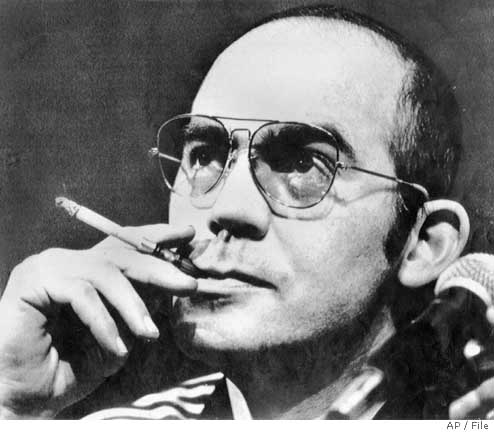
On this day back in 2005 the great Hunter S. Thompson signed off for the last time, with a gunshot to the head. He had his reasons for such a dramatic exit, but it seemed like a tremendous loss at the time, a feeling that has deepened in the intervening years as the authoritarian shift in US politics has cried out for the sort of biting social commentary that was Thompson’s speciality.

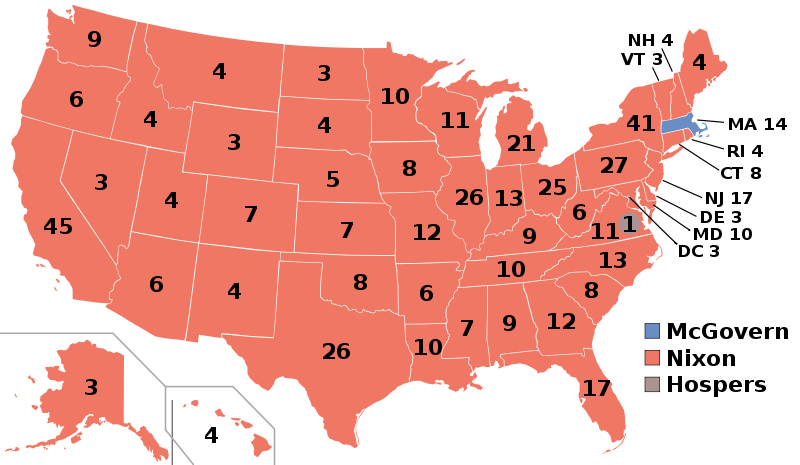
Thompson is best known for Fear and Loathing in Las Vegas, his 1971 account of a drug-fuelled trip to Nevada, but I think his finest work is Fear and Loathing on the Campaign Trail ’72, a collection of his reports on the 1972 US Presidential elections. …Vegas is a great book, but ultimately rather downbeat, charting as it does the defeat of 60’s counterculture at the hands of the Man. …Campaign Trail is much more optimistic, as Thompson gets caught in the tide of the McGovern campaign and starts to believe that progressive politics might just have a chance. It ends in disappointment of course, when Nixon wins with a landslide, but at least Thompson didn’t have to wait too long to see Tricky Dicky’s downfall. (Years later Thompson would write the definitive Nixon obituary, He Was a Crook.) …Campaign Trail‘s depiction of the youthful energy of McGovern’s supporters is still inspirational today, and should be required reading for community organisers and political activists everywhere.

To mark the anniversary of Thompson’s death The Quietus has a previously unpublished interview, along with a brief but useful biography. The BBC produced a fine documentary on Thompson’s life and work a couple of years ago, and Terry Gilliams’ film version of Fear and Loathing in Las Vegas, with Johnny Depp as Thompson, is worth seeing too.

The style of journalism that Thompson pioneered has become so commonplace now that it’s almost a cliche, but out of his many imitators none have come close to the man himself. I’m going to settle down tonight with my dog-eared copy of Fear and Loathing on the Campaign Trail ’72, and have a few drinks in his memory.

2010: The year in review

The year’s end draws nigh, and I feel I should produce some sort if review of the twelve months gone by…

First up, the topic that is dearest to our hearts, this blog. Here’s our top ten posts for the year, by traffic:

  1. Second Life demographics – a brief review
  2. Second Life, with graphics, on the iPhone?
  3. On Second Life and addiction
  4. O Superman
  5. What’s up
  6. Zombie Epidemiology
  7. Ladies and Gentlemen We Are Floating in Space
  8. Anatomy of a scandal
  9. Running Away
  10. That gum you like is going to come back in style

The demographics post is top by miles, with nearly as many hits as the rest put together, thanks to Google deciding that it should be the #1 result for the query “second life demographics 2010“. It got a lot of traffic in October, presumably due to media studies students researching start-of-term assignments, with another surge this month, probably because other SL bloggers are preparing their end-of-year posts. I think that the fact that this very slight essay, which I knocked out over one lunchtime back in April, should still be able to masquerade as an authoritative source says more about the paucity of serious academic interest in the topic than any brilliance in my writing.

Of the others, the addiction post benefited from my efforts to promote it by dropping a link into the comments of any blog post that mentioned the topic; the Superman post got a boost after it was featured in the Herald; “What’s up” gets traffic from people looking for pictures of 4 Non Blondes (a Google quirk that has at various times also given us hits from searches for Laura Palmer, Mae West and Catherine Deneuve/Susan Sarandon); the Zombie post is still getting referrals from the Undead Report; the rest, I don’t know, probably just random clicks.

Other posts from this year that I thought were OK, but that didn’t make the top ten:

I’m not sure if there was a theme to our posts this year; possibly something about the importance of narrative in the formation of identity, or some such pseudo-intellectual nonsense.

The year in Second Life? Stagnation, layoffs and general management chaos are the things that spring to mind; more detailed round-ups can be found at Daniel Voyager’s blog and Your2ndPlace if you’re interested.

In the real world it’s been a busy year politically; the event with the most direct effect on us was the return of a Conservative government to power in the UK. It’s been a bit of a phoney war since the summer, with only some student-led skirmishes, but the cuts will start to really kick in from now on, and the class struggle should get more intense. 2010 saw the right resurgent over in the US too, without much sign of the left regrouping; hopefully that will change in the months ahead.

In our last New Year review I suggested that we would be posting more general cultural comment during 2010; this remained, alas, an unfulfilled ambition, but I have belatedly managed to think about picks for book, film and album of the year.

Choosing a book was the hardest task; looking back I see that I didn’t read a single new novel all year, though I did buy a copy of Jonathan Franzen’s Freedom, which is glaring at me accusingly from the shelf. Instead I stuck to the classics, of which my favourite was Fielding’s Tom Jones. I hardly saw any new films either; from a restricted field I would have to give the nod to The Social Network. I did buy a lot of new albums; the two I’ve listened to most are Majesty Shredding by Superchunk and The Suburbs by Arcade Fire.

And so to the future… I expect I’ll keep this project going, out of habit if nothing else. Things might be a little quiet in January, while I’m busy with my New Year resolutions – do more serious writing, get more exercise – but once these have been discarded it’ll be back to our usual cavalcade of whimsy.

I’ll finish by sending our best wishes for 2011 to all our readers – may the New Year find you happy, healthy and prosperous.

Reoccurring Dreams

There was a lively debate amongst the commenters at Botgirl’s blog over the last week or so, concerning that perennial preoccupation of the SL intellectual elite, the question of identity in virtual environments.

I must have listened (and occasionally contributed) to this discussion dozens of times in the last three years, but I’m not sure that I’ve ever read anything that was a significant advance on what Sherry Turkle was writing about fifteen years ago.

The particular facet of the issue that we (for of course I couldn’t resist chipping in with my two cents’ worth) focussed on this time around was the significance of choosing to represent oneself in Second Life with an avatar that differs substantially from one’s corporeal incarnation, especially with regard to gender.

How dishonest is this? Moral relativist that I am, my answer to that question is “it depends”; upon a lot of things, but mainly the expectations of the parties to the interaction. In the discussion parallels were drawn with other media, such as written fiction or cinema, with the point being made that no one feels deceived when they discover that, say, Robert De Niro isn’t really a taxi driver. This is true to a degree; for books, plays and movies there are commonly accepted cultural norms that define when it’s OK to make stuff up and when it’s not, and people do feel cheated when the rules are broken.

There is much less consensus regarding online interaction though, and, crucially, in a space like Second Life there is no easy way to communicate the extent to which one is using the platform as a vehicle for personal reinvention, as opposed to expressing one’s everyday self (which of course opens up the question of where one’s “true” identity really lies, or if such a thing even exists).

I’ve noted before that the research evidence suggests that it’s harder than one might think to create a new personality in a virtual world (certainly my avatar is boringly similar to my mortal form, in appearance and character), so in theory it should be possible to get to “know” someone just by interacting with their SL alter-ego. I suspect that there are not many people who could be bothered to put in the work required for this though, and there is always the (mostly unconscious) drive to project one’s internal object-relations on to the virtual relationships, which further muddies the waters.

With all this going on it’s hardly surprising that miscommunication and unhappiness can occur from time to time. I don’t think that there’s much to be done about it; it’s the price we pay for access to the creative possibilities of the medium,  like Cézanne being poisoned by Emerald Green.

Like I said though, none of this is new, or particularly profound, except insofar as it sheds some light on that other topic that has launched a thousand SL blog posts; “Why blog about Second Life?” Why make the same points about the same issues over and over, when we could be turning our minds to something more productive? I can only answer for myself of course, but I think (as, unsurprisingly, I’ve said before) that SL blogging is essentially just another form of role-play, a chance to imagine oneself as a heavyweight intellectual commentator, without all the tiresome business of actually having to think too much about what one writes.

It keeps me amused anyhow. And I get to link to some cool music.

Subterranean Hope

I’m sure I’m not the only one for whom the story of the trapped Chilean copper miners has called to mind the classic novel Germinal.

A vividly-drawn tale of the struggle for survival in the coalfields of northern France in the mid-nineteenth century, Zola’s naturalistic masterpiece is one of my favourite books, but it is rather grim. I had to stop reading it for a day or two at several points, to take a break from the relentless tide of misfortune that befalls the central characters, who are pictured so realistically that it is impossible not to empathise with their suffering. It does end on a note of optimism though, with one of the most rousing passages in literature:

“Beneath the blazing of the sun, in that morning of new growth, the countryside rang with song, as its belly swelled with a black and avenging army of men, germinating slowly in its furrows, growing upwards in readiness for harvests to come, until one day soon their ripening would burst open the earth itself.”

Nearly two centuries have passed since the period portrayed in Germinal, but it’s worth remembering that mining remains one of the most hazardous professions in the world, with more than twelve thousand workers losing their lives every year. Even in safety-conscious Switzerland eight men died during the construction of the Gotthard tunnel.

Let’s hope the discipline and solidarity shown by the 33 miners of San Jose inspires workers the world over to unite, organise and demand an improvement in their conditions.

Twilight of the Gods

A couple of posts ago I was pondering the question of why I completely lack any sort of religious sensibility; it turns out that it’s because I am perfectly in tune with the Universe.

It would be nice to think that, now reason has banished God from both biology and physics, the proponents of organised religion would accept that the game was up, and fade away without a fuss, but, as I touched on in that post, I expect that won’t be happening any time soon.

On the unreliability of memory

There is a lot to be said for the traditional summer break of the professional middle classes; decamping from the hot, busy city to a quiet rural retreat, there to enjoy the simple peasant lifestyle. Of course I am referring to that fantasy peasant lifestyle that involves loafing around, consuming copious quantities of artisanal foodstuff and quaffing the local intoxicant, rather than any actual peasant lifestyle of unremitting toil, but it’s nice to imagine that one is getting back in touch with the slower pace of life enjoyed by our forefathers.

I always come back from my summer holiday determined to escape the rat race by finally getting down to writing the classic novel that I am convinced dwells within me. For a couple of weeks I spend my lunchtimes in the coffee shop tapping at my laptop, then life starts to intrude, and my grand projects fade away for another year.

In some ways it’s reassuring that my life is interesting enough that I don’t really have time to devote to literary endeavour, but it’s also a little frustrating to think that with some more application I could produce something a bit more impressive than this blog.

A few times in the last year, most recently just a couple of months ago, I’ve resolved to post less about Second Life, and more about interesting things, like politics, or literature, or music, but every time I seem to have found myself coming back to commenting about the virtual world. I think there’s some avoidance going on on my part; it’s easier to recycle the same old stuff about SL than take a chance on trying something new.

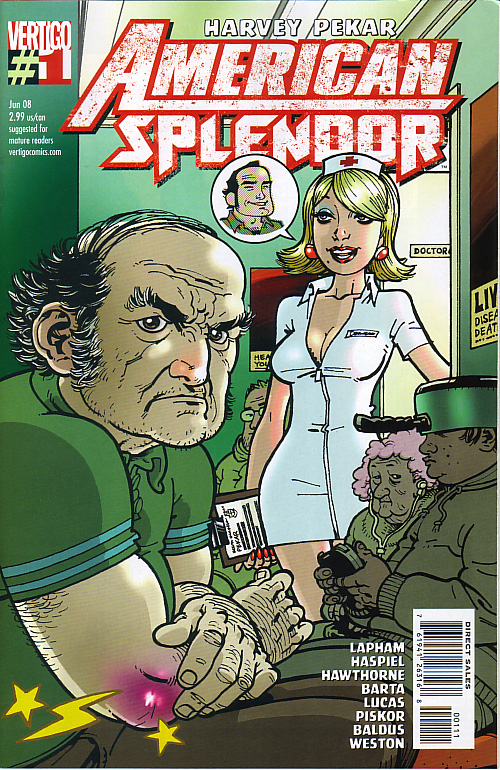
I spent several evenings last week reading my old copies of American Splendor, and thinking that, if Harvey Pekar could get it together to present slices of his life experience to the world back in the 70’s, when self-publishing was a real challenge, I should be able to do something more productive with this space, with which, in theory at least, I could reach a worldwide audience of millions with a couple of clicks of a mouse.

I have over the years posted a few vaguely Pekaresque pieces (mostly tagged “Nostalgia”), but I find it hard to be completely accurate in my recollection. It’s not that I actively make stuff up – the basic facts are all there – but when I try to reconstruct the subjective elements, like the emotions and motivations that were associated with these past events, I can’t help but be aware that my memories will have been extensively edited by my unconscious in the light of my subsequent life experience. I can’t put myself back into the mind of my past self, only the mind of my present self thinking about the past, and I know that means that what seem like solid memories are really projections of my current preoccupations woven out of carefully selected snippets of history.

The drive is to create a narrative, to give meaning to what, on more objective analysis, I would have to admit was an essentially random existence. Like an author foreshadowing significant events in a story, I give weight to certain memories, while suppressing others, to convince myself that my current situation is a point on a consciously planned journey, rather than the culmination of a series of individually insignificant choices that have gradually limited my options in ways I can only vaguely grasp.

Does it matter that my thoughts about the past may not entirely correspond with reality? Human memory is not a simple recording device; it is a dynamic psychological tool that allows us to adapt to the present and anticipate the future by utilising our processed experience. Excessive verisimilitude in our recollections can get in the way of efficient functioning, and a little mnemonic creativity is essential to our continued sanity.

One way to conceptualise the self is to see it as, at any given moment, the sum of the biographical memories that seem relevant to our present circumstances, the story we tell ourselves about who we are. We take the continuity of our self as a given, but our memory of who we were yesterday is under the control of our present selves, and we may distort it to preserve the illusion of stable identity. Of course we can observe that other people seem more or less the same from day to day, which may reassure us that we don’t change much either, but there is always the suspicion that the unconscious is our own personal Ministry of Truth.

Anyway, the conclusion that I draw from all this is that the past is gone and probably wasn’t how I remembered it anyhow, the future is uncertain and will take care of itself, and the best thing to do is just live in the now. I guess that’s why I never manage to get anything done. Maybe I should give up on the literary pretensions, and start writing self-help books instead.

From Off the Streets of Cleveland

I’m just back from holiday, and I was going to leave it a while before I started blogging again, but I have been moved to action by the sad news of the passing of a true hero of the counter-culture, Harvey Pekar, of American Splendor fame.

I’m not usually one for vicarious grief, but I have been feeling genuinely cut-up since I heard that Harvey was dead. His work was personal and honest, sometimes painfully so, never glossing over his own character flaws, and it was hard to read it without getting to feel that you really knew the guy. Long before anyone had even dreamed of blogs, Harvey was there, documenting the daily grind of a lowly wage-slave, creating poetry from the rhythms of his blue-collar existence.

If you’re not familiar with American Splendor then visit your local comic-book store and pick up an anthology – the best one to start with is probably American Splendor: The Life and Times of Harvey Pekar which collects up the best of the early issues; also worth reading is Our Cancer Year, which chronicles Harvey’s experience of lymphoma – it is quite grim in parts, but ultimately positive. More recent comics can be found online at The Pekar Project. The 2003 biopic American Splendor was justly lauded by the critics, and Harvey also features in a segment of the 1988 documentary Comic Book Confidential (which was where I first came across his work). He appeared several times on the Letterman show in the late 80’s, until he fell out with the host after criticising NBC’s owners General Electric on air. He also recorded a series of opinion pieces for radio station WKSU, which can be listened to at their website.

Harvey’s work was based on the idea that the lives and experiences of ordinary people, living through good times and bad with their family, friends and community, were worth recording, and would tell the story of our times more accurately than more conventional histories. As he said, “Ordinary life is pretty complex stuff”, and few have captured it better than he did in the pages of American Splendor.

Liberté, Egalité, Virtualité

There was an interesting story in the Herald this week, concerning Greg Drayman, a well-known figure around the SL auto-racing circuit I’m told, who found himself on the wrong end of a permanent banning order earlier this month, as a result of conviction on what seem like trumped-up charges. As one might expect Mr Drayman is not best pleased at this turn of events, especially since the penalty extended to the confiscation of all his virtual land and property, including the popular Kokopelli Raceway Park.

This act of Linden absolutism backs up my theory that social relations in Second Life are essentially feudal in nature, and that the conflicts that arise are analogous to those which drove the transformation of western society in the late Eighteenth and early Nineteenth centuries, culminating in the triumph of bourgeois liberal democracy. (An excellent overview of this period is provided by E. J. Hobsbawm in The Age of Revolution: Europe, 1789-1848).

What are the demands that must be met before we could be confident that injustices like those inflicted on Mr Drayman could happen no more? What concessions must be wrung from the Lindens to bring the political culture of Second Life into the Nineteenth century, never mind the Twenty-first?

If we take our cue from the liberal revolutionaries of the past we would campaign for basic democratic rights: universal suffrage, civil liberties and the rule of law. The Terms of Service should be replaced by a written Constitution (approved by referendum), a Legislature should be elected to write new laws as necessary, and day-to-day policy should be directed by an elected Executive, all overseen by an independent Judiciary. Some sort of land reform would seem to be essential too. As we have noted before SL land is distributed under a leasehold system; for capitalist social relations to really take hold there would have to be the possibility of owning freehold land.

These rights might seem unobtainable, since it is difficult to see how any leverage could be exerted on Linden Lab as long as they own and control the physical infrastructure of the grid. Any assault on the virtual Bastille could be repulsed by the flick of a switch, and cyber-insurrectionists liquidated just as easily.

There may be a technical solution to this though; it would involve engineering interoperability between the main grid and OpenSims running on non-Linden hardware. The key thing would be to allow SL residents to import into their inventories items created on external systems, preferably without the Lindens being aware of this. (I have no idea if this is feasible; I imagine it would involve hacking into the asset servers in some way.) Political dissidents could reside on democratically constituted OpenSim servers, storing their virtual lives safely beyond the reach of the SL authorities, ready to be transferred to an alt when they needed to visit SL proper. Nobody would need to have a premium account, unless they particularly wanted to lease land on the main grid, though there would be no real reason to do that if land could be bought outright on a non-Linden grid. Merchants could set up in the free zones, attracted by the lower tax rates and superior governance, which would give a them a competitive edge over businesses still paying dues to the Linden empire.

If enough people got on board with this, and if the rebels were able to stay one step ahead of the Lindens’ attempts to secure their borders, the Lab’s revenue from subscription and tier payments would dwindle, to the point where they would be forced to concede to democratic demands, as the ancien régimes of Europe were obliged to cede power to a triumphant bourgeoisie in the Nineteenth century.

Would this be enough to satisfy those of us with more radical aspirations? The situation might be akin to that in Russia after the February Revolution, with Liberals and Mensheviks trusting the bourgeoisie to complete the process of democratic reform, and Bolsheviks arguing that only a dictatorship of the proletariat could truly achieve the goals of the revolution.

It seems clear that a campaign for democratic rights in Second Life is long overdue, and that communists should play a leading part in such a movement (though in organisational terms we would have to maintain a separate identity within the anti-Linden struggle, to ensure we were in a position to oppose the liberal tendency to compromise with counter-revolutionary forces). It would be a big task, but I don’t think that it’s impossible. I have some more detailed thoughts on Party structure, programme, propaganda and tactics, but I’ll save them for another post.

On being kind not cruel

Remember Gwen Bell? Social media guru? I wrote an embarrassingly mean-spirited post about her blog back in January? (I don’t know what was bugging me that day, but whatever it was it had my misanthropy turned up to 11).

Anyhow… this month Gwen has been running “The best of 2009 blog challenge“, inviting bloggers to reflect on the year just past, and nominate their favourites in various categories, one each day.

I’m usually no good at posting to a deadline like this, due to my almost complete lack of self-discipline, but it just so happens that today’s prompt is “Book”, and I was just thinking today of something that I read a few months ago, which struck me at the time as especially memorable.

It’s a passage from Hunter S. Thompson’s Hell’s Angels: The Strange and Terrible Saga of the Outlaw Motorcycle Gangs, first published in 1966, and the book that made Thompson’s name, though the style is much more straight reportage than the gonzo journalism he is famous for. It’s a solid piece of work, humanising the Angels and locating the moral panic that grew up around them in the context of social change in 60’s America, without ever losing sight of the fact that they always had the potential to act in seriously unpleasant ways.

The bit that sticks in my mind wasn’t written by Thompson himself (though he does provide many quotable lines), but by Allen Ginsberg, part of an speech he gave in 1965, in which he tried (successfully as it turned out) to dissuade the Angels from carrying out their threat to attack a march against the then-raging Vietnam war:

To take the heat off, you’ve got
to take the heat off
INSIDE YOURSELVES –
Find Peace means stop hating yourself
stop hating people who hate you
stop reflecting HEAT
THERE ARE PEOPLE WHO ARE NOT HEAT
THE MOST OF PEACE MARCHERS ARE NOT HEAT
They want you to join them to relieve
the heat on you & on all of us.

Take the heat – Anxiety Paranoia –
off us, AND off the police, off all the fearful –
REASSURE, and act clearly in such a way
as to reassure –
by being kind not
cruel –
and it’ll be remembered and responded to.

Ginsberg’s plea has been rendered no less urgent by the passage of four decades. I can’t pretend to myself that I’ll be able to live by his words, but I’ll try to recall them when I’m blogging, and my Anxiety Paranoia is getting a little out of control.

Incomplete hints of impossible marvels

One of my favourite places in SL used to be Innsmouth in October Country, a run-down coastal town with more than a few hidden secrets. Sadly, it disappeared some time ago, to be replaced, last time I looked, by an anonymous marina.

Now Innsmouth has been resurrected, though it’s looking even more dilapidated and spooky than it used to:

The whole place seems deserted, though the lighthouse is still working:

But be careful – the town is not as empty as it seems, and a little exploration may turn up more than you really want to find…